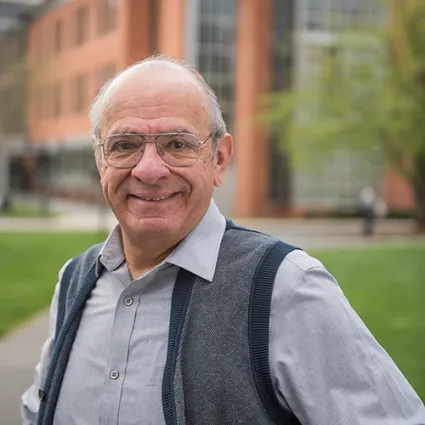
Professor Kate Trinajstic is a vertebrate palaeontologist and holds the rank of John Curtin Distinguished Professor at Curtin University's School of Molecular and Life Sciences (MLS), within the Faculty of Science and Engineering. She also serves in the Office of the Provost. Her academic journey includes a BSc (Hons) from Murdoch University and a PhD in Geology from the University of Western Australia (2000), focusing on microvertebrates from the Gneudna Formation. She joined Curtin in 2009 as a Curtin Research Fellow and secured an ARC QEII Fellowship in 2011 to study early vertebrate musculature and skeleton development. Her current research explores the origins of electroreception and nocturnality in early jawed vertebrates, supported by an ARC Discovery Project (2014). Her research interests span vertebrate paleontology, with a focus on skeletal and muscular evolution in early vertebrates, internal fertilization mechanisms, and the application of advanced imaging techniques like synchrotron scanning. Fieldwork locations include Western Australia’s Kimberley region, Morocco, and South Africa. Notable achievements include discoveries of the world’s oldest vertebrate sexual organs and live birth in Devonian fishes, published in Nature and Science . Professor Trinajstic has received prestigious awards such as the 2010 Malcolm McIntosh Award for Physical Science and the 2009 Top Ten Species Award. Her work bridges paleontology with evolutionary biology, contributing to understanding vertebrate diversification and adaptation. She collaborates widely, with over 80 peer-reviewed publications, and her research often integrates geochemical and morphological analyses to unravel fossil preservation mechanisms.