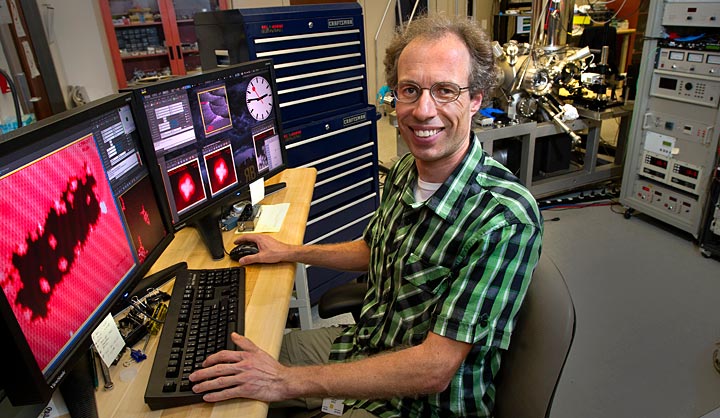
Bingqian Xu is a Professor in the School of Electrical & Computer Engineering at the University of Georgia. His research focuses on molecular electronics, single-molecule biosensing, and nanotechnology with applications in biomedical engineering and renewable energy. He leads studies on charge transport mechanisms in molecular junctions, prion protein aggregation, and plant cell wall hydrolysis. Research interests include developing novel nanostructured materials, AFM-based biosensing techniques, and optoelectronic devices. Recent work explores genipin's role in neuroregeneration and high-value utilization of agricultural waste. Xu's lab investigates photo-induced molecular devices and self-assembled supramolecular architectures. Publications span over 15 years, covering topics like single-molecule force spectroscopy, aptamer-based toxin detection, and graphene functionalization. His work bridges chemistry, physics, and engineering with interdisciplinary applications in biomedicine and environmental sustainability. Key contributions include creating a modular platform for neuron-innervated heart assembloids and developing air-stable molecular junctions with extreme longevity. His team's AFM techniques enable real-time analysis of protein aggregation and enzyme-substrate interactions at nanoscale resolution.