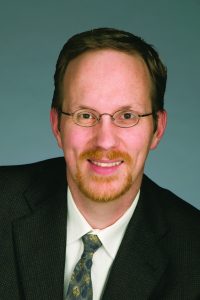
Chris Eliasmith is a Professor jointly appointed in the Systems Design Engineering and Philosophy departments at the University of Waterloo, with a cross-appointment to Computer Science. He is the Founding Director of the Centre for Theoretical Neuroscience and holds the Canada Research Chair in Theoretical Neuroscience. His research focuses on mathematical modeling of neural systems, including the Neural Engineering Framework (NEF) and Semantic Pointer Architecture (SPA), which underpin the world’s largest functional brain simulation, Spaun. He leads the Computational Neuroscience Research Group (CNRG), advancing neuromorphic computing, spiking neural networks, and cognitive modeling. Education: PhD in Neuroscience & Psychology (2000), Washington University in St. Louis MA in Philosophy (1995), University of Waterloo BASc in Systems Design Engineering (1994), University of Waterloo Research: His work integrates theoretical neuroscience with practical applications in robotics, AI, and neuromorphic hardware. Key contributions include the NEF, Spaun, and innovations like the Legendre Memory Unit (LMU) and Spatial Semantic Pointers (SSPs). His lab explores adaptive neural systems, decision-making models, and biologically plausible machine learning algorithms. Teaching: Recent courses include SYDE 556 (Simulating Neurobiological Systems), SYDE 750 (Topics in Systems Modelling), and PHIL 356 (Intelligence in Machines, Humans, and Other Animals). Awards: 2015 NSERC Polanyi Prize Labs & Projects: The CNRG develops tools like Nengo for simulating large-scale neural systems and collaborates on neuromorphic hardware platforms such as Loihi. Current projects span neural robotics, cognitive architectures, and biologically inspired AI systems.