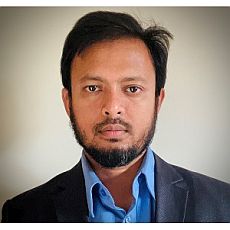
Professor Joshy Easaw is a Professor of Economics at Cardiff Business School, Cardiff University, where he joined in October 2014 after holding permanent appointments at Bath and Swansea Universities. He is currently a Visiting Professor at the Department of Economics, University of Bologna, Italy, and serves as the decolonisation of curriculum and research lead for the CARBS Race Equality Committee, which he helped found. His research spans macroeconomics, political economy, and development economics, with specific focus on bounded rationality , microfoundations of household expectations , professional forecasters' inattentiveness , and the interaction between economic and political institutions . His work examines how households form expectations about macroeconomic variables, how voters perceive policy competence, and the relationship between democracy, institutions, and economic growth in developing economies. Easaw's recent publications reveal strong trends in uncertainty modeling, household expectation formation, and historical economic analysis, particularly regarding the long-term impacts of the transatlantic slave trade. His methodological approaches combine theoretical modeling with empirical analysis using household surveys and professional forecast data. Leverhulme Trusts Research Fellowship (2007-2008) for research on 'Microfoundations of how households form subjective macroeconomic expectations: The role of news' Professor Easaw has successfully supervised nine PhD students whose careers span academia (including positions at the University of Manchester, Taiwan, and China) and international institutions (World Bank). His research has been supported by various grants, though specific current funding isn't detailed in the provided text. He actively contributes to the academic community as a member of the Royal Economic Society and has previously been a member of the American Economic Association and Econometric Society. His scholarly work spans multiple research teams and collaborations, with recent projects examining uncertainty spillovers in the euro area, the impact of the transatlantic slave trade on contemporary institutions, and innovative approaches to election forecasting using ensemble methods.