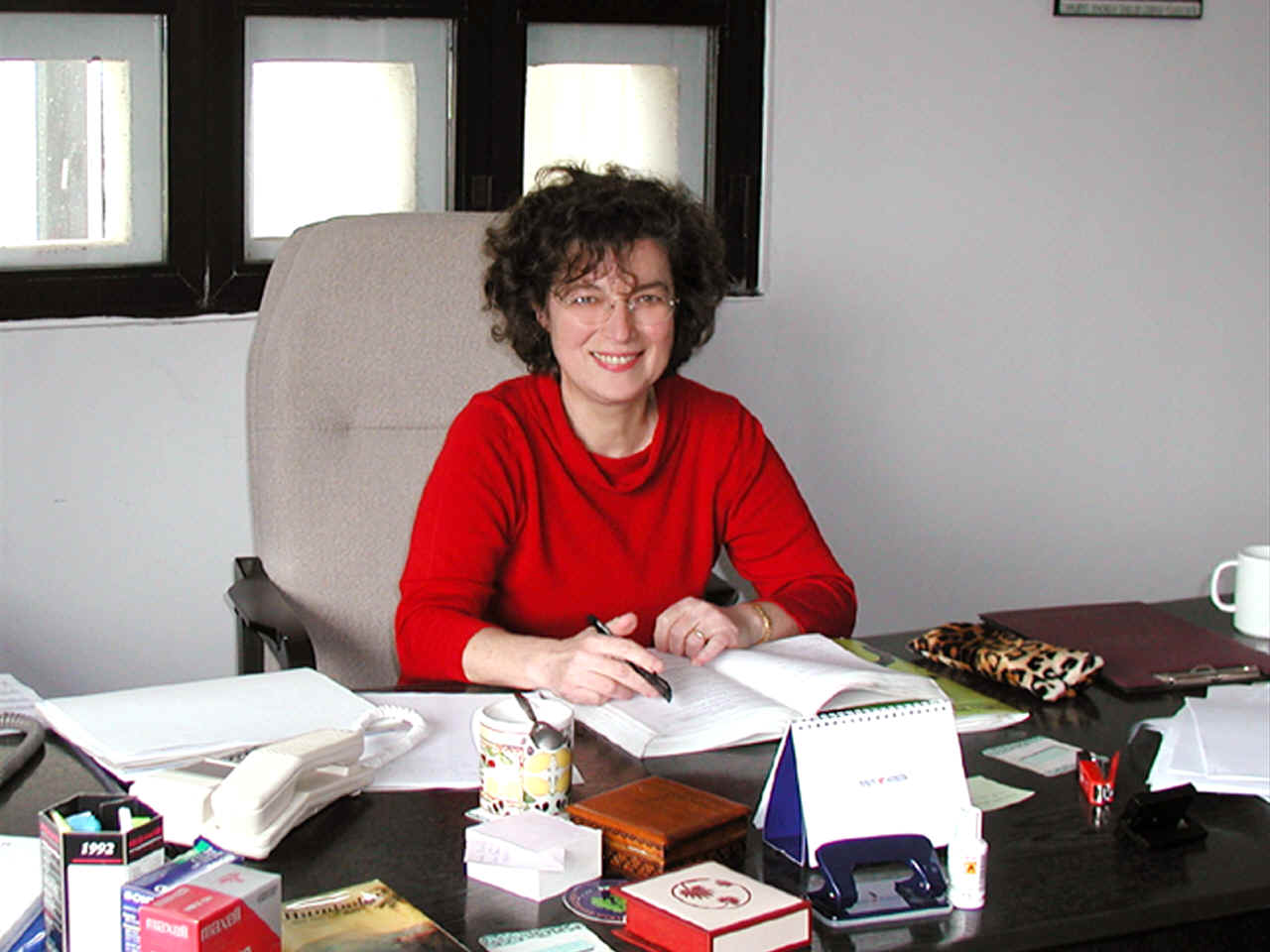
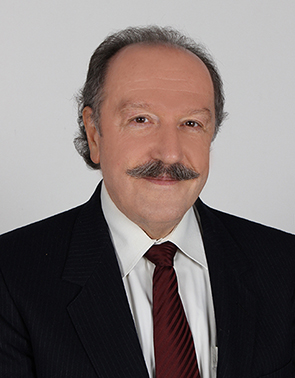
Abdullah Karaman is a Professor at the Department of Geophysical Engineering, Istanbul Technical University (ITU). His research focuses on geophysical modeling, subsidence due to longwall mining, hydrothermal systems, and seismic data analysis. He leads projects on geothermal applications using particle swarm optimization and collaborates internationally. Dr. Karaman has supervised 8 ongoing theses and has authored/co-authored over 17 publications since 1997. His work spans geophysical exploration, environmental geohazards, and subsurface imaging techniques. Education: Master of Science in Geophysics (1989) Research Interests: Hydrothermal system characterization using magnetotelluric methods Seismic inversion and diffraction imaging Geophysical monitoring of coal mine subsidence Optimization algorithms in geophysical data analysis Awards: None explicitly mentioned. Grants & Projects: Geothermal Applications of Particle Swarm Optimization Modeling Technique (2016–2021) Kordil Engineering Company: Geophysical consulting for international projects (2021) His lab focuses on integrating geophysical techniques with machine learning for high-resolution subsurface imaging.
Prof. Dr. Gökhan Apaydin is a full Professor at the Department of Electrical and Electronics Engineering, Faculty of Engineering and Natural Sciences, Uskudar University. He holds a PhD from Bogazici University (2007) and has held academic positions at institutions including the University of Technology Zurich and a visiting role at the University of Illinois at Urbana-Champaign. His research focuses on computational electromagnetics, radio wave propagation, and numerical modeling techniques. Education: BSc (2001), MSc (2003), PhD (2007) in Electrical and Electronics Engineering from Bogazici University Research Interests: Electromagnetic diffraction modeling, MATLAB-based simulations, numerical methods (FDTD, MoM), surface wave propagation, and renewable energy systems. His work emphasizes practical applications in radio wave modeling and environmental impact assessments. Publications: His articles focus on diffraction phenomena, waveguide analysis, and tool development (e.g., PETOOL). Recent trends include hybrid numerical methods and real-world terrain modeling for radiowave prediction. Awards: Received TÜBİTAK Publication Incentive Awards (2021). Administration & Leadership: Serves as Deputy Head of the Electrical Engineering Department, chairs international committees (URSI), and oversees projects like the Electromagnetic Wave Propagation Package. Active in academic governance and Bologna Process coordination. Labs/Teams: Leads the Electromagnetic Research Group, focusing on wave propagation and measurement validation.
Aslı Çakır is an Associate Professor in the Department of Metallurgy and Materials Engineering at Mugla Sitki Kocman University, Turkey. Her academic journey includes a B.Sc. in Engineering Physics from Ankara University (2000), M.Sc. in Physics from Bogazici University (2009), and a Ph.D. in Physics from Mugla Sitki Kocman University (2015). Key research areas: Heusler alloys , shell ferromagnetism , phase transformations , high-entropy alloys , and magnetic shape memory materials . She has contributed to understanding magnetic field effects on precipitate formation, exchange bias , and thermal stability in functional alloys. Recent publications focus on Ni-Mn-Sn , Ni-Mn-Ga , and Cu50Mn45Al5 systems. Her work involves collaborations with international institutions and utilizes techniques like neutron diffraction , Density Functional Theory , and ferromagnetic resonance . She has served as a jury member for graduate theses and as an editor for journals like Journal of Alloys and Compounds . Scientific Awards : International Academic Collaboration (2021), Rare-Earth-Free Magnet Material Development (2017) Projects : TÜBİTAK 1001 (2022-2024), BAP (2017-2020), TÜBİTAK (2007-2008)
Ayhan Altintas is a Professor in the Department of Electrical and Electronics Engineering at Bilkent University's Faculty of Engineering, and serves as Director of the Communications and Spectrum Management Research Center. With extensive experience in electromagnetic theory and applications, he has held significant leadership roles including Chair of the Electrical and Electronics Engineering Department (2005-2011) and President of URSI Turkey National Committee. His educational background includes B.S. and M.S. degrees from Middle East Technical University (Ankara, Turkey) and Ph.D. from Ohio State University. He completed postdoctoral work at Australian National University and has held visiting positions at Tokyo Institute of Technology, Technical University of Munich, and Concordia University. Phi Kappa Phi member Sigma Xi member IEEE Senior Member Co-founder of IEEE Turkey Section Chaired IEEE AP/MTT/ED Chapter Professor Altintas specializes in electromagnetic scattering, antenna design, wave propagation, and wireless communications. His research integrates theoretical electromagnetics with practical applications in spectrum management and metamaterial-based sensing systems, particularly for structural health monitoring and wireless displacement measurement. His recent publications demonstrate expertise across computational electromagnetics, metamaterial sensors, and optical resonators, with a strong focus on both theoretical modeling and experimental validation. Key themes include boundary condition analysis, diffraction phenomena, and metamaterial applications for wireless sensing. He has received significant recognition including the IEEE Third Millennium Medal, Fulbright Scholarship, Alexander von Humboldt Fellowship, and the Best Educational Program Award in Software Quest 2002 for his wireless propagation applet. IEEE Third Millennium Medal Fulbright Scholar Alexander von Humboldt Fellow Best Educational Program Award (Software Quest 2002) Professor Altintas actively mentors graduate students, with several advisees contributing to award-winning educational tools and research publications. His lab focuses on electromagnetic field analysis, spectrum management, and metamaterial applications, with ongoing projects in wireless sensing and propagation modeling. He teaches core electromagnetics courses including Engineering Electromagnetics (EEE 351), Advanced Electromagnetic Theory I (EEE 603), and High Frequency Techniques in Electromagnetics (EEE 554).
Prof. Dr. Ahmet DEMİR is a faculty member at the Faculty of Engineering and Natural Sciences, Karabük University, Turkey. He has served as Department Head and Major Field Head at Karabük University since 2017. PhD in Electronic Engineering from Gebze Technical University (2001-2003) MSc in Mathematics from Gebze Technical University (1999-2001) BSc in Mathematics from Dokuz Eylül University (1993-1998) His research focuses on applied mathematics and acoustics, particularly sound wave propagation, diffraction, and radiation in complex waveguide structures. He employs Wiener-Hopf techniques and advanced mathematical modeling to analyze noise control in mechanical systems. His work demonstrates trends in aeroacoustics, duct acoustics, and impedance-based sound propagation analysis. Collaborations include institutions like Technische Universiteit Eindhoven and University of Southampton.
Turgay SEYDİOĞLU is a full-time Lecturer at Kastamonu University's Vocational School in the Department of Electronics and Automation, serving since 2002. His academic credentials include a PhD in Materials Science and Engineering from Kastamonu University (2024), an MSc in Physics from Gazi University (2007), and a BSc in Physics Engineering from Ankara University (1997). His educational background comprises: PhD in Materials Science and Engineering, Kastamonu University (2019-2024) MSc in Physics, Gazi University (2004-2007) BSc in Physics Engineering, Ankara University (1991-1997) Dr. SEYDİOĞLU's research spans General Physics, Nuclear Physics, Electromagnetism, Semiconductors, Superconductors, and Electronics. His experimental work focuses on hydrothermal synthesis of ZnO nanorods and YBCO-family superconductors, investigating doping effects and growth parameters on structural, optical, and electrical properties. Current projects examine gadolinium/nickel doping in ZnO and rare-earth substitutions in Y-358 superconductors. His 13 publications (2007-2024) predominantly explore zinc oxide nanomaterials and high-temperature superconductors. Key themes include hydrothermal synthesis optimization, rare-earth/transition metal doping effects, and comprehensive characterization of mechanical, dielectric, and crystallographic properties, bridging materials science and electronic engineering applications. Dr. SEYDİOĞLU teaches undergraduate courses including DC Circuit Analysis, Basic Electronics, and Physics while collaborating extensively with Kastamonu University researchers like Sedat Kurnaz and Özgür Öztürk. His work shows growing academic impact with 20 citations and h-index 3 (Google Scholar), though no thesis supervision or research projects are documented.
Mustafa Gökhan UZGÖREN is a Professor in the Department of Electrical and Electronics Engineering at Beykent University. He holds a distinguished academic career with previous appointments as Professor at Istanbul Ayvansaray University, Gedik University, Istanbul Cultural University, Kadir Has University, and Istanbul University. His administrative roles include Department Head, Vice Rector, and Dean across these institutions. His educational background includes a Doctorate (1982), Master's (1977), and Bachelor's (1975) in Electrical Engineering from Istanbul Technical University. UZGÖREN's research focuses on electromagnetic theory , wave diffraction , and scattering phenomena . His work spans analytical methods in wave interactions with complex surfaces, antenna design, and high-frequency electromagnetic modeling. Key areas include dielectric interfaces, impedance boundaries, and curved structures. His publications (1984–2010) predominantly explore wave diffraction mechanics, scattering at discontinuities, and electromagnetic boundary problems, with consistent applications in antenna technology and waveguide systems. Students Advised: 9 graduate theses supervised (1994–2005), including research on 3D object modeling, network security, diffraction theory, and circuit design. He maintains an IEEE membership since 1979 and has authored/co-authored 15+ textbooks on electromagnetic fields, antenna theory, and mathematical methods in engineering.
Mefharet Kocatepe is a Professor in the Department of Mathematics at Bilkent University's Faculty of Science. She obtained her PhD from the University of Michigan (1978) after completing BS and MS degrees at Middle East Technical University. Her research focuses on Nuclear Fréchet Spaces, structure theory of Köthe spaces, and spaces of Whitney functions on compact sets. Key contributions include classification theorems for Dragilev spaces and isomorphism results for function spaces. She has received notable scientific awards including the Sedat Simavi Science Award (1985) and Bilkent Distinguished Teaching Award (1997). Her publications demonstrate consistent focus on topological vector spaces and functional analysis over a 30-year period. Administratively, she served as Department Chair since 1994 and previously as Assistant Chairman at Middle East Technical University (1985-1986).
Caner İmren is an Assistant Professor at Istanbul Technical University's Department of Geophysical Engineering, within the Faculty of Mining Engineering. He holds a PhD in Geophysical Engineering from the same institution. His research focuses on tectonics, seismic studies, and marine geology, with notable contributions to understanding the North Anatolian Fault and the geodynamics of the Marmara Sea region. He has led projects like the investigation of the Ancient City of Perinthos-Heraklia using geophysical methods. Education: PhD in Geophysical Engineering, Istanbul Technical University (2000–2004) MSc in Geophysical Engineering, Istanbul Technical University (1994–1997) BSc in Geophysical Engineering, Istanbul Technical University (1989–1994) Research Interests: Seismic reflection and fault dynamics Marine geophysical exploration (e.g., Marmara Sea) Archaeological geophysics (e.g., GPR applications) Pangea breakup and continental drift Subsurface imaging techniques Key Projects: Investigation of Perinthos-Heraklia (2022–2024): Geophysical methods applied to uncover archaeological features. Contributions to the TAMAM and SoMAR projects studying seismic hazards in the Marmara Sea. Teaching: Courses include Fundamentals of Exploration Geophysics, Marine Geophysical Methods, and Geophysical Measurements.
Yasir Bashir is an Assistant Professor at Istanbul Technical University's Department of Geophysical Engineering, Faculty of Mining. His academic journey includes a PhD from Universiti Teknologi Petronas (2013-2018) and prior roles as Lecturer at University of Technology PETRONAS (2015-2020) and Universiti Sains Malaysia (2020-2023). His research focuses on applied geophysics, seismic imaging, reservoir characterization, and integration of machine learning with geophysical data. Key projects include high-resolution seismic imaging, 4D seismic analysis, and geothermal exploration. Education: PhD in Geophysics, Universiti Teknologi Petronas (2013–2018) MSc in Geoscience, University of Balochistan (2004–2006) BSc in Geology, Quaid-i-Azam University (2010–2012) Research Interests: Seismic inversion and reservoir characterization Machine learning applications in geophysics Carbonate and clastic reservoir modeling 4D seismic for reservoir monitoring Geothermal exploration using seismic and borehole data Notable Awards: USM 2021 MOOC Award Professional Technologist (Malaysia Board of Technologists, 2022) Best Paper Presentation Award (GeoSea 2022) Grants & Projects: Executive: Integrated Geo-Seismic Modeling for Hydrocarbon Reservoir Delineation (₺334,868) Researcher: Gravity And Magnetic Survey Of Prefeasibility Study Of Ulu Slim Geothermal Prospect ($10,000) Completed: High Resolution Seismic Imaging using Diffraction Data (₺150,000) Labs/Teams: Leading the Center of Seismic Imaging (CSI) collaboration with international partners, focusing on advanced seismic algorithms and reservoir characterization.
İlkay Bakırtaş Akar is a Professor in the Department of Mathematics at Istanbul Technical University. Her research focuses on nonlinear wave phenomena, particularly in optical and quantum systems. She investigates soliton dynamics in parity-time symmetric potentials, nonlocal nonlinear media, and cubic-saturable environments. Her work explores symmetry-breaking bifurcations, self-similar evolution mechanisms, and lattice soliton stability under varying nonlinear conditions. Notable projects include studies on High-order dispersion terms in nonlinear Schrödinger equations, PT-symmetric complex potentials' effects on soliton solutions, Competing nonlinearities in optical media. Her research has led to advancements in understanding soliton behavior in structured optical lattices and nonlocal environments. Collaborations involve international teams focusing on waveguide engineering and nonlinear pulse shaping techniques. Awards: No specific honors listed in the provided materials. Advising: Supervised 5 ongoing theses but no student names disclosed. Grants include projects funded through BAP (Scientific and Technological Research Council of Turkey) focusing on soliton solutions and lattice dynamics. Labs/Teams: Active in nonlinear optics and mathematical physics research groups at ITU's Department of Mathematics.
Caner Imren is an Assistant Professor at the Department of Geophysical Engineering , Istanbul Technical University . His research focuses on tectonics, seismic exploration, ground-penetrating radar (GPR) applications, and Pangea-related continental dynamics. He has led projects such as the Investigation of the Ancient City of Perinthos-Heraklia Using Geophysical Methods (2022–2024). Research interests include seismic data enhancement for hydrocarbon exploration, diffraction imaging algorithms, and archaeological geophysics. Notable contributions include studies on the North Anatolian Fault, Sea of Marmara tectonics, and the Cretaceous breakup of Pangea. Imren actively collaborates on projects blending geophysical methods with environmental and urban challenges, such as the Water in Istanbul initiative. His work spans 28 publications, with recent highlights in Physics and Chemistry of the Earth (2025), Computers and Geosciences (2024), and Tectonics (2023). He maintains an ORCID profile (0000-0001-7477-9107) and has contributed to over 2,400 citations.
Levent Onural is a Professor at the Department of Electrical and Electronics Engineering, Bilkent University, Ankara, Turkey. He served as Dean of the College of Engineering and Director of the Graduate School of Engineering and Science (2010-2016). A Fulbright scholar, he earned his BS, MS, and PhD from Middle East Technical University and State University of New York at Buffalo. Research Interests: Focus on signal processing for optical wave propagation, diffraction, and holography, particularly in holographic 3DTV. His work spans 250+ publications and 4,000+ citations. Leadership & Service: Held key IEEE roles, including President-elect (2005), Board of Directors (2001-2003), and multiple editorial roles. Coordinated EC-funded projects like 3DTV and Real3D. Scientific Awards: TUBITAK Incentive Award (1995) IEEE Third Millenium Medal (2000) IEEE Haraden Pratt Award (2011) EURASIP Group Technical Achievement Award (2011) Bilkent University Distinguished Teacher Award (2011) IEEE Fellow Patents: US 6,337,917: Rule-based video object segmentation US 9,501,036: Holographic 3D video display US 10,379,496: Holographic true 3D image display US 10,409,221: Wide viewing angle holographic video camera EP 2 663 901 B1: Holographic display
Ozlem Ozgun is a Professor in the Department of Electrical and Electronics Engineering at Hacettepe University, Ankara, Turkey. She serves as Vice Dean of the Faculty of Engineering (2021-present) and previously held leadership roles including Department Vice Chair (2017-2020) and Chair of the Electromagnetic Fields and Microwave Techniques Division (2021-2024). Her academic journey includes positions at TED University as Founding Department Chair (2012-2015) and at Middle East Technical University-Northern Cyprus Campus as Assistant Professor (2008-2012). Education: Ph.D (2007): Middle East Technical University, Dept. of Electrical and Electronics Engineering M.Sc (2001): Bilkent University, Dept. of Electrical and Electronics Engineering B.Sc (1998): Bilkent University, Dept. of Electrical and Electronics Engineering Professor Ozgun's research focuses on computational electromagnetics with emphasis on transformation electromagnetics, finite element methods, and radio wave propagation. Her work bridges theoretical electromagnetics with practical applications in radar systems, antenna design, and wireless communications. She has pioneered techniques using coordinate transformations to solve complex electromagnetic problems, developing innovative methods for modeling scattering phenomena, wave propagation, and metamaterial applications. Her research has significant implications for radar cross-section reduction, microwave imaging for medical applications, and 5G communication systems. Analysis of her recent publications reveals a consistent focus on advancing computational techniques in electromagnetics, particularly through transformation optics and domain decomposition methods. Her work shows increasing integration of machine learning approaches with traditional electromagnetic modeling, especially in radar cross-section analysis and inverse synthetic aperture radar techniques. There's also a strong emphasis on practical tools development, with multiple software packages released for public use including PETOOL, GO+UTD, and VectGUI. Scientific Awards: Hacetepe Science Award (2024) IEEE Antennas and Propagation Society Distinguished Lecturer (2025-2027) Top 2% of the 'career-long impact' category in the world's most influential scientists list (2023-2024) URSI elevation to senior membership (2020) IEEE elevation to senior membership (2013) Prof. Dr. Leopold B. Felsen Award for Excellence in Electromagnetics (2009) Professor Ozgun has supervised 15 graduate students to completion, with research spanning radar cross-section computation, electromagnetic scattering, and microwave imaging. She has secured multiple research grants including TÜBİTAK-TEYDEB and TÜBİTAK-ARDEB projects focused on high-frequency radar analysis and electromagnetic modeling. Her professional service includes significant editorial roles and leadership positions in URSI-Turkey where she served as President of the Steering Committee (2018-2023). She is actively involved in developing computational tools for electromagnetic education and research, with several MATLAB-based applications available for public use. Her research group maintains strong collaborations with international institutions including Penn State University, and she has established a productive research environment focused on advancing computational electromagnetics through innovation in numerical methods and practical applications.
Dr. Naki KAYA is an Assistant Professor at Kafkas University’s Kağızman Vocational School, Department of Medical Services and Techniques. With a PhD in Physics (2020) from Gazi University and a Master’s (2012) and Bachelor’s (2009) in Physics from Kilis 7 Aralık University and Gaziantep University respectively, their academic career has focused on superconductivity, nanotechnology, and general physics. Research Interests: Their work primarily investigates superconducting materials like MgB₂ and Bi-based systems, with emphasis on structural characterization, doping effects (e.g., carbon nanotubes, Zn(NO₃)₂·6H₂O), microhardness properties, and dielectric behaviors. They employ techniques such as CVD doping, XRD, AFM, and Vickers hardness testing. Current affiliations: Kafkas University (2025–present), Istanbul Gelişim University (2022–2023), Istanbul Arel University (2016–2022). Leadership roles: Deputy Director of Kağızman Vocational School (2022–present), Department Chair at Istanbul Arel University (2020–2022). Scientific Contributions: Their publications (14 articles, 11 conference papers, 1 book, 4 book chapters) explore superconducting phase transitions, synthesis methods, and mechanical properties. Key projects include the Hi-SCALE initiative on high-temperature superconductivity (2020–2024) and TÜBİTAK-supported research on MgB₂ fabrication.