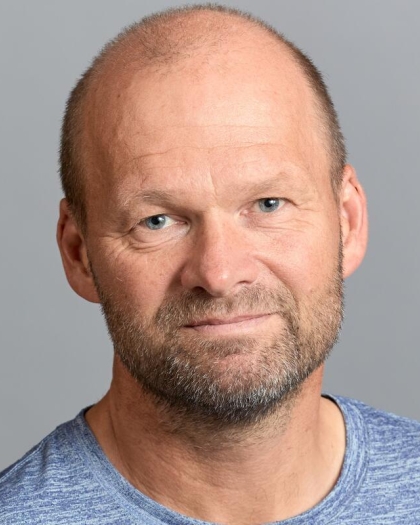
Øyvind Fiksen is a Professor in the Department of Biological Sciences at the University of Bergen, specializing in biological oceanography and marine ecosystem dynamics. His work focuses on how individuals drive population and community dynamics in marine environments through mechanistic models, state-variable optimality theory, and trait-based ecosystem modeling. Professor Fiksen's research spans behavioral ecology, predator-prey interactions in fish, zooplankton, and microbes, investigating how these interactions structure marine ecosystems. His teaching portfolio includes Marine Ecology courses, and he has been instrumental in developing the Centre of Excellence in Biology Education (bioCEED) at the University of Bergen. During 2012-2015, he served as Head of Education and Deputy Head of Department at BIO, contributing to Bergen's recognition as a Centre of Excellence in Education. Analysis of his recent publications (2020-2024) reveals a strong emphasis on climate change impacts on marine systems, particularly how environmental changes affect fish phenology, distribution patterns, and ecosystem dynamics. His work integrates theoretical modeling with empirical data across multiple spatial and temporal scales, with notable contributions to understanding mesopelagic zone dynamics, tuna reproductive strategies, and cod-capelin interactions. A consistent theme throughout his research is the application of mechanistic models to predict ecosystem responses to environmental change. Excellent Teaching Practitioner from UiB Professor Fiksen has supervised numerous doctoral students including Johanna Myrseth Aarflot, Johanna Jennifer Elisabeth Fall, Tom Langbehn, Agurtzane Urtizbera Ijurko, Øystein Varpe, and Christian Jørgensen. His research has been supported by significant funding from EU, NFR (Norwegian Research Council), and NOKUT, including projects such as ETHOFISH, ADAPT, ECOBE, CLIMAR, TBECO, EGGVALUE, bioCEED, MARmaED, FILAMO, and PANDORA. As part of bioCEED, he has delivered over 40 invited talks on educational activities at local and national forums, demonstrating his commitment to both research and teaching excellence. His laboratory work focuses on theoretical ecology approaches to marine ecosystem modeling, with particular expertise in individual-based models that connect physiological processes to population dynamics. Current research directions include investigating how coastal water darkening affects marine phenology, optimizing tuna spawning strategies, and understanding the three-dimensional spatial dynamics of predator-prey interactions in marine environments.