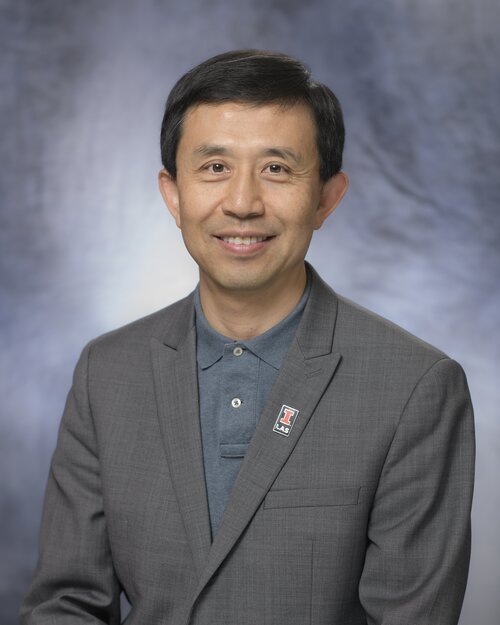
Shaowen Wang is a Professor of Geography and Geographic Information Science and the Siebel School of Computing and Data Science at the University of Illinois Urbana-Champaign (UIUC). He serves as Associate Dean for Life and Physical Sciences in the College of Liberal Arts and Sciences and is a Senior Faculty Fellow in the Office of the Vice Chancellor for Research and Innovation. His research focuses on advancing cyberGIS and geospatial data science, with applications in environmental modeling, public health, and sustainability. Wang leads the NSF-funded Institute for Geospatial Understanding through an Integrative Discovery Environment (I-GUIDE) and directs UIUC’s CyberGIS Center for Advanced Digital and Spatial Studies. Education: PhD in Geography, University of Iowa (2004) Master of Computer Science, University of Iowa (2002) MS in Geography, Peking University (1998) BS in Computer Engineering, Tianjin University (1995) Research Interests: Wang’s work integrates cyberGIS, spatial AI, and high-performance computing to address complex geospatial challenges. His research spans environmental modeling (e.g., hydrology, climate), public health (e.g., spatial accessibility to healthcare), and scalable geocomputation. His CyberGIS Center develops tools like CyberGIS-Compute and CyberGIS-Jupyter to democratize geospatial analytics. Recent Publications Trends: His recent work emphasizes AI-driven geospatial analysis (e.g., deep learning for hydrographic mapping), scalable solutions for environmental modeling, and cyberinfrastructure for reproducible research. Key contributions include frameworks for integrating HydroShare with computational tools and visual analytics for disaster resilience. Awards and Honors: Elected Fellow, AAAS (2021), AAG (2022), UCGIS (2024) NSF CAREER Award (2009) AAG Distinguished Scholarship Honors (2022) UIUC Romano & Centennial Professorial Scholars Advising and Grants: As a PI/co-PI, Wang has secured over $60M in research funding from NSF, NIH, USDA, and others. He has advised over 20 PhD students and 20 postdoctoral fellows, many now leading roles in academia and industry. His grants support projects like the I-GUIDE institute and spatial AI for extreme events. Labs and Initiatives: Directs the CyberGIS Center and co-leads the I-GUIDE initiative. Collaborates with the Taylor Geospatial Institute on projects like AI-driven hydrographic mapping and urban heat island analysis using sensor networks.