معرفی
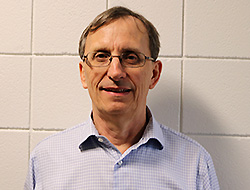
Professor Rebecca Hodge is a Professor in the Department of Geography at Durham University, where she has served since 2011 after progressing from Lecturer (2011-2016) to Associate Professor (2016-2022). Her academic foundation includes a PhD in Geography from the University of Cambridge (2007) and prior postdoctoral work at the University of Glasgow (2007-2011).
Her educational background:
- PhD, Geography, University of Cambridge (2007)
Professor Hodge's research centers on fluvial geomorphology, specializing in sediment transport mechanics within gravel-bed and bedrock-alluvial river systems. She pioneers the integration of high-resolution measurement techniques—including Terrestrial Laser Scanning, CT scanning, and 3D printing—with advanced numerical modeling (e.g., Cellular Automaton frameworks) to investigate how grain-scale interactions govern reach-scale sediment flux. Her work critically examines sediment cover dynamics, critical shear stress thresholds, and the upscaling of small-scale processes in river morphology.
Analysis of her 15 most recent publications (2019-2025) reveals a dominant focus on quantifying river bed roughness, sediment cover dynamics, and innovative measurement methodologies. Key trends include the application of 3D point cloud analysis for critical shear stress estimation, acoustic monitoring of river systems, and network-scale modeling of alluvial processes across diverse environments from Antarctic ice shelves to U.S. bedrock rivers.
Her significant recognition includes:
- Gordon Warwick Medal from the British Society for Geomorphology (2022) for excellence in geomorphological research within 15 years of her doctorate
Professor Hodge actively mentors PhD candidates including Holly Wytiahlowsky, Jiao Chen, and Mel Oliveira Guirro, with research spanning Antarctic glacial channels, bedrock-alluvial transitions, and gravel-bed river mechanics. Her collaborative projects involve institutions across the UK, USA, and Brazil, addressing fundamental questions in sediment transport and river response to environmental change.
Her laboratory work emphasizes experimental flume studies and field deployments of cutting-edge sensors, directly informing theoretical models of river evolution and sediment dynamics.