
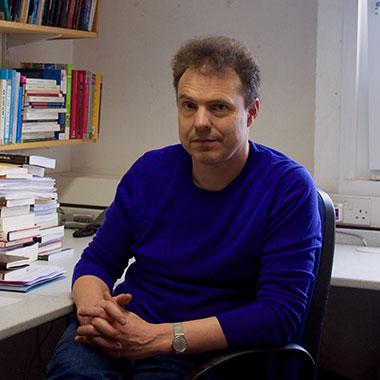
معرفی
Jeremy Larkins is a Lecturer in International Relations at the Department of Politics and International Relations, Goldsmiths, University of London. His work bridges international political theory with interdisciplinary explorations of cultural and intellectual history, focusing on the pre-modern and modern evolution of political thought.
- PhD (1999), London School of Economics
- MSc (1991), London School of Economics
- Diploma (1990), London School of Economics
- BA (1986), University of Leeds
His research investigates the cultural and intellectual history of international political theory, analyzing how Renaissance discourses on space, art, and philosophy shaped modern sovereignty. Current projects include studies on Dante’s political theology and Hegel’s conceptualization of international relations through the Phenomenology of Spirit.
Jeremy’s published monograph, From Hierarchy to Anarchy: Territory and Politics Before Westphalia, examines the Renaissance origins of territorial statehood. His work spans interdisciplinary methodologies, connecting IR theory with historical, philosophical, and artistic discourses.
He supervises PhD research on EU energy policy, EU soft power and art, and national identity in the Balkans, with a focus on critical international relations theory, classical/medieval international thought, and postcolonial perspectives.
Prior to joining Goldsmiths in 2012, Jeremy taught at the University of Leeds, University of Westminster, and Buckingham University. He serves on the International Studies Committee of the Gilbert Murray Trust, contributing to academic governance and research networks.
Jeremy Larkins در سایتهای دیگر
جستوجوهای مرتبط
شاید اینها هم برایتان مناسب باشند
 Jeremy JenningsKing’s College London · استاد
 Kevin KilleenUniversity of York · استاد
 Jérémie BarthasÉcole Normale Supérieure · پژوهشگر ارشد
 Theodore ChristovGeorge Washington University · دانشیار
 Lorenzo CelloUniversity of Queensland · استاد مدعو
 Sara MigliettiSchool of Advanced Study, University of London · مدرس ارشد