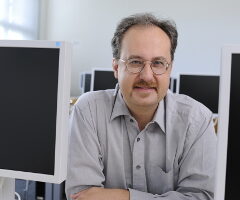
Tommaso Proiettiمشاهده پروفایل
استادیار
Tommaso Proietti serves as Tenure-Track Assistant Professor at Sant'Anna School of Advanced Studies, leading the Soft NeuroBionics Lab within the Bioelectronics and Bioengineering Area of the Biorobotics Institute. His career spans industrial engineering at General Motors, postdoctoral research at Harvard Biodesign Lab, and prior affiliations with Northwestern University and Sorbonne University. His academic credentials include: B.S. in Control Engineering, Sapienza University of Rome (2010) M.S. in Control Engineering, Sapienza University of Rome (2013) Ph.D. in Robotics Engineering, Sorbonne University (2017) Proietti's research pioneers soft wearable robotics for rehabilitation and human augmentation, with core expertise in physical human-robot interaction , biomechanics , and adaptive control systems . His lab develops inflatable exosuits and sensor technologies targeting upper-limb mobility restoration for stroke survivors, spinal cord injury patients, and industrial workers. Recent work emphasizes clinical validation of wearable systems in real-world environments while optimizing comfort and natural movement. Analysis of his 15 most recent publications (2022-2025) reveals three dominant research trajectories: (1) clinical assessment tools using wearable sensors for neurological rehabilitation, (2) pneumatic soft exosuits for industrial and medical applications, and (3) fundamental advances in human-robot interaction frameworks. His work increasingly bridges engineering innovation with tele-rehabilitation implementation, particularly for stroke recovery and ALS management. Scientific recognition: No awards documented in source materials Academic contributions: No student advising information provided No research grant details disclosed The Soft NeuroBionics Lab under Proietti's direction focuses on creating ultralightweight, textile-integrated robotic systems that provide targeted assistance without restricting natural movement. Current projects include shoulder exosuits for industrial fatigue reduction and pronosupination aids for spinal cord injury, with strong industry-clinical partnerships driving real-world deployment.