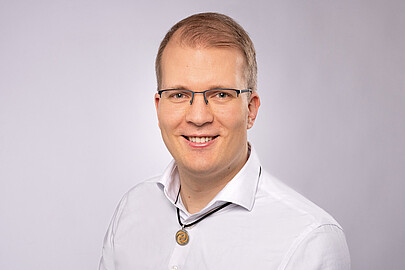
Lukas Heinrichمشاهده پروفایل
استادیار
Lukas Heinrich is an Assistant Professor of Data Science in Physics at the Technical University of Munich (TUM), affiliated with the Department of Physics within the TUM School of Natural Sciences. His position specifically focuses on the intersection of data science methodologies and physics research, particularly in high-energy physics contexts. Based at the campus in Garching near Munich, he contributes to both research and teaching activities at one of Europe's leading technical universities. Professor Heinrich's research primarily centers on particle physics, with a strong emphasis on data analysis techniques for experiments conducted at the Large Hadron Collider (LHC), particularly using the ATLAS detector. His work spans Higgs boson physics, searches for new physics beyond the Standard Model, and the development of advanced machine learning methods for particle physics applications. The research fingerprint shows strong engagement with ATLAS Detector technologies, proton-proton collisions, Standard Model physics, lepton physics, transverse momentum analysis, Higgs boson studies, and Large Hadron Collider operations. His recent publications demonstrate a clear trend toward integrating sophisticated data science approaches with traditional particle physics analysis. The 2025 publications particularly highlight work on neural simulation-based inference for parameter estimation, searches for exotic Higgs boson decays, and combination of search channels for various physics phenomena. This reflects a growing emphasis on machine learning and advanced statistical methods to extract maximum information from complex particle collision data. Professor Heinrich is actively involved in teaching, with courses including Data Science Methods, Data Science Tools, Machine Learning and Deep Learning in Physics, and Experimental Physics. His teaching appointments for the 2024/25 and 2025 summer terms show a strong commitment to educating the next generation of physicists in modern data analysis techniques. He also participates in seminars on Physics of Strong Interaction, demonstrating breadth in his teaching responsibilities beyond pure data science topics. Through his Assistant Professorship of Data Science in Physics, Heinrich leads efforts to bridge traditional physics research with cutting-edge computational approaches, contributing significantly to both the academic curriculum and research output of the TUM physics department.