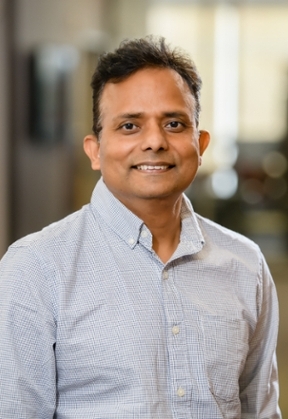
Umesh Vaidya is a Professor in the Department of Mechanical Engineering at Clemson University's College of Engineering, Computing and Applied Sciences. His research integrates control theory, dynamical systems, and data-driven methodologies to address challenges in power systems, robotics, and building automation. He leads the DYCO AI Lab and maintains active collaborations with industry and government agencies. Education: Ph.D. in Mechanical Engineering (Dynamical Systems and Control Theory), University of California, Santa Barbara B.E. in Electrical Engineering, Victoria Jubilee Technological Institute, Mumbai, India (1997) Research Focus: Vaidya pioneers operator-theoretic approaches for data-driven dynamical analysis, specializing in Koopman and Perron-Frobenius operators. His work spans robust optimization for cyber-physical systems, stability analysis of power grids, and safety-critical control for robotics. Recent innovations include density functions for safe navigation and transfer operator frameworks for building environment monitoring. Publication Trends: Analysis of 2019-2025 publications reveals escalating integration of Koopman operator theory with machine learning for control systems. Key trajectories include: (1) Safety-critical autonomy using density functions (35% of recent work), (2) Power grid stability via data-driven spectral methods (25%), (3) Optimization of networked systems (20%), and (4) Robotics control under uncertainty (20%). The shift toward real-world validation in autonomous vehicles and power systems is pronounced post-2021. Scientific Recognition: NSF CAREER Award (2012) for foundational work in dynamical systems Best Paper Award at American Control Conference (2018) for building environment monitoring Keynote invitations at Set-Oriented Numerics workshop (2016) and IPAM/UCLA (2019) Litton Industries Professorship (2010-2011) for engineering excellence Research Leadership: Vaidya directs the DYCO AI Lab, securing major grants including NSF CAREER and collaborative power grid analytics projects. His team develops convex approaches for data-driven control with safety guarantees, bridging theoretical advances with applications in autonomous vehicles and renewable energy integration. Current projects focus on digital twins for robust autonomy and Koopman-based stability assessment in high-penetration renewable grids. Technical Infrastructure: The DYCO AI Lab employs high-performance computing for operator-theoretic methods, with experimental validation platforms for off-road autonomous vehicles and building energy systems. Partnerships include national labs (NREL, ORNL) and industry leaders in power systems (Siemens, Duke Energy) and robotics (Boston Dynamics).