Mag. phil. Mag. art. Dr. phil. Stephan Hametner is a Professor at PH-OÖ (University College of Teacher Education Upper Austria) since 2014, specializing in Subject Didactics for General Music Education across elementary and secondary levels. His expertise spans Systemic-constructivist didactics Empirical research in music education Curriculum development Academic supervision Organizational development Academic background highlights include: PhD in Music Education/Pedagogy (2004, magna cum laude ) Diploma in Music Education (University of Music and Performing Arts Vienna & University of Vienna, 2000 magna cum laude ) Diploma in Rhythmics (1996 magna cum laude ) Research focuses on systemic-constructivist music pedagogy , with key contributions in Didactic frameworks for music interpretation Empirical validation of teaching methods Integration of movement and music Subject-oriented educational theory His publications analyze music's role in cognitive development and pedagogical innovation, emphasizing experiential learning. He also contributes to media education through 50 ethnomusicological radio programs (Radio Orange 94.0, 2000-2005) Interactive educational CD-ROMs Academic case studies Active in international collaborations, he serves as expert for Bern University of the Arts and contributes to the Rhythmic Expositur Biel project. Current projects include reception-aesthetic film analysis for teacher training and music identity development in educational settings.
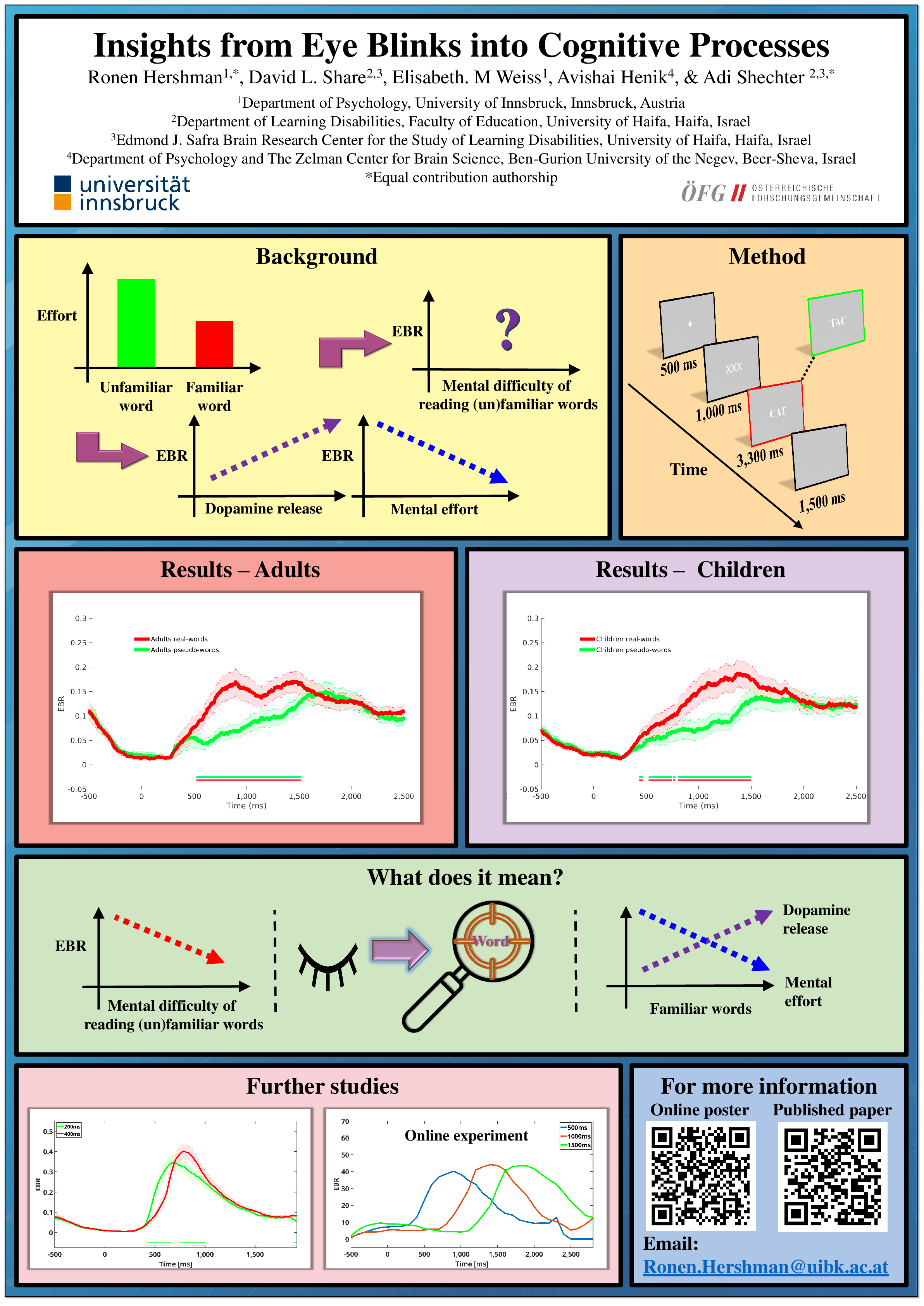
Ronen Hershman is a Research Fellow at the Department of Clinical Psychology I, University of Innsbruck. He specializes in cognitive psychology research with a focus on pupillometry, eye movements, and cognitive control mechanisms. His work primarily investigates numerical processing and conflict resolution using Stroop task paradigms. His research interests center on: Cognitive control mechanisms in conflict tasks Pupillometry as an indicator of cognitive effort Numerical cognition and processing Eye movement patterns in cognitive tasks Development of methodological tools for pupillometry analysis Hershman's publications demonstrate a consistent focus on cognitive conflict paradigms, particularly Stroop task variations, with an emphasis on temporal analysis of pupillary responses. His methodological work includes developing CHAP, an open-source pupillometry analysis software that has become a significant contribution to the field. He has taught courses including Research Seminar, Specific Clinical Research Methods, and specialized seminars on pupillometry and eye movement methodologies. His teaching portfolio includes both graduate and undergraduate level instruction in statistics and research methods.
David Ribeiro Lamas is a Professor of Human-Computer Interaction at Tallinn University's School of Digital Technologies, where he heads the Human-Computer Interaction group. He also serves as the chair of the Estonian chapter of ACM's SIGCHI and as an expert member of IFIP's TC13. With an extensive international career spanning the USA, UK, Portugal, Cape Verde, Mozambique, Afghanistan, and Estonia, he has developed deep expertise in designing organizations, communities, and human technologies. His educational background includes a PhD in Human Computer Interaction from Portsmouth University (1998), an MSc in Computer Science from Minho University (1994), and an Honours BSc in Informatics/Applied Mathematics from Portucalense University (1989). He also completed specialized studies in Strategic Management at the Polytechnic University of Catalunya and a postdoc in Augmented and Virtual Environments at Michigan State University. Lamas' research primarily focuses on design theory and methodologies, with recent work emphasizing trust in technology, facial recognition systems, and vibrotactile interfaces. He has pioneered academic programs including the Master in Human-Computer Interaction and the Masters in Interaction Design (run online with Cyprus University of Technology). His approach combines theoretical rigor with practical application, particularly in cross-cultural contexts. His publication record shows a strong trend toward understanding human trust in technology systems, with significant work on facial recognition, vibrotactile feedback systems, and trust frameworks. His research spans both theoretical contributions to HCI methodology and practical applications addressing real-world challenges in digital accessibility and user experience. 2025 HCI Pioneer Award from IFIP TC13 2025 Tallinn Conference Ambassador 2024 IFIP Service Award 2015 Badge of Merit from Tallinn University 2011 Best Paper Award for work on Estonia's M-Government Services 2000 Best Paper Award for research on Web navigation guidance Lamas has successfully supervised forty-eight master students, seven doctoral students, and two post-doc researchers, and currently supervises twelve doctoral students. His leadership extends to numerous research projects including COST Actions on Interactive Narrative Design and Human-Computer Interaction methodologies. He founded and leads STARTS.EE, Tallinn University's initiative promoting encounters between science, technology, and the arts. He has been instrumental in building the Estonian HCI community through seasonal courses on Experimental Interaction Design, Research Methods in HCI, and the Design of Human Technologies since 2010. His World Usability Day events bring together over 600 researchers and practitioners annually from the Baltics, Nordic countries, and beyond. Lamas has chaired major international conferences including INTERACT 2019, NordiCHI 2020, AfriCHI 2021, and ICIDIS 2021.
John Van Opstal is a Full Professor of Biophysics and Director of the Donders Centre for Neuroscience at Radboud University, Nijmegen, The Netherlands. His research focuses on neurophysiological mechanisms underlying auditory perception, multisensory integration, and gaze control, with significant contributions to cochlear implant technology and neurotechnology. He holds a PhD from Radboud University (1988) and has held academic positions since 1984, progressing from Assistant Professor (1990–1998) to Associate Professor (1998–2005) before becoming Full Professor in 2010. Director of Donders Centre for Neuroscience (2018–present) Chair in Biophysics (2010–present) Former Honorary Professor in Systems Neuroscience (2005–2010) Research Interests: Combining neurophysiological recordings, psychophysics, and computational modeling to understand how sensory inputs guide behavior. Key areas include sound localization, vestibular function, and the development of neural prosthetics like cochlear implants. Awards: Member of Academia Europaea (2017), ERC Advanced Grant (2016), VICI Grant (2005), and extensive funding from national/international bodies. His work has led to over 9M€ in competitive grants. Grants & Students: Supervised 14 PhD students through the HealthPAC project (2014–2017), focusing on perception-action mechanisms in health and disease. Active in translational research, including collaborations with Advanced Bionics and Philips.
Mark Delaere is a Full Professor of Musicology at KU Leuven's Faculty of Arts, Department of Musicology, holding this position since 1992 when he became Associate Professor and was promoted to Full Professor in 1995. His academic career includes a 1989 Visiting Researcher position at TU Berlin. His research spans critical areas of modern music scholarship: Historical analysis of 20th and 21st century Western classical music since 1950 Specialized expertise on Karel Goeyvaerts and the Second Viennese School (Schoenberg, Webern, Berg) Theoretical frameworks for music analysis and aesthetics Contemporary multimedia integration in musical performance Professor Delaere's publication portfolio reveals consistent focus on serial music development, temporal structures in composition, and critical analysis of major 20th century composers. His recent work examines multimedia applications in contemporary music while maintaining deep engagement with historical European avant-garde traditions. His distinguished recognition includes: Van Dyck Chair appointment at UCLA (2014) Election as Ordinary Member of the Royal Academy for Sciences and Art of Belgium (2005) Breughel Chair at the University of Pennsylvania (1998) As an active faculty member at KU Leuven, Professor Delaere contributes to graduate education and research supervision while maintaining international scholarly collaborations, particularly through his editorial work on composer correspondence and historical musicology projects.
Sonja Kotz is a Professor and Chair in Neuropsychology and Translational Cognitive Neuroscience at Maastricht University's Faculty of Psychology and Neuroscience. She also leads the Department of Neuropsychology & Psychopharmacology. Her career includes roles as a Research Professor at the Max Planck Institute for Human Cognitive and Brain Sciences (1996-2016), Head of Department at the University of Manchester (2013-2015), and academic leadership across Europe and the US. She holds honorary professorships at Universities of Lisbon, Leipzig, and Manchester. Education: Habilitation in Psychology (Leipzig University, 2006), PhD in Psychology (Tufts University, 1996), and MA equivalent in Psycholinguistics (Tübingen University, 1986). Her research focuses on neuroimaging integration, cognitive/affective neuroscience, and translational approaches to brain-rhythm interactions. Research interests emphasize rhythm processing across species, auditory-motor coupling, and body-brain dynamics. Recent work explores temporal regularity perception in macaques and humans, multisensory speech integration, and clinical applications of resting-state EEG analysis. Awards include the Max Planck Minerva Award (2007-2012) and MERA-ILCB Fellowship (2024). Professional roles include presidency of the Society for Neurobiology of Language (2019-2020) and the European Society for Cognitive and Affective Neuroscience (2014-2018). She leads the BAND-Lab (Brain, Auditory Neuroscience, and Development) and sits on editorial boards of NeuroImage , Cortex , and Frontiers journals. Current projects involve cross-species synchronization studies and translational cognitive neuroscience.
Engel Andreas Karl is a Full Professor of Physiology and Director of the Department of Neurophysiology and Pathophysiology at the University Medical Center Hamburg-Eppendorf (UKE). He also serves as Scientific Director of the Center for Experimental Medicine at UKE and holds visiting roles at Universitat Pompeu Fabra (Barcelona) and the University of Hamburg. His work focuses on neural synchrony, the binding problem, and consciousness. He earned his MD from the Technical University of Munich and has held prestigious fellowships including the DFG Heisenberg and Daimler-Benz Fellowships. Education: M.D. (Dr. med.), Technical University of Munich, 1987 Studies in Medicine and Philosophy at Saarland University, Technical University of Munich, and Goethe University Frankfurt Research Interests: Engel explores neural mechanisms of perception, action, and consciousness, particularly through EEG/MEG studies. Key areas include gamma oscillations, multisensory integration, and network dynamics in neurological disorders. His work bridges neurophysiology with theories of cognition, emphasizing sensorimotor coupling and enactive views of mind. Awards: ERC Advanced Grants (2023-2028; 2011-2016) Member of Hamburg Academy of Sciences Heisenberg Fellowship (DFG) Grants & Leadership: Coordinates Collaborative Research Centre SFB 936 ('Multi-Site Communication in the Brain') and leads studies on network dysfunction in disorders like schizophrenia and multiple sclerosis. His lab develops novel electrophysiological methods for resting-state network analysis. Labs/Teams: Center for Experimental Medicine (UKE), interdisciplinary collaborations in neurophysiology and computational neuroscience.
Maria Concetta Morrone is a Professor of Physiology at the School of Medicine, University of Pisa, with a distinguished career spanning multiple institutions including Università Vita-Salute San Raffaele (2000-2008), Italian Institute of Technology (2008-2017), CNR Institute of Neuroscience (1995-2000), and Scuola Normale Superiore (1981-1995). Her research bridges biophysics, visual perception, and computational neuroscience. Education: Physics (University of Pisa, 1977); Biophysics training (Scuola Normale Superiore, 1973-1980) Research Interests: She investigates human spatial vision, attention mechanisms, multisensory perception, brain plasticity in development and neurodevelopmental disorders, and computational models applied to robotics. Her work incorporates psychophysics, electrophysiology, ultra-high field fMRI, and artificial intelligence. Scientific Recognition: Awards include the Ken Nakayama Medal (2019), ERC-IDEA Advanced Grant (2014), and Accademia Dei Lincei honors (2002). She has coordinated multiple European Community grants.
Tobias Heed is a University Professor in the Faculty of Psychology at Paris Lodron University Salzburg, specializing in cognitive neuroscience with a focus on tactile perception, motor control, and multisensory integration. His research examines how the brain processes touch, integrates sensory information, and guides movement across the lifespan. His primary research interests include spatial coding mechanisms in touch, the influence of body posture and movement on perceptual organization, developmental trajectories of sensorimotor integration from infancy to adulthood, and pain-related movement avoidance. He investigates how tactile temporal order judgments reveal fundamental aspects of spatial processing and how visual-tactile recalibration alters perceptual hand maps. Analysis of his recent publications (2023-2025) reveals sustained focus on parietal cortex function in tactile-motor transformations, limb-specific coding in 3D space, and the neural basis of crossing effects in temporal order judgments. His work increasingly incorporates meta-analytic approaches and cross-species comparisons between macaque and human ventral intraparietal areas. Professor Heed co-leads the Children's Sensory Lab at the university, which investigates how children discover their bodies and the world through sensory experiences. His media engagements, including features in 'Wie Kinder ihren Körper und die Welt entdecken' (How Children Discover Their Body and World), demonstrate active science communication about embodied cognition and body-world interactions.
Chiara Banfi is a researcher at the Institute of Psychology , Faculty of Natural Sciences , University of Graz. Her work spans cognitive psychology, educational psychology, and neuroscience, focusing on reading/spelling deficits, arithmetic development, and healthcare administration. Research Networks : Brain and Behavior (Gehirn und Verhalten) Her publications highlight interdisciplinary research at the intersection of cognitive development, neuroimaging, and clinical medicine. Key trends include: Language-specific impacts on numerical cognition Neurological correlates of dyslexia Immunological responses to SARS-CoV-2 Healthcare system comparisons (electronic vs. paper records) Longitudinal studies of learning disorders She contributes to medical research through analyses of pulmonary hemodynamics and immunological profiles, while her educational psychology studies inform developmental theories of literacy and numeracy.
Cliodhna Quigley is a researcher in the Department of Behavioral and Cognitive Biology within the Faculty of Life Sciences at University of Vienna. She holds a Dr. rer. nat. in Psychology from Universität Leipzig, where her doctoral research focused on selective attention and visual processing in aging. Previously, she completed a postdoctoral position at Veterinärmedizinische Universität Wien from 2016 to 2022. Dr. Quigley's research centers on animal cognition, particularly examining how visual illusions affect mate choice and how audiovisual signals are integrated during courtship behavior. Her work primarily uses ring doves as model organisms to investigate perceptual mechanisms and reproductive behaviors. She has developed innovative research tools including the Vienna Talking Faces (ViTaFa) multimodal database for studying audiovisual integration. Her publication record shows consistent output with 17 publications in recent years, including significant contributions in 2023-2025. Her research has garnered attention across multiple platforms, with news mentions, social media engagement, and academic readership. Courtship Neuroscience (primary research focus) Behavioral Neuroscience (53% of research footprint) Audition Psychology (28% of research footprint) Psychological Research (17% of research footprint) Dr. Quigley actively engages with the public through media contributions, having provided expert commentary on topics including animal perception of beauty and how different species experience the world. Her work has been featured in multiple news outlets and academic platforms, demonstrating both scholarly impact and public relevance.
Nora Schnabl-Andritsch is a Professor at the Faculty of Performing Arts of the Music and Arts Private University of the City of Vienna (MUK), where she has served as a lecturer since 2000. She also holds a contract lecturer position at the University of Music and Performing Arts Vienna (mdw) since 1988, specializing in Rhythmics, percussion ensemble, movement accompaniment, and instrument making. Education Rhythmic-Musical Education (Teaching Qualification), University of Music and Performing Arts Vienna (1980-1984) Percussion Instruments, University of Music and Performing Arts Vienna (1984-1991) Music and Movement Pedagogy (Master of Arts), University of Music and Performing Arts Vienna (2004-2005) Her research and pedagogical work focuses on Rhythmics , inclusive teaching models , and interdisciplinary collaborations between music, movement, and visual language. She has led artistic-scientific projects such as the Sparkling Science Project (2012-2015) and The Art of Inclusion (2017-2019), emphasizing inclusive educational contexts and multisensory creative processes.
Elisabeth Wolfsteiner is a Researcher at the Institute of Marketing of the University of Applied Sciences Wiener Neustadt. Her work focuses on digital marketing, consumer behavior, and sustainability communication, with a particular emphasis on social media dynamics and behavioral interventions. Research Associate at FHWN Active in digital well-being and food sustainability Recipient of Ella Award (2nd place, 2024) Her research explores: Parental social media use and children's digital well-being (DigiWell project) Authenticity of brand communication through selfies Application of virtual influencers in destination marketing Nudging strategies for climate-conscious consumption (biscuit4all project) Key trends in her publications (2023-2025) include: Consumer psychology in digital interactions Sustainability adoption mechanisms AI-generated content evaluation Meat alternative market dynamics Scientific recognition: 2025 Best Paper Award for sponsorship recognition research 2024 Ella Award for teaching innovation She contributes to multidisciplinary projects involving behavioral science, food technology, and digital marketing. Her collaborations extend to industry partners and academic institutions across Europe.
Elissa Pustka is a University Professor of Romance Linguistics and Communication Studies at the Department of Romance Studies, University of Vienna, where she serves as Director of Studies for Romance Studies. She teaches French linguistics courses across BA and MA levels, including STEOP modules, seminars on corrective phonetics, sociolinguistics of Paris, and sociolectal variation in metropolitan areas, with a focus on experiential learning through excursions. Her research spans phonology (particularly staged orality in comics and audio books), semantics and pragmatics, perception/cognition/emotion in language, language contact/variation/change (with emphasis on creole studies and linguistic landscape), and foreign language didactics. She employs empirical methods including field research, corpus linguistics, perception experiments, and statistical analysis, often integrating digital tools and sensory approaches to pronunciation training. Recent publications reveal strong trends in linguistic landscape studies applied to language education, innovative French phonology research (especially schwa and liaison phenomena in learner contexts), and comics-based pedagogy. Her work bridges theoretical linguistics with practical classroom applications, frequently involving citizen science projects like VisibLL that engage school students in documenting Vienna's multilingual public spaces. Professor Pustka leads the FWF science communication project "Making French pronunciation visible" (WKP213, starting January 2025) and organizes major academic events including the XIIe Congrès de l'APFA (October 2025) on "Jeunesses francophones" and the 39th Romance Studies Day in Konstanz (September 2025) on comics in language teaching. She collaborates with schools across Vienna on exhibitions exploring neighborhood linguistic diversity. She directs the VisibLL project team, which partners with Viennese schools (GRG5 Rainergymnasium, BG8 Piaristengymnasium) to investigate linguistic landscapes through student-led citizen science, resulting in public exhibitions at district offices and museums. Her work emphasizes community engagement in linguistic research while advancing methodologies for multilingual didactics.
Severin Maurer is a Lecturer and Researcher at the University of Applied Sciences Wiener Neustadt , affiliated with the Institute of Market Research & Methodology . His research focuses on interdisciplinary fields including User Experience (UX) research combined with psychophysiological methods, biomedical engineering (e.g., blood pressure measurement techniques), and gender studies. Research Interests: Development of paradigms integrating traditional UX methods with psychophysiological measurements (e.g., facial expression analysis, heart rate variability). Biomedical studies on non-invasive blood pressure monitoring and its clinical applications. Market research on sensory perception and consumer behavior in food products, particularly the impact of visual and sensory cues. Gender gap analysis in modern professional contexts (Gender Gap 4.0 project). Key Projects: Paradigms for UX Research : Combining UX methods with psychophysiological techniques to assess user stress and emotional responses. Under Pressure – The Final Chapter : Evaluating blood pressure measurement techniques and their clinical relevance. Gender Gap 4.0 : Investigating gender disparities in contemporary work environments. Advising & Collaboration: Collaborates with institutions on UX and biomedical projects, contributing to teaching materials like instructional videos. Active in presenting research at conferences (e.g., 48th EMAC Annual Conference). Labs/Teams: Part of the Institute’s research teams focusing on market methodology and biomedical applications.