Paola Quaglia is an Associate Professor at the Department of Information Engineering and Computer Science, University of Trento. Her primary teaching activities include courses on Concurrency and Linguaggi formali e compilatori (Formal Languages and Compilers), focusing on shared-memory concurrency and compiler design methodologies applicable to formal/natural language analysis. Quaglia's research expertise spans Algorithms, Concurrency, Process Calculi, Formal Languages, Systems Biology, and Stochastic Processes . Her work bridges computational modeling with biological systems, emphasizing formal verification and concurrent programming paradigms. Notable publication trends include contributions to stochastic process algebra , BlenX/Beta-binders for biological modeling, and model-checking techniques for concurrent systems. She has extensively explored the intersection of programming language theory and computational biology.
Paolo Liberatore is an Associate Professor in the Department of Computer, Control and Management Engineering at Sapienza University of Rome. His research focuses on knowledge representation and reasoning in artificial intelligence, with expertise in belief revision, abduction, computational complexity, and compilability. His educational background includes a Laurea in Computer Engineering (1994) and a PhD in Computer Engineering (1998) from Sapienza University of Rome. Liberatore's research spans several key areas of artificial intelligence. He has made significant contributions to belief revision, including the development of commutative operators for integrating information from multiple sources and efficient algorithms for knowledge revision. His work on abduction addresses diagnostic problems and the minimization of tests for identifying abductive explanations. In computational complexity, he has analyzed the complexity of reasoning about actions, belief update, and model checking. Additionally, he has pioneered work on compilability and compact representations of knowledge, showing how precompilation can reduce the complexity of AI problems. His recent publications (2015-2022) reflect a continued focus on belief merging, integration, and revision, with an emphasis on handling uncertainty and reliability of sources. The work spans theoretical foundations and practical applications in multi-agent systems and knowledge fusion. Liberatore has been recognized with several awards: CNR scholarship for new graduates (awarded twice) ECCAI Award for best European doctoral thesis in Artificial Intelligence (1998) Best Paper Award at the International Conference on Principles of Knowledge Representation and Reasoning (KR 2004) He has led and participated in numerous research projects, including the Italian-French coordinated project "Knowledge fusion and planning in multi-agent decision making" and the university project "Applications of artificial intelligence techniques to web services composition". His project portfolio also includes significant contributions to model checking, satisfiability, mobile robotics, multi-robot systems for emergency response, and verification of web services. Although not explicitly mentioned in the provided text, his extensive involvement in program committees (e.g., KR, ECAI, IJCAI) and editorial boards (e.g., Journal of Artificial Intelligence Research) underscores his active role in the AI research community.
Fabio Patrizi is an Associate Professor in Computer Science at the Department of Computer, Control and Management Engineering (DIAG) at Sapienza University of Rome. He serves as Coordinator of the Bachelor in Information Engineering program at the Latina site. His academic career includes significant service roles such as Editorial Board Member for the prestigious Artificial Intelligence Journal (AIJ) since 2023, Area Chair for ICSOC 2023, and co-chair for the KR 2025 track on Knowledge Representation & Reasoning and Planning & Scheduling. Patrizi's educational background led to National Scientific Habilitation for Full Professorship for sector SC 09/H1 (now GSD 09/IINF-05). His research spans Formal Methods, Knowledge Representation, Machine Learning, Reasoning about Action, Planning in AI, Service-oriented Computing, and Business Processes. His work focuses on theoretical, methodological, and practical aspects including Behavior and Service composition, Planning programs, MAS Verification, Reasoning About Actions, Infinite-plan synthesis, Data abstraction techniques, and Reinforcement Learning with non-Markovian Rewards. His publication record includes over 70 scientific papers in top-level international journals and conferences. Recent research trends show a strong focus on temporal reasoning in reinforcement learning, planning frameworks, process mining, and verification techniques. His work bridges theoretical foundations with practical applications in AI planning and verification. ICDT Test of Time Award on Automatic verification of data-centric business processes (2009) RMIT Visiting Researcher's Award (2011) ICAPS 2024 Outstanding SPC Award Patrizi has supervised 2 PhD students and actively serves on program committees for major AI conferences including AAAI, IJCAI, ICAPS, AAMAS, KR, and ECAI. His research projects include MARLeN (Principal Investigator, 2023-2025), AIPlan4EU (Task Leader, 2021-2023), DRAPE (Principal Investigator, 2019-2022), WhiteMech (Participant, 2019-2024), TAILOR (Participant, 2020-2023), VerySynCopated (Principal Investigator, 2014-2016), ACSI (Participant, 2010-2013), and SM4All (Participant, 2008-2011). He is a member of the Data Management & Service-Oriented Computing and Artificial Intelligence & Knowledge Representation research groups at DIAG, contributing to collaborative efforts in advanced AI research and applications.
Marco Montali is a Full Professor in Computer Engineering at the Faculty of Engineering, Free University of Bozen-Bolzano. His research focuses on artificial intelligence, process science, and data-aware systems, emphasizing the integration of model-driven and data-driven techniques. He holds a BEng, MEng, and PhD from the University of Bologna. His work bridges AI, formal methods, and process mining, with over 250 publications and significant contributions to declarative process modeling and runtime verification. Education: BEng cum laude in Computer Science Engineering, University of Bologna (2003) MEng cum laude in Computer Science Engineering, University of Bologna (2005) PhD in Electronics, Computer Science and Telecommunications Engineering, University of Bologna (2009) Research Interests: AI and formal methods for process modeling Data-aware dynamic systems and process mining Runtime verification and declarative constraints Object-centric processes and multi-process systems Awards: 2015 Marco Somalvico Award (Best under-35 AI researcher in Italy) 10 Best Paper Awards and 2 Test-of-Time Awards Top 2% Most Cited Scientists (2023) Grants/Projects: Lead the PINPOINT PRIN project and contributed to EU projects like ACSI and Optique. Active in third-party collaborations, including Ontopic s.r.l., a semantic technologies startup. Labs/Teams: Director of the Artificial Process Intelligence (API) research group and co-founder of Ontopic s.r.l.
Andrea Alexander Janes is an associate professor at the Free University of Bozen-Bolzano, Italy, and an adjunct professor at the University of Oulu. He previously held positions at FHV Vorarlberg University of Applied Sciences and the Free University of Bozen-Bolzano. His research focuses on software engineering methodologies, including Lean/Agile approaches, value-based software engineering, empirical studies, and technology transfer. He holds a Master's in Business Informatics from TU Vienna and a PhD in Computer Science (with distinction) from the University of Klagenfurt, followed by a habilitation in Computer Science. Education: PhD in Computer Science, University of Klagenfurt, Austria (with distinction) Master’s in Business Informatics, TU Vienna, Austria Completed habilitation in Computer Science Research interests include software development processes, quality assurance, empirical software engineering, and microservices architecture. He has organized and chaired numerous international conferences and workshops, including ECSA 2026, ICSE 2025, and ESOCC 2025. His teaching spans courses in software engineering, operating systems, and agile methodologies at both bachelor’s and master’s levels. Key research projects include TeleCareHub (2022–2026), ADVERB (2019–2022), and SQuaSME (2016–2017). He collaborates with industry partners, focusing on applications like healthcare, sports analytics, and energy-efficient systems. His work emphasizes bridging academic research with practical industry needs through technology transfer and student engagement. Labs/Teams: Active in the NOI Techpark and collaborates with local IT companies, fostering student-industry interaction through events like the Reality Check series.
Ludovica Adacher is an Associate Professor at the Department of Civil, Computer and Aeronautical Engineering, Roma Tre University, Rome, Italy, specializing in optimization methodologies for transportation and logistics systems. Her work bridges theoretical operations research with practical engineering applications across multiple critical infrastructure domains. Her research focuses on Transportation Engineering and Operations Research, with deep expertise in Air Traffic Management, Urban Traffic Control, and Logistics optimization. She develops advanced models for vaccination clinic design, airport operations, and sustainable freight distribution, emphasizing cost-QoS tradeoffs, environmental impact reduction, and robustness under uncertainty. Her methodological toolkit includes Lagrangian relaxation, heuristic algorithms, and simulation techniques applied to real-world congestion and resource allocation problems. Analysis of her 15 most recent publications reveals a consistent pattern of addressing high-impact transportation challenges through mathematical optimization. Her work spans air traffic congestion resolution, electric vehicle infrastructure planning, urban freight sustainability, and healthcare logistics, with increasing emphasis on multi-objective frameworks that balance operational costs, environmental metrics, and social factors. The research demonstrates strong interdisciplinary connections between civil engineering, computer science, and aeronautical systems.
Andrea Corradini is a Full Professor at the Computer Science Department of the University of Pisa , where he coordinates internationalization efforts. His research focuses on algebraic and categorical semantics of programming languages, concurrency, graph grammars, and term rewriting systems. He teaches advanced programming courses and has advised numerous students in their academic and research endeavors. His recent work spans ecological studies on wildlife behavior, machine learning applications, and formal methods in software engineering. Teaching: Advanced Programming (Master's level) Fondamenti dell'Informatica (Bachelor's level) Research Interests: Formal semantics of programming languages Graph transformation systems Concurrency theory Applications of category theory in computer science Recent Research Trends: His publications explore interdisciplinary topics, including wildlife behavioral ecology (e.g., brown bears, lynx), machine learning for material science, and formal verification techniques. Recent studies highlight human impacts on animal behavior and innovative computational methods for ecological modeling. Scientific Contributions: Dr. Corradini has coordinated international projects like ASCENS and GETGRATS, advancing graph transformation theory. His work bridges theoretical foundations with practical applications in software systems and ecological conservation.
Marcantonio Ruisi is a Full Professor of Economics, Business, and Statistics at the University of Palermo. He serves as a key academic leader, holding a delegation for relations with businesses, university consortia, and cultural institutions, and coordinates activities promoting spin-offs and innovative startups. His work also focuses on public engagement and fostering academic-industry collaboration. Research Interests : Ruisi’s research spans sustainable business models, corporate sustainability, entrepreneurship, tourism management, and innovation strategies. He explores topics such as start-up development, green economy principles, gamification in business, and the economic impact of cultural events like the Cous Cous Fest. His work often intersects with practical applications, such as corporate check-ups for academic spin-offs and strategic management tools like the Sustainability Balanced Scorecard. Recent Trends : His publications highlight a focus on sustainability as a competitive advantage, digital transformation (e.g., gamification, digital marketing), and innovation ecosystems. He also addresses challenges in tourism management, including destination marketing and revenue optimization in hospitality. Advising & Grants : Ruisi has guided numerous theses on topics ranging from corporate social responsibility to tourism policy, reflecting his interdisciplinary approach. His projects often involve collaboration with industry partners, supporting the commercialization of academic research and fostering entrepreneurial ecosystems.
Massimo Benerecetti is an Associate Professor in Computer Science at the Department of Electrical Engineering and Information Technologies, University of Naples "Federico II". He is actively involved in teaching and research, with a focus on algorithms, data structures, and formal verification of software systems. Position: Associate Professor Institution: University of Naples "Federico II" Department: Department of Electrical Engineering and Information Technologies Research Areas: Software Analysis, Model Checking, Formal Verification, Security Protocols, Multi-Agent Systems Contact: massimo.benerecetti@unina.it His research interests lie in the domain of formal methods for software and system verification, particularly in automated reasoning, model checking, and the analysis of security protocols and multi-agent systems. He has contributed to national research projects funded by MIUR, including PRIN and FIRB initiatives focused on automated verification and reasoning in complex systems. Although no recent publications are listed in the provided text, his academic work centers on advancing formal techniques for software validation, especially in distributed and context-aware environments. His teaching responsibilities include core computer science courses such as Algorithms and Data Structures I and II, as well as specialized topics like Automated Software Verification. Massimo Benerecetti has also played an active role in the academic community through organizational and committee roles in international conferences such as CONTEXT, MCMAS, MoChArt, CLIMA, and KR, reflecting his engagement with interdisciplinary research at the intersection of AI, logic, and formal methods. He advises students and conducts office hours by appointment, maintaining an accessible academic presence. There is no indication of part-time status, awards, or student advisees in the provided information.
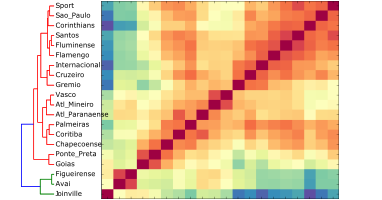
Diogo F. Pacheco is a Postdoctoral Fellow at the Center for Complex Networks and Systems Research, Indiana University Bloomington, supervised by Fil Menczer and Alessandro Flammini. He maintains dual affiliations as a member of the BioComplex Lab and an invited researcher at the Computational Intelligence Research Group, University of Pernambuco. His educational background includes: Ph.D. in Computer Science from Florida Institute of Technology (2017), dissertation: Information Densification of Social Constructs via Behavior Analysis of Social Media Users Master's in Computer Science from University of Pernambuco (2008), thesis: An Evolutionary Multi-Objective Approach to Decision Support in Sugarcane Harvest Bachelor's in Computer Science from University of Pernambuco (2006), thesis: Decision Support in Intelligent Systems for Agricultural Crops Dr. Pacheco specializes in computational social science and complex systems modeling, with core expertise in social media analysis for societal insights. His methodology combines data-driven behavioral modeling , network science , and machine learning to examine phenomena including language spreading, football supporter dynamics, organ donation awareness, and social disorganization. Early work focused on multi-objective optimization for agricultural decision support, evolving into contemporary research on digital footprints as proxies for human behavior. Analysis of his 15 most recent publications reveals a clear trajectory from agricultural optimization (2006-2008) to computational social science (2014-2019). Recent work demonstrates sophisticated applications of Twitter data for cross-disciplinary studies in public health, criminology, and sports analytics, often correlating digital behavior with socio-economic indicators. His GitHub ecosystem simulations for DARPA represent cutting-edge multi-agent modeling of online communities. Dr. Pacheco actively collaborates with research groups including the BioComplex Lab (Indiana University) and University of Pernambuco's Computational Intelligence Research Group. His current projects involve large-scale social media simulations, human mobility modeling, and social disorganization metrics using location-based data. Prior to his Ph.D., he gained five years of industry experience following his Master's degree.
Francesco Spegni is a Researcher at the Department of Civil, Building and Environmental Engineering (DICEA) within the School of Engineering at Marche Polytechnic University (UNIVPM), Italy. His work integrates advanced computational methods with civil engineering applications, focusing on built environment management through cutting-edge technological solutions. His research spans Augmented Reality , Construction Safety , Building Information Modeling , Facility Management , and Blockchain systems. Key investigations include marker-less AR registration for infrastructure inspections, cybersecurity in construction processes, and mixed reality applications for facility operations. His interdisciplinary approach bridges computer science and civil engineering to solve practical challenges in construction safety and infrastructure management. Analysis of his 2023-2025 publications reveals a dominant trend toward seamless integration of cyber-physical systems in built environments. Core themes include marker-less augmented reality for indoor/outdoor transitions, blockchain notarization of BIM processes, and natural language processing for safety management. His work consistently targets real-world implementation challenges in unprepared environments, emphasizing accuracy, interoperability, and practical usability for construction and facility management professionals.
Roberto Bagnara is a Full Professor of Computer Science at the Department of Mathematics and Computer Science of the University of Parma, Italy. He has been a faculty member since 1997, progressing from Assistant Professor to Associate Professor and finally to Full Professor in November 2010. In addition to his academic position, he serves as Chief Scientist, CTO, and President of BUGSENG srl, a university spin-off focused on software verification and validation technologies. Professor Bagnara received his laurea degree (magna cum laude) in Computer Science from the University of Pisa in July 1992, followed by a Ph.D. in Computer Science from the same university in September 1997. Prior to his doctoral studies, he worked at CERN in Geneva with Tim Berners-Lee, the inventor of the World Wide Web, and at the University of Bologna's Physics Department developing software for data acquisition and analysis. His research spans abstract interpretation, program analysis and verification, and semantics-based program manipulation techniques . Professor Bagnara has made significant contributions to the fields of static program analysis, with particular focus on convex polyhedra manipulation, constraint logic programming, and formal verification of safety-critical software. His work bridges theoretical foundations with practical applications, resulting in several influential software projects including the Parma Polyhedra Library (PPL), CHINA, PURRS, and ECLAIR. The PPL is particularly notable as it's used in the GNU Compiler Collection (GCC), the most widely used compiler suite worldwide. Professor Bagnara's recent publications reveal a strong focus on safe and secure programming, particularly in C language ecosystems. His work on C-rusted, MISRA compliance, and floating-point verification demonstrates his commitment to practical solutions for real-world software verification challenges. His research increasingly integrates formal methods with industry needs, especially for safety-critical embedded systems. Professor Bagnara has supervised numerous thesis students and has been involved in multiple national and international research projects, including ESPRIT, COFIN, and PRIN projects. He has served on program committees for major conferences such as SAS, VMCAI, and ICLP, and has organized workshops and summer schools in his field. He leads the Applied Formal Methods Laboratory at the University of Parma, which focuses on developing theoretical foundations and practical tools for software analysis and verification. The laboratory's work has significant industrial impact, particularly through the ECLAIR project, which aims to create an industrial-strength platform for analysis, verification and transformation of imperative languages.
Enea Zaffanella is an Associate Professor in Computer Science at the University of Parma , where he has been affiliated since 2000. His academic career spans from Fellow Researcher to Assistant Professor, culminating in his current role since 2006. He teaches courses in Programming Methodologies , Compilers , and Foundations of Computer Science at both undergraduate and graduate levels. PhD in Computer Science from School of Computing, University of Leeds (2002) Laurea in Computer Science from University of Pisa (1993) Research focuses on Static Analysis and Software Verification using Abstract Interpretation . Key contributions include theoretical frameworks for Constraint Logic Programs analysis, Convex Polyhedra abstractions, and Widening Operators design. His work bridges formal theory with practical implementations like the Parma Polyhedra Library (PPL) and its successor PPLite . Recent publications explore Hybrid Systems verification, Data Science linting tools (Pyra), and EVM Bytecode analysis. He received the Radhia Cousot Young Researcher Best Paper Award in 2019. Collaborations include academic Research Projects (PRIN, ESPRIT) and industrial partnerships through BUGSENG srl .
Arkaitz Zubiaga is a Senior Lecturer (Associate Professor) at Queen Mary University of London, where he co-leads the Social Data Science lab and serves as Director of Graduate Studies. He is also part of the leadership team of the Centre for Human-Centred Computing. His research sits at the intersection of Computational Social Science and Natural Language Processing, focusing on developing NLP and LLM methods for processing social media and Web data to tackle societal harms. Zubiaga's research interests concentrate on addressing problematic issues with damaging societal effects, including hate speech, misinformation, inequality, biases, and other forms of online harm. He investigates how LLMs can be misused for malicious purposes such as spreading misinformation, generating abusive content, or exacerbating societal biases. His work emphasizes detecting and addressing irresponsible AI use where content is falsely claimed to be human-generated. His publication record shows a clear trend toward addressing bias in detection systems, particularly in cyberbullying detection where swearing bias has been identified as a critical issue. His recent work explores zero-shot and few-shot learning approaches for cross-lingual applications, stance detection, and claim verification. The research spans multiple disciplines including computational linguistics, social computing, and AI ethics, with a growing focus on multimodal approaches and longitudinal model evaluation. 2024 OSNEM best survey award for work on session-based cyberbullying detection Zubiaga actively mentors PhD students, with Peiling Yi recently passing her viva (April 2025) and welcoming new PhD students Alaa Bazaid and Ali Khairallah. He serves as senior area chair for ACL 2025 and leads the HYBRIDS MSCA Doctoral Network. His work demonstrates a strong commitment to developing responsible AI systems that can detect and mitigate online harms while addressing critical issues of bias and fairness in computational approaches.
Paolo Pasini is a Fixed-term Assistant Professor at the Department of Electronics and Telecommunications (DET) within Politecnico di Torino. His academic roles span teaching and research, with a focus on algorithms, formal verification, and hardware optimization. Scientific Branch: IINF-01/A - Electronics (Area 0009 - Industrial and Information Engineering) ERC Sectors: Algorithms, Software Engineering, Theoretical Computer Science, Web Systems Research interests center on hardware model-checking algorithms, portfolio-based verification engines, pre-simplification steps, circuit manipulation, and interpolation-based techniques. His recent publications highlight applications in FPGA optimization, edge computing, and machine learning classification. 2025: Low-Power Subgraph Isomorphism at the Edge Using FPGAs 2025: NN2FPGA: Optimizing CNN Inference on FPGAs 2024: Bounded Model Checking with Interpolation Teaching roles include: PhD: Data Structures in Python (2022/23) Master’s: Edge Computing Systems for AI and ML (2023/24-2025/26), Modeling and Optimization of Embedded Systems (2023/24-2024/25) Bachelor’s: Digital Electronic Design (2024/25-2025/26), Algorithms and Data Structures (2019/20-2022/23)