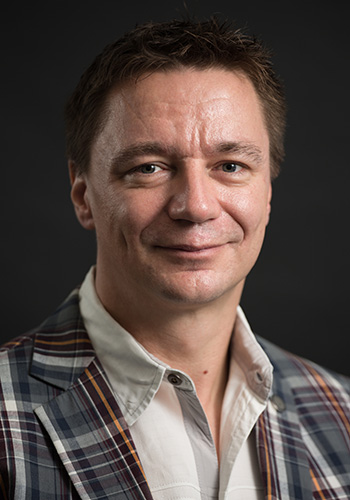
Kostas Tassis serves as Professor in the Department of Physics at the University of Crete, Greece, having joined in 2012 as Assistant Professor, promoted to Associate Professor in 2018, and to full Professor in 2023. He leads the PASIPHAE project (Polar-Areas Stellar-Imaging in Polarization High-Accuracy Experiment), an ERC Consolidator Grant awarded in 2018, and maintains active affiliations with Skinakas Observatory and the Institute of Theoretical and Computational Physics. His academic background includes: BSc in Physics from the University of Thessaloniki (1999) PhD in Theoretical Astrophysics from the University of Illinois at Urbana Champaign (2005) His research centers on star formation processes, interstellar medium physics, and magnetohydrodynamic simulations, with particular emphasis on cosmic magnetic fields and their role in astrophysical systems. He employs both theoretical modeling and observational polarimetry to investigate phenomena ranging from molecular cloud dynamics to cosmological-scale magnetic field effects. Analysis of his recent publications reveals dominant focus on LiteBIRD mission simulations, interstellar dust polarization, and magnetic field strength estimation techniques. Key thematic clusters include cosmic microwave background polarization analysis, blazar variability studies, and computational approaches to non-ideal magnetohydrodynamics in star-forming regions, demonstrating strong integration of observational data with theoretical modeling. Notable recognitions include: ERC Consolidator Grant for PASIPHAE project (2018) His research program involves extensive international collaboration, particularly through the PASIPHAE survey and LiteBIRD mission consortia. Current work emphasizes polarimetric instrumentation development and large-scale cosmic magnetometry, with significant contributions to understanding magnetic field roles in galaxy evolution and star formation processes. He maintains active involvement with multiple University of Crete research units including the Crete Center for Theoretical Physics (CCTP) and Skinakas Observatory, where observational components of his PASIPHAE work are conducted.