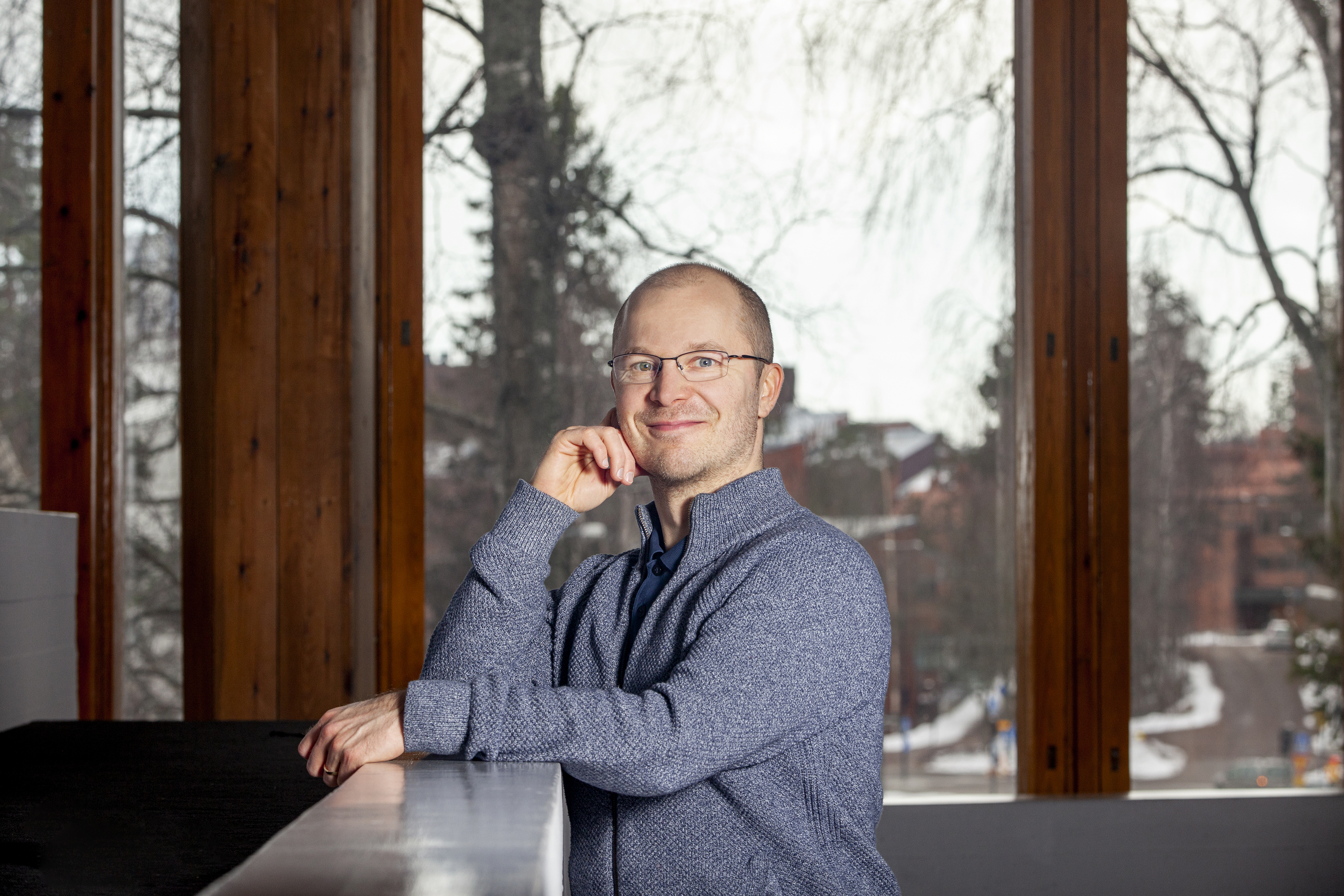
Dr. Olle Järv is an Academy Research Fellow at the University of Helsinki's Department of Geosciences and Geography. As Docent in Human Geography and holder of a joint PhD from University of Tartu and Ghent University, his research focuses on leveraging big data sources like mobile phone records and social media for analyzing human mobility patterns across European cross-border regions. Key research areas: Spatial segregation, urban diversity, transnationalism, and pandemic-induced mobility changes Current projects: BORDERSPACE (2020-2025) – Mapping transnational spaces through mobility data MOBI-TWIN (2023-2026) – Regional mobility patterns in twin transitions WinWin4WorkLife (2024-2027) – Sustainable cross-border remote work His methodological innovations include developing tools for analyzing social media data and mobile phone records to study urban dynamics. Recent recognitions include the 2024 Research Council of Finland Award and 2021 Best Paper Award from Journal of Location Based Services.
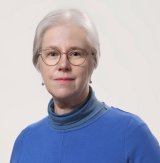
Brita Wårvik is a Professor in the Department of Languages at Åbo Akademi University, affiliated with the Faculty of Humanities, Psychology and Theology. She holds a Doctor of Philosophy (Phil. Dr.) from the same institution, awarded in 2013, and has been actively contributing to linguistic research for decades. Doctor of Philosophy (Phil. Dr.), Åbo Akademi University, 2013 Her research centers on discourse analysis, pragmatics, and historical English linguistics, with a particular focus on Early Modern and Medieval English texts. She investigates discourse interaction, textual structures, and pragmatic conservatism in religious prose, often employing corpus-based and textual analysis methods. Her work bridges micro and macro perspectives in discourse, exploring how semantic units contribute to broader text worlds. Analysis of her recent publications reveals a consistent trajectory in historical discourse studies, with increasing emphasis on corpus linguistics, manuscript variation, and the evolution of discourse markers. Her editorial work, such as the 2024 volume Structures in Discourse , highlights her leadership in synthesizing interdisciplinary perspectives on language use. Scientific Awards: Teacher of the Year (2001) ÅAU Student Union's Rose (2007) Brita Wårvik actively supervises and mentors academic visitors and collaborators, as seen in her hosting of scholars like Carmen Lee and Lieselotte Anderwald. She is the coordinator of the ongoing Project ICLE (International Corpus of Learner English) , securing research continuity and international collaboration. Her involvement in organizing workshops, such as the ICLE+30 FI-subcorpus Workshop in 2024, underscores her role in fostering academic exchange. In terms of research infrastructure, she is deeply embedded in the ICLE network, contributing to the development of learner language corpora. Her activities reflect strong international collaborations, particularly in the fields of historical linguistics and discourse studies, with a visible presence in both research and academic community-building.
Pekka Marttinen is a tenured Associate Professor of Machine Learning at Aalto University, Department of Computer Science, and leads the Machine Learning for Health (Aalto-ML4H) group within the Helsinki Institute for Information Technology HIIT. Education: M.Sc. in Applied Mathematics, University of Helsinki (2004) Ph.D. in Statistics, University of Helsinki (2008) Title of Docent in Information and Computer Science, Aalto University (2015) Research Focus: His methodological work spans large language models, reinforcement learning, deep learning, probabilistic machine learning, and causal inference . These techniques are applied to critical domains of healthcare, bioinformatics, statistical genetics, epidemiology, and personalized medicine . The group develops novel algorithms, theoretical guarantees, and open-source software that enable data-driven discovery and decision-making in medicine and biology. Publication Trends: Across 2022-2024 the lab has concentrated on (i) rigorous causal reasoning over temporal clinical data, (ii) principled uncertainty quantification in LLMs, (iii) representation learning for neural network comparison, and (iv) translational projects that turn raw EHRs into actionable clinical insights. Earlier work integrated high-dimensional genomics with metabolomics and mapped evolutionary forces in bacterial pathogens. Scientific Awards & Recognition: While no specific awards are listed, his sustained publication record in top-tier venues (NeurIPS, ICML, AISTATS, Nature Genetics, PLOS CB) and his role as responsible professor of the Machine-Learning, Data-Science and AI major signify significant peer recognition. Advising & Grants: Prof. Marttinen currently mentors 8 PhD students as primary supervisor and an additional 7 PhD students as co-supervisor. He has already graduated 8 PhDs since 2014. The group is supported through competitive funding including the Finnish Center for Artificial Intelligence (FCAI) doctoral program. Labs & Teams: He directs the Machine Learning for Health (Aalto-ML4H) research group, comprising postdocs Hans Moen, Ti John, Alexander Nikitin, Negar Safinianaini, Linli Zhang, Zhiyuan Li, and the above-mentioned PhD cohort.
Suvi Saarikallio is a Professor of Music Education at the University of Jyväskylä, Finland , affiliated with the Faculty of Humanities and Social Sciences and the Department of Music, Art and Culture Studies . She leads interdisciplinary research bridging music psychology, education, and therapy, with a focus on youth development, emotion regulation, and well-being. Research Groups: Centre of Excellence in Music, Mind, Body and Brain (2022-2029), Musiconnect (2022-2027) Key Projects: Music and You, Stress & music listening, MPACT (Music and Sports), Music and Cross-modal Associations, SOSUS (Social Sustainability for Children) Research Trends: Her recent publications explore music's role in emotional regulation, cross-modal perception, health outcomes, and educational applications. Themes include AI's impact on music evaluation, rhythm's connection to cognitive skills, and music's influence on stress and social-emotional development. Contact: suvi.saarikallio@jyu.fi
Valeriy Vyatkin is a Professor at the Department of Electrical Engineering and Automation, Aalto University. His research focuses on advancing industrial automation, control systems, and their integration with emerging technologies like machine learning and digital twins. He specializes in standards such as IEC 61499, addressing interoperability, formal verification, and performance optimization in distributed automation systems. Key research interests include: Physics-informed machine learning for industrial processes (e.g., steel rolling, reservoir engineering) Formal methods for control system validation and safety-critical applications Development of adaptive automation frameworks for Industry 5.0 challenges, including human-robot collaboration and energy systems Interoperability between legacy and modern industrial standards (OPAS, OPC UA) Recent work emphasizes real-time simulation, FPGA-based control prototyping, and AI-driven solutions for energy efficiency and sustainability in manufacturing, horticulture, and process industries. Publications span topics like robotic walker design, probabilistic model checking, and decentralized learning management systems. He collaborates on EU and industry-funded projects, focusing on digital twin implementation, edge computing, and virtual commissioning. His team develops tools for automated code generation, system migration, and anomaly detection in complex industrial settings.
Vesa Haapala serves as a University Lecturer in Finnish Literature at the University of Helsinki's Faculty of Arts, Department of Finnish, Finno-Ugrian and Scandinavian Studies. His academic career spans over two decades with consistent scholarly output and creative writing. Haapala completed his Doctorate (FT) in 2005 with a dissertation on Edith Södergran's poetry collection 'Dikter,' followed by a Licentiate degree (FL) in 2000 and Master's degree (FM) in 1996, all from the University of Helsinki. His research interests focus on Finnish poetry analysis, particularly the works of Edith Södergran and Aleksis Kivi, contemporary Finnish literature, literary avant-garde movements, and ecocriticism. Haapala has made significant contributions to understanding poetic collections as cohesive wholes (runoteos kokonaisuus), examining how series and sequences function within literary works from Petrarch to contemporary authors. His publication record reveals a consistent pattern of scholarly articles in leading journals like 'Joutsen' and 'Avain,' alongside creative output including poetry collections ('Vantaa' 2007, 'Termini' 2009, 'Kela' 2013) and the novel 'Karhunkivi' (2016). His recent work includes the 2021 textbook 'Särmä: Suomen kieli ja kirjallisuus: Tietokirja' and the poetry collection 'Hämärä ei tanssi enää' (2019), demonstrating his dual commitment to academic scholarship and creative expression. Kalevi Jäntin palkinto (2007) Kirjastoapuraha from Taiteen keskustoimikunta (2010-2014) Otavan Kirjasäätiön apuraha (2008-2015) WSOY:n Kirjallisuussäätiön apuraha (2011-2012) Haapala has supervised multiple doctoral and Master's students including Matias Koriseva, Tuula Rautio, Sanna Rämö, Daniela Silén, Anna Tomi, and Denise Ziegler. He has also served as an opponent for doctoral dissertations and participated in national research programs including the National Doctoral Program in Literature Studies. His current project 'Lintukoto' (2021) continues his exploration of Finnish literary traditions while his role in developing educational materials like the 'Särmä' textbook series demonstrates his commitment to teaching and knowledge dissemination.
Päivi Leino-Sandberg is a Professor of Transnational European Law at the University of Helsinki's Faculty of Law, where she also serves as Deputy Director of the Erik Castrén Institute of International Law and Human Rights. She has established herself as a leading scholar in EU constitutional and institutional law, with extensive experience bridging academic research and practical policy work. Professor Leino-Sandberg specializes in EU constitutional and institutional law, with particular focus on: Legal expertise in EU policymaking processes Transparency and accountability in EU governance The dynamics of powers within the European Union EU integration models and constitutional development The intersection of national and EU legal systems Her recent research demonstrates a consistent pattern of examining the political dimensions of EU law through empirical and interdisciplinary approaches. Recent work has focused on the Next Generation EU recovery framework, EU transparency practices, and the evolving constitutional architecture of European integration. She frequently employs empirical methodologies to uncover the practical workings of EU legal institutions beyond formal legal texts, with publications analyzing confidential EU documents, recovery funds governance, and the language of EU legal reasoning. Professor Leino-Sandberg's scholarly contributions have been recognized with significant honors including membership in the Finnish Academy of Science and Letters (2025) and the Best referee article published in 2024 in Lakimies. Her work has been cited by the EU Court of Justice and the German Federal Constitutional Court, demonstrating its impact on legal practice. She actively supervises doctoral students and has served as an opponent for doctoral dissertations at institutions including the University of Amsterdam and University of Utrecht. Professor Leino-Sandberg has secured substantial research funding, including multiple projects from the Research Council of Finland's Strategic Research Council and foundation grants totaling over €500,000 in the past five years. Professor Leino-Sandberg leads the Erik Castrén Institute's research on EU governance and is principal investigator for major projects including '2035Legitimacy' and '(In)security and Democracy.' She frequently collaborates with international research networks and has established the University of Helsinki as a hub for critical EU constitutional scholarship.
Sandra Reimann is a Professor of German Philology at the University of Oulu's Faculty of Humanities, leading the German Language and Culture department. She holds a habilitation in linguistic studies of online self-help communication and has held visiting professorships at institutions like Karl Franzens University in Graz. Her career includes roles at the University of Regensburg since 2001 and radio journalism since 1992. Her research focuses on applied linguistics, media communication, business communication (including advertising), and health communication. She investigates technical language in medicine/psychology, emotional linguistics, digital corpus analysis, and interdisciplinary communication challenges. Key projects include leading the Regensburg Advertising Research Archive and exploring sustainability messaging in cross-cultural contexts. Reimann's recent work examines gender language in job advertisements, sustainability communication strategies, and online health information quality. Her publications span 40+ years of advertising analysis, from historical radio spots to modern digital campaigns. She contributes to both academic conferences and practitioner-oriented research through the Regensburger Verbund für Werbeforschung network. Her professional service includes roles as spokesperson for the Regensburg Advertising Research Network and oversees the advertising archives. Though no formal awards are listed, her extensive research collaborations across European universities highlight her disciplinary influence. She actively bridges academic and corporate sectors through applied linguistic studies in branding, health communication, and technical language mediation.
Mia Liljeström is a Staff Scientist at the Department of Neuroscience and Biomedical Engineering, Aalto University. She holds a Doctoral Degree in Engineering and Technology from Aalto University (2010) and a Master's Degree in Engineering and Technology from Helsinki University of Technology (2002). Doctoral Degree: Aalto University, 2010 Master's Degree: Helsinki University of Technology, 2002 Her research focuses on Magnetoencephalography (MEG) , Functional Connectivity , and Brain Networks . She explores Transcranial Magnetic Stimulation (TMS) , Functional MRI , and Neural Networks to map language-critical brain areas and study cortical dynamics. Recent work includes automated speech artefact removal from MEG data and test-retest reliability of brain connectivity metrics. Mia actively participates in conferences like MEG Nord and has presented invited talks on language processing and large-scale brain networks. Her publications emphasize MEG-informed TMS, cortical beta modulation, and brain stimulation precision. She contributes to the UN Sustainable Development Goal of Quality Education through neuroimaging research.
Ti John is a Research Fellow at Aalto University's Department of Computer Science within the School of Science. He is affiliated with Professor Marttinen's research group and the Probabilistic Machine Learning group led by Professor Samuel Kaski. His work connects with the Finnish Center for Artificial Intelligence (FCAI) and the Helsinki Institute for Information Technology (HIIT). Dr. John's research focuses on machine learning, particularly Bayesian optimization, Gaussian processes, and point process models. His work spans theoretical developments in neural processes and practical applications in healthcare analytics and large language models. He has made significant contributions to equivariant neural processes, causal mediation analysis in healthcare, and interpretability of additive models. His publication record shows consistent output with 17 publications between 2021-2024, including multiple papers at top AI conferences like NeurIPS, ICML, and ICLR. His research demonstrates strong interdisciplinary connections between statistical modeling, artificial intelligence, and healthcare applications. Active reviewer for NeurIPS, ICLR, AISTATS Reviewer for Journal of Machine Learning Research Member of Finnish Center for Artificial Intelligence project Dr. John has been actively contributing to the machine learning community through peer review and conference participation, demonstrating expertise across multiple subfields of artificial intelligence and statistical modeling.
Daniel Ventus is a Project Leader at Åbo Akademi University's Faculty of Education and Welfare Studies, specializing in interdisciplinary research across Psychology, Sexual Health, and Educational Technology. He leads the Experience Lab Health-related solutions and contributes to EU-funded projects like INTAKT and APOLLO2028 , focusing on academic procrastination interventions and healthcare worker resilience. Key research areas: Premature Ejaculation, High-Intensity Interval Training, Resilience Processes, Educational Robotics, and Mental Health interventions Recipient of the 2024 Best Poster Presentation Award at SWESrii for internet interventions His recent publications (2024-2025) examine: HIIT's impact on ejaculation control Real-time resilience assessment tools LLM-powered language learning systems for vulnerable children Physiological and psychological factors in sexual dysfunction As a peer reviewer for journals including Andrology and Scientific Reports , he contributes to multiple disciplines. Media visibility includes coverage in Finland-Swedish educational initiatives and sexual health research outreach (2018-2025).
Mona Moisala is a Doctor of Psychology and active researcher specializing in cognitive science and psychology, with particular expertise in attentional multimodal networks and brain responses to digital media. Her research has been supported by major projects funded by the Academy of Finland, including 'Bridging the Gaps,' 'Kasvava mieli,' 'Mind the Gap Between Digital Natives and Educational Practices,' and 'CENT.' Her research interests focus on how digital media affects cognitive functions, particularly in adolescents and young adults. She investigates media multitasking, video gaming, social media interactions, and their neural bases, examining how these activities influence attention, concentration, and brain responses. Her work bridges cognitive neuroscience with practical applications for education and mental well-being. Analysis of her publication trends shows a consistent focus on cognitive neuroscience applied to digital media effects, with increasing attention to adolescent development and educational implications over time. Her research combines experimental methods with real-world applications, as evidenced by her popular science book 'Concentration recovery guide' which translates complex cognitive concepts for general audiences. Behavioral Science Faculty Pro Gradu Award (2013) Mona Moisala actively supervises master's theses and has served as Principal Investigator on major research grants totaling millions in funding. Her research has generated significant media attention, with 47 media appearances where she discusses cognitive science topics for public audiences. She has also contributed to academic service through journal reviewing for publications like Cortex, Brain and Behavior, and Computers in Human Behavior, and has been a member of organizations including Heureka and Young Academy Finland. Her international collaboration includes a visiting researcher position at Leiden University (2018), demonstrating her engagement with the global research community. Her work continues to address critical questions about how digital environments shape cognitive development and brain function.
Professor Jaakko Husa is a Full Professor in Law and Globalisation at the University of Helsinki , Faculty of Law. With a PhD in Public Law (1995), he has held multiple full professorial chairs in Comparative Public Law, Constitutional Law, and Legal Culture before joining Helsinki. Current research focuses on interdisciplinary comparative law, legal globalization, and comparative legal history Key areas include Nordic law, constitutional studies, and legal linguistics Research Trends : His recent work explores methodological pluralism in comparative law, constitutional dynamics in Asian and Nordic contexts, and linguistic challenges in legal comparison. He emphasizes contextual, historical, and cross-disciplinary approaches. Scientific Awards : Best article prize (2021) As an elected member of the Finnish Academy of Science and Letters and titular member of the International Academy of Comparative Law, Husa maintains active roles in academic governance, including membership in the Research Council of Finland (2025-2027). He has published over 250 works in leading law journals and with publishers like Cambridge University Press and Edward Elgar.
Mickaël Bettinelli is an Associate Professor at Université Savoie Mont Blanc, affiliated with the LISTIC laboratory. He holds a PhD in Computer Science (Distributed Artificial Intelligence) from Université Grenoble Alpes and previously worked as a postdoctoral researcher at the University of Oulu's Center for Ubiquitous Computing under the EU Horizon 2020 Fractal project. Current research focuses on federated learning and distributed systems resilience Developed DonatelloPyzza, an educational Python gridworld game Active reviewer for journals/conferences including IEEE Transactions and AAMAS His research bridges federated learning, multi-agent systems, and collective intelligence, emphasizing societal impact through sustainable technological solutions and science popularization via his French YouTube channel DonatelloPyzza . Publications span topics like decentralized decision-making and bias mitigation frameworks. Scientific Awards Prix 'Coup de coeur', Concours Conter et Rencontrer les Sciences 2024 Best Paper Award at JFSMA 2021
Niko Mäkitalo is an Assistant Professor at the University of Jyväskylä's Faculty of Information Technology and a member of the University Consortium Chydenius. His research focuses on advancing cyber-physical systems through innovative software architectures for AI, IoT, and the Cloud-Edge Continuum, with significant emphasis on hardware and network infrastructures. He teaches and mentors graduate students in these areas. Research Interests: Mäkitalo's work centers on creating intelligent environments via novel software frameworks, engineering methodologies for distributed AI/ML applications, and addressing ethical/privacy challenges in edge computing. He explores the intersection of agile development practices, third-party code management, and industry standards like IDSA/GAIA-X for AI integration. Key Contributions: His recent work includes studies on software ownership dynamics, regulatory-aware AI deployment, and liquid AI systems. He leads the Empirical Software Engineering Research group and collaborates on initiatives like 6GSoft for edge-cloud software solutions. Advising & Grants: Mäkitalo supervises Master's and Ph.D. candidates in software engineering and systems architecture. His projects often involve industry partnerships to address real-world challenges in smart manufacturing, autonomous systems, and networked environments. Labs/Teams: Active in the Empirical Software Engineering Research group, contributing to cross-disciplinary projects at the University of Jyväskylä's tech innovation ecosystem.