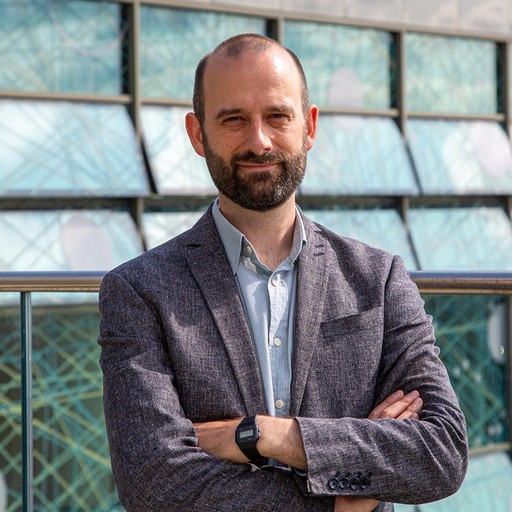
Linqi Luمشاهده پروفایل
استادیار
Linqi Lu is an Assistant Professor in the Department of Communication at the University of North Dakota. She holds her position in the College of Arts and Sciences, specializing in interdisciplinary research that bridges communication, computer science, and psychology. Her work focuses on multimodal framing, emerging AI technologies, and communication's critical role in advancing public health, social justice, and public safety. Ph.D. in Communication with minors in Computer Science and Educational Psychology University of Wisconsin-Madison, 2025 Dr. Lu's research interests span Human-AI Communication, Health Persuasion, Computational Social Science, Multimodal Framing, and Human-Computer Interaction. Her work demonstrates a strong interdisciplinary approach, connecting communication theory with practical applications in health technology and AI. She teaches courses including Risk and Crisis Communication (COMM 451) and Principles of Professional Communication (COMM 516). Her publication record shows a consistent trajectory of impactful research since 2020, with significant growth in 2022-2025. Her work primarily appears in high-impact health communication journals, with increasing focus on AI applications in communication research. Notably, she has published several 2025 articles exploring cutting-edge topics like multimodal LLaVA chatbots, visual framing in social protests, and advanced AI applications for content analysis. Through her Google Scholar profile, she has accumulated 247 citations with an h-index of 7 and i10-index of 6, indicating solid scholarly impact in her field. Dr. Lu frequently collaborates with researchers from the University of Wisconsin-Madison, including prominent scholars like Douglas McLeod and Dhavan Shah. Her research demonstrates strong connections between communication theory and practical applications in public health crises, particularly during the pandemic. She has secured research funding for projects related to health communication, risk perception, and digital interventions, though specific grant details aren't provided in the source material. Her work with interdisciplinary teams demonstrates her ability to bridge communication theory with computer science applications, particularly in developing AI tools for health communication research and interventions.