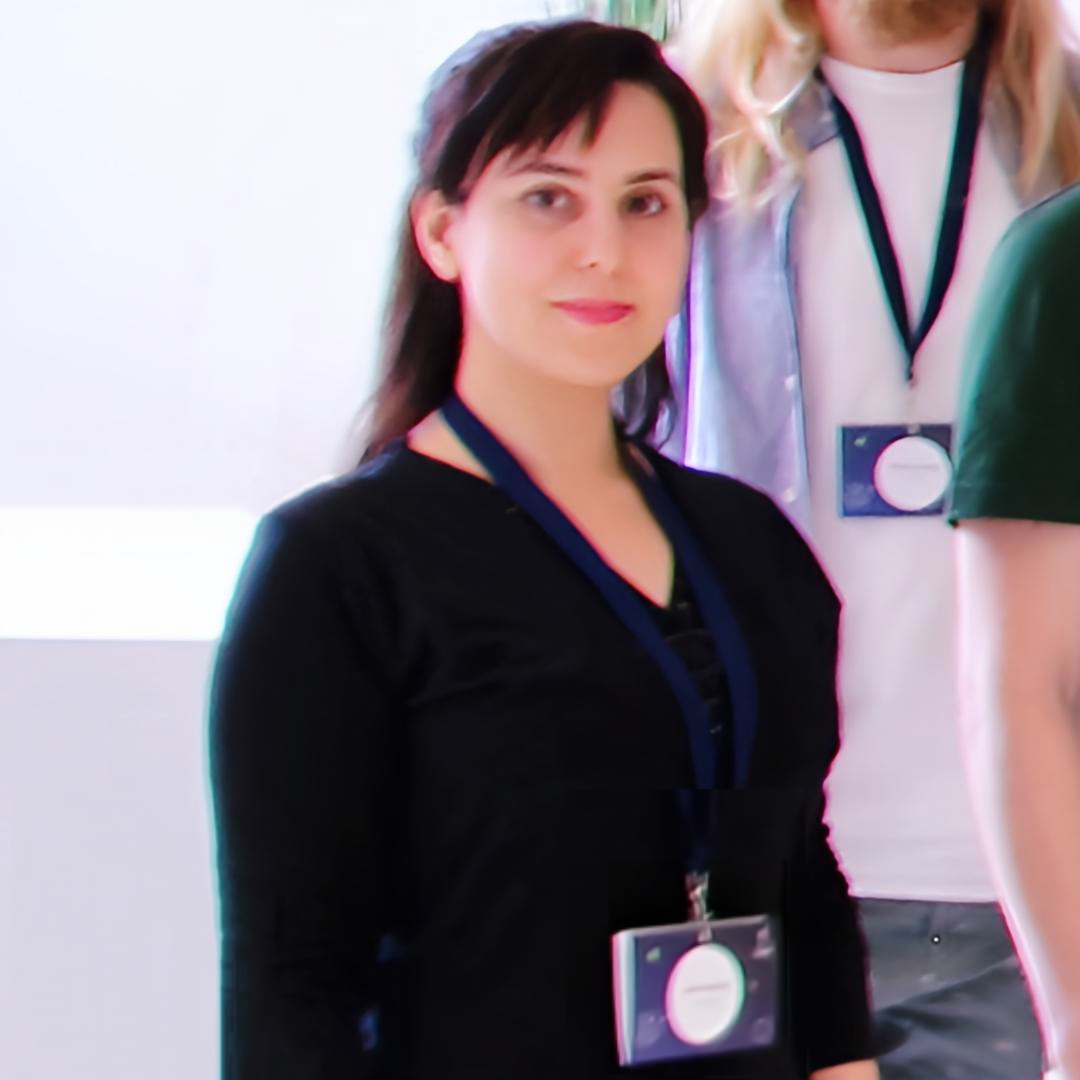
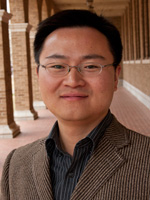
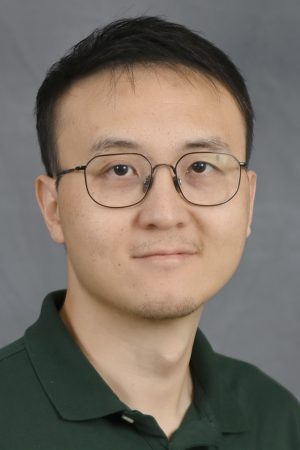
Sneha D. Goenka is an Assistant Professor at Princeton University in the Department of Electrical and Computer Engineering, with associated faculty status in the Computer Science department. She earned her Ph.D. from Stanford University (2024) and dual B.Tech./M.Tech. degrees from IIT Bombay (2017). Her research bridges computer systems architecture and computational genomics to develop accelerated genomic pipelines. Education : Ph.D. (Electrical Engineering, Stanford 2024), Dual Degree (IIT Bombay 2017) Her work focuses on optimizing genomic data processing through hardware-software co-design, achieving speedups in clinical and evolutionary genomics. She led the development of the world's fastest genome diagnosis technique using nanopore sequencing and cloud computing. Recent publications highlight her expertise in GPU/FPGA acceleration (SegAlign, Darwin-WGA) and ultra-rapid variant detection pipelines. Her research has been published in top venues like Nature Biotechnology , New England Journal of Medicine , and SC/HPCA conferences . Scientific Awards : Stanford Centennial TA Award (2024) ACM Heidelberg Laureate Forum Young Researcher (2024) Forbes 30 Under 30 (Science) (2023) NVIDIA Graduate Fellow (2022) Cadence Women in Technology Scholar (2021) She advises students in her lab and has collaborated with institutions like Stanford Medicine, NVIDIA Research, and D.E. Shaw Research. She also contributed to the Pratham satellite project at IIT Bombay.
François Trahay is a Full Professor in the Computer Science department at Télécom SudParis (Institut Mines-Télécom) and a member of the Benagil Inria team. He leads research in high-performance systems, runtime systems, and performance analysis for HPC and distributed systems. He holds an HDR from Institut Polytechnique de Paris and a PhD from University of Bordeaux (2009). His work includes the EZTrace framework for performance analysis and contributions to storage systems optimization. Education: 2021: Habilitation à Diriger des Recherches (HDR), Institut Polytechnique de Paris 2010: PostDoc at Riken, University of Tokyo 2009: PhD in Computer Science, University of Bordeaux 2006: MS in Computer Science, University of Bordeaux Research focuses on runtime system design, HPC trace analysis, and storage efficiency. Recent projects include PALLAS trace format (IPDPS 2025) and GPU performance prediction (Euro-Par 2024). He advises 4 current PhD students and has supervised 2 former students now in industry. Key contributions include: Co-developer of EZTrace performance analysis framework Co-author of 60+ peer-reviewed papers in top venues (IPDPS, IEEE Cluster, ICPP) Technical leadership in Inria's Benagil team and Samovar Lab
Atakan Aral is a Visiting Lecturer at the Department of Computing Science, Umeå University. His research focuses on Edge Computing, Edge AI, and the Internet of Things (IoT), with a particular emphasis on resource management and sustainable environmental monitoring. He is affiliated with the Autonomous Distributed Systems Lab and Green Distributed Computing Group, both part of the Wallenberg AI, Autonomous Systems and Software Program (WASP) initiative. His work spans theoretical frameworks and practical implementations in edge intelligence and distributed systems. Research Interests: Edge Computing architectures and workflows Neuromorphic and energy-efficient AI systems Federated learning and multi-cluster collaboration Sensor networks for environmental monitoring Optimization of resource allocation in distributed systems Key Publications Trends: Recent work emphasizes neuromorphic edge AI applications, hierarchical federated learning, and energy-efficient IoT deployments. His articles often intersect computing continuum concepts with real-world challenges like rural environmental monitoring and latency-critical systems. Scientific Awards: No awards explicitly listed in the provided text. Advising & Grants: No formal student advisees or grant details provided. However, he contributes to the De facto Center of Excellence in Autonomous Distributed Systems (2023–2029), indicating involvement in large-scale collaborative research. Labs & Teams: Member of the Autonomous Distributed Systems Lab (lead in distributed systems research) and Green Distributed Computing Group (focused on sustainability in computing).
Mian M. Hamayun is an Associate Professor of Computer Science and Head of Subject Group at the University of Birmingham Dubai campus, part of the College of Engineering and Physical Sciences. He holds a PhD in System Modelling, Simulation & Virtualization from the University of Grenoble Alpes, France, and has academic qualifications from Joseph Fourier University and COMSATS Institute of Information Technology, Pakistan. PhD in System Modelling, Simulation & Virtualization, University of Grenoble Alpes, 2013 MS in Informatics (Parallel & Distributed Systems), Joseph Fourier University, 2009 MSE in Software Engineering (Gold Medalist), COMSATS, 2005 PGCHE, University of Birmingham, 2021 FHEA and SFHEA, University of Birmingham (2021, 2024) His research spans Transaction Level Modeling (TLM) , MPSoC simulation , cloud computing , virtualization , Internet of Things/Vehicles , edge AI , and TinyML . He focuses on performance estimation, binary translation, and system-level simulation for embedded and distributed systems. The recent publications reflect a strong trend in IoT and vehicular networks , secure telemedicine , cloud orchestration , and embedded system simulation . His work integrates virtualization with security, real-time constraints, and machine learning on edge devices. Senior Fellow of the Higher Education Academy (SFHEA), 2024 Fellow of the Higher Education Academy (FHEA), 2021 Dr. Hamayun has supervised multiple research students and contributed to projects involving fatigue detection, person re-identification, retinal image analysis, and secure surgery frameworks. He has taught core computer science courses including Operating Systems, Networks, Data Structures, Algorithms, and Functional Programming at both undergraduate and postgraduate levels. His prior roles include Assistant Professor at NUST SEECS, R&D Engineer in France, and Lecturer at IUT1. He leads research in virtual prototyping and edge intelligence at the Dubai campus, contributing to smart city and cognitive systems initiatives. His lab work involves hybrid simulation environments, secure automotive platforms, and distributed IoT systems.
Swiss Federal Institute of Technology in LausanneSwitzerland
Tao Lin is a Tenure-Track Assistant Professor and Principal Investigator of LINs Lab at Westlake University, School of Engineering. He leads cutting-edge research in deep learning optimization, generalization, and robustness, particularly in distributed and federated settings. Prior to this, he was a Ph.D. student at École Polytechnique Fédérale de Lausanne (EPFL), Switzerland, under the supervision of Prof. Martin Jaggi and Prof. Babak Falsafi. Doctor of Science, School of Computer and Communication Sciences, EPFL, Switzerland (2017–2022) Master of Science, School of Computer and Communication Sciences, EPFL, Switzerland (2014–2017) Bachelor of Engineering (with honors), College of Electrical Engineering, Zhejiang University, China (2010–2014) His research focuses on the intersection of optimization and generalization in deep learning, leveraging theoretical and empirical insights into loss landscapes and training dynamics to design efficient and robust learning and inference methods. This includes work on decentralized and federated learning under noisy, heterogeneous, and hardware-constrained environments. His work spans algorithmic innovation, theoretical analysis, and practical system integration. The recent publications from his lab demonstrate a strong trend in advancing federated learning, efficient inference for large language models, multimodal foundation models in pathology, and robust training under distribution shifts. Key themes include communication efficiency, model personalization, gradient tracking, and hardware-aware learning. His group has published at top venues including NeurIPS, ICML, ICLR, CVPR, and ECCV, with several papers receiving oral or spotlight presentations. ECCV Best Paper Candidate, 2024 Top 2% Scientists Worldwide 2024 (Stanford University) Doctoral Program Thesis Distinction Award, EPFL, 2022 Outstanding Performance Bonus, EPFL, 2021–2022 Top Reviewer: NeurIPS, ICML, AISTATS He advises multiple Ph.D. and master’s students, including Yongxin Guo, Futing Wang, Peng Sun, and Yuxuan Sun, whose work has been accepted at premier conferences. He has secured competitive grants as PI and participant, including the National Natural Science Foundation of China for Excellent Young Scientists Fund (Overseas) and the Science and Technology Innovation 2030 – Major Project. He also contributes to the community through service as an area chair (NeurIPS, ICML), reviewer for top journals and conferences, and organizer of workshops and academic events. His open-source contributions, such as Post-local SGD, have been integrated into PyTorch. Tao Lin teaches graduate courses such as Research Methodology of Computer Science and Technology and Deep Learning at Westlake University. He is actively involved in academic governance, serving on committees for student seminars, academic exchange, doctoral studies, and teaching leadership. The LINs Lab runs a regular research seminar on Deep Learning and Optimization, fostering a collaborative and dynamic research environment.
Zahra Ebrahimi is a researcher in the field of approximate computing, reconfigurable accelerator design, and embedded systems. She joined the Chair of Embedded Systems at Ruhr University Bochum in April 2024, following her PhD research associate role at the Center for Advancing Electronics Dresden (Cfaed) from 2018 to 2024. Her work focuses on energy-efficient hardware/software co-design for edge-to-cloud computing, with applications in neural networks and bio-signal processing. She leads the BMBF-funded project X-DNet , collaborating with Huawei Research Center Munich. Education : B.Sc. and M.Sc. in Electrical Engineering from Sharif University of Technology, Iran Key Projects : ReAp (DFG), Re-Learning (ESF), X-ReAp (DFG), X-DNet (BMBF) Research Interests : Approximate computing, reconfigurable accelerators, embedded systems, SW/HW co-design, energy-efficient edge/cloud computing. Recent Trends : Zahra’s research emphasizes applying approximation techniques to neural networks for 5G/6G applications and designing specialized hardware like CGRAs for bio-signal processing and distributed computing. Collaborations : Academic-industry partnership with Huawei Research Center Munich.
Jianyi Cheng is a Lecturer in Computer Architecture at the School of Informatics, The University of Edinburgh, where he is affiliated with the Institute for Computing Systems Architecture. His work focuses on advancing computing systems through innovative hardware design and optimization. His research interests lie primarily in computer architecture and reconfigurable computing, with emphasis on FPGA-based acceleration, high-level synthesis, and energy-efficient system design. These areas are critical for next-generation computing platforms in domains such as AI, scientific computing, and embedded applications. The trends in his research, though not detailed in specific publications here, align with modern challenges in hardware-software co-design and domain-specific architectures. His work bridges the gap between theoretical algorithms and practical implementations on programmable logic. Jianyi Cheng has not been listed with any scientific awards in the provided text. He is actively involved in research within the Institute for Computing Systems Architecture, contributing to advancements in computing systems. While specific grants or advising roles are not mentioned, his position suggests engagement in research leadership and student supervision.
Jingjie Li is a Lecturer (Assistant Professor) in the School of Informatics at the University of Edinburgh, where he conducts interdisciplinary research at the intersection of computer systems, cybersecurity, and human-computer interaction. He is a member of the Institute for Computing Systems Architecture and the School of Informatics Ethics Committee. Ph.D. in Computer Engineering, University of Wisconsin-Madison (2017–2023) B.Eng. (R&D) with First-Class Honours, Australian National University (2015–2017) B.Sc., Beijing Institute of Technology (2013–2015) His research focuses on user-centric security and privacy , measuring human behavior in digital systems , and efficient human-machine interfaces . He investigates risks in emerging technologies such as smart homes, AR/VR, and AI systems, aiming to make them safer and more human-centric. His work combines technical innovation with behavioral insights to design practical privacy controls, measure digital risks, and build efficient computing platforms. The recent publications highlight a strong trend in privacy transparency , AI explainability , smart home and AR/VR security , and hardware-software co-design . His work frequently appears in top-tier venues including IEEE S&P, USENIX Security, ACM CHI, and ISCA, reflecting a consistent focus on both technical depth and human factors. Notable scientific awards include: ACM CHI Best Paper Award (2019) Facebook Trustworthy Products in AR, VR, and Smart Devices Award (2021) CPS Rising Star, NSF (2022) Generative AI Laboratory Seedcorn Award, University of Edinburgh (2024) Qualcomm Innovation Fellowship Finalist (2019, 2021) Jingjie Li actively supervises PhD students including Jiuming Jiang and Karen Jiamin Zheng, and co-supervises Lawrence Piao and Temima Hrle. He has received research support through fellowships such as the UW–Madison Chancellor’s Opportunity Fellowship and has collaborated globally with institutions including Max Planck Institute, Visa Research, and CSIRO. He serves on the program committees of major conferences like ACM CCS, USENIX Security, and ACM CHI. He leads a dynamic research team focused on systems security and human-centered computing, hosting undergraduate researchers and mentoring students through projects in privacy, AI transparency, and hardware security. His lab fosters interdisciplinary collaboration and real-world impact through community engagement, such as the 'Hack Your Age' workshop with intergenerational participants.
Zhu Zhichun is an Associate Professor in the Department of Electrical and Computer Engineering at the University of Illinois at Chicago, College of Engineering. His primary research focuses on computer architecture, performance modeling, and energy-efficient designing of computer systems. Ph.D. in Computer Science from College of William and Mary (2003) B.Sc. in Computer Engineering from Huazhong University of Science and Technology, China (1992) His research interests center around computer architecture , particularly in performance modeling and evaluation , energy-efficiency computer designs , and memory system optimization . He investigates techniques for improving power efficiency, thermal management, and bandwidth utilization in DRAM and PCM memory systems, with a focus on multicore processors and low-power designs. Zhu's publications demonstrate consistent work in memory architecture and power-efficient computing . Key trends include thermal modeling , DRAM optimization , and hybrid memory systems . His collaborations with Zhao Zhang, Jiang Lin, and other researchers highlight interdisciplinary approaches to solving computer architecture challenges.
Sandro Bartolini serves as Associate Professor in the Department of Information Engineering and Mathematical Sciences at the University of Siena, Italy, where he teaches advanced courses in computer architecture and parallel programming while leading cutting-edge research in high-performance computing systems. His academic journey began with a cum laude Laurea in Computer Engineering followed by a PhD in Computer Science and Engineering from Università di Pisa. Education: PhD in Computer Science and Engineering, Università di Pisa Laurea in Computer Engineering (cum laude), Università di Pisa Research Focus: His work centers on photonic interconnects for chip multiprocessors , energy-efficient software optimization for multi-core/GPU architectures, and performance-portable parallel programming models . Current investigations span cryptographic acceleration, blockchain algorithms, and hardware/software co-design for emerging computing paradigms, with strong emphasis on practical implementations bridging theoretical advances and real-world applications. Publication Trends: Recent publications (2019-2023) reveal three dominant threads: (1) Photonic network innovations addressing energy bottlenecks in chip multiprocessors, (2) The PHAST library ecosystem enabling seamless CPU/GPU programming across domains from autonomous vehicles to UAV navigation, and (3) Hardware accelerator designs for convolutional networks and cryptographic workloads. These works consistently target performance-portability challenges in heterogeneous computing environments. Grants and Collaborations: As principal investigator for the Italian Ministry-funded PHOTONICA project, he established international research partnerships with Murcia University, Columbia University, and Hong Kong University of Science and Technology, while securing industry collaborations with STMicroelectronics, Intel Munich, IBM, and IMEC. He has also managed complex IT system deployments for Siemens Italy, RAI (Italian public broadcasting), and SpaceDys. Academic Leadership: Bartolini serves as Associate Editor for the Eurasip Journal of Embedded Computing and actively contributes to the European HiPEAC network. His research group at Siena maintains strong industry ties for technology transfer, particularly in photonic interconnect validation and parallel programming frameworks for next-generation computing systems.
Dr. Yong Chen is a Professor and Interim Department Chair in the Computer Science Department at Texas Tech University (TTU), where he founded the Data-Intensive Scalable Computing Laboratory (DISCL). He also serves as Co-Director of the NSF Cloud and Autonomic Computing Center (CAC@TTU), focusing on data-intensive computing, high-performance computing (HPC), cloud systems, and parallel/distributed architectures. His research bridges hardware-software co-design for scientific and enterprise applications. Ph.D., Computer Science, Illinois Institute of Technology (2009) M.S., Computer Science, University of Science and Technology of China (2003) B.E., Computer Engineering, University of Science and Technology of China (2000) Dr. Chen's research spans data-intensive computing, HPC, cloud systems, and parallel architectures. He develops scalable solutions for scientific discovery and enterprise computing, emphasizing systems software, storage optimization, and hardware-software co-design. His work addresses challenges in metadata management, 3D-stacked memory, and efficient resource allocation in distributed environments. Recent publications include studies on 3D-stacked memory optimization (IEEE TC), metadata indexing (SC), and parallel file system reliability (ICS). His work is characterized by interdisciplinary collaboration and practical applications in HPC domains. NSF-TCPP Early Adopter Status Award Best Paper Award (IPDPS'21) Outstanding Teaching Assistant, IIT (2006) Dr. Chen advises students through graduate and undergraduate research assistantships at DISCL and CAC@TTU, offering financial support for qualified candidates. He has contributed to major conferences as Program Co-Chair (ICPP) and Committee Member (IPDPS, CCGrid, ISC, HPCAsia). Labs/Teams: Data-Intensive Scalable Computing Laboratory (DISCL), NSF Cloud and Autonomic Computing Center (CAC@TTU).
Charles McGuffey is an Assistant Professor in the Computer Science Department at Reed College, part of the Division of Mathematical and Natural Sciences. He joined Reed in 2021 following a Ph.D. in Computer Science from Carnegie Mellon University and dual bachelor’s degrees in Computer Engineering and Computer Science from Clarkson University. Education: Ph.D. in Computer Science (Carnegie Mellon University, 2021); B.S. in Computer Engineering and Computer Science (Clarkson University, 2016). His research focuses on computer systems and algorithm design, particularly hardware-software interactions for performance optimization. Key areas include Processing-in-Memory (PIM) , caching techniques, memory hierarchy management, and non-volatile memory systems. He explores understudied aspects of computer design to enhance practical efficiency. Recent publications emphasize kd-trees , trie structures , and algorithms for asymmetric memory systems. Topics like spatial locality , granularity change , and writeback-aware caching reflect his work on memory-centric computing. He engages in summer research projects supported by Reed’s Summer Scholarship Fund, focusing on innovative computer systems and algorithm development.
University of North Carolina at CharlotteUnited States
Dr. Ke (Cory) Wang serves as Assistant Professor at the University of North Carolina at Charlotte in the Department of Electrical and Computer Engineering, where he conducts research in computer architecture and parallel systems. Ph.D. in Computer Engineering (2022), George Washington University M.Sc. in Electrical Engineering (2015), Worcester Polytechnic Institute B.Sc. in Computer Science (2013), Peking University His research focuses on machine learning-enabled computer architecture with emphasis on network-on-chip design , domain-specific accelerators , and cross-layer optimization for manycore systems. Specific areas include anomaly detection, graph neural network acceleration, and fault-tolerant communication frameworks. Recent publications demonstrate increasing integration of deep learning techniques with traditional architecture design, particularly for graph convolutional networks and heterogeneous systems . His work addresses multi-objective optimization across performance , energy efficiency , and security dimensions . Key scientific recognitions include: National Science Foundation award (CSR: Small: Cross-layer Design, 2023) National Science Foundation award (CRII: SHF: Flexible Design Framework, 2023) Dr. Wang leads the Intelligent Computer Architecture & Systems Laboratory , which develops advanced frameworks for network-on-chip optimization and AI-driven system design.
Carliss Y. Baldwin is the William L. White Professor of Business Administration at the Harvard Business School. She specializes in corporate finance and real options theory, with a focus on the financial consequences of modular design in hardware and software systems and their impact on economic institutions. Education: MIT (BSc in Economics, 1972), Harvard Business School (MBA, DBA) Her research explores how modular architectures enable flexibility, scalability, and innovation in the computer industry, as detailed in her co-authored book Design Rules: The Power of Modularity . She also investigates the interplay between design principles and economic value creation, emphasizing the role of organizations in implementing and commercializing designs. Baldwin has served on Harvard University's joint Ph.D. program in Information Technology and Management and currently teaches courses like Acquisitions & Alliances at the MBA level. Beyond academia, she contributes to the Climate Neutral Network and Madeira School as a director and trustee, respectively.
Dr. Viktor Melnyk serves as an Assistant Professor in the Department of Applied Computer Science at the Institute of Mathematics, Informatics and Landscape Architecture within the Faculty of Natural Sciences and Technology at John Paul II Catholic University of Lublin. His academic activities span teaching, research, and extensive student supervision across multiple years. His research interests focus on cybersecurity, cryptography, and FPGA-based systems, with particular expertise in wireless network security (especially IEEE 802.15.4), hardware acceleration, and machine learning applications in electronic design. His work bridges theoretical computer science with practical security implementations, evident in his numerous publications and student thesis topics. Analysis of Dr. Melnyk's recent publications reveals a consistent focus on hardware security implementations, particularly for low-rate wireless networks and reconfigurable computing systems. His research trajectory shows increasing integration of machine learning techniques with traditional security protocols, reflecting broader trends in the field. The publications demonstrate both theoretical depth and practical implementation focus, with many papers addressing specific hardware implementations. Dr. Melnyk has served as an Independent External Expert for evaluating grant proposals in the European COST Open Call competition, indicating professional recognition of his expertise. His contributions to the academic community extend to reviewing numerous scientific articles across various domains including biomedical data processing, cyber-physical systems, and cloud computing. His academic advising is exceptionally active, with documentation of supervising over 100 diploma theses from 2015 through 2025 across both Bachelor's and Master's levels. The thesis topics consistently align with his research interests, covering cybersecurity, cryptography, network security, and hardware implementations. He teaches courses including 'Operating Systems,' 'Network Data Protection Technologies,' and 'Multimedia Systems,' with teaching materials adapted for remote delivery during the pandemic period.