Maureen Garvey is an Associate Professor and Coordinator of Reference Services at the College of Staten Island (CUNY). She holds Master's degrees in political philosophy from the National University of Ireland and Library Science from City University London. Her career includes roles at institutions like Bank Street College of Education, the Library Council of Ireland, and John Jay College. Her research focuses on library services innovation, particularly in virtual reference systems, public policy impacts on libraries, and resource-sharing practices in resource-constrained environments like Cuba. She advocates for student information literacy to improve retention and success. Key publications include studies on pandemic-era library adaptations, neoliberal policies in Irish libraries, and collaborative teaching methods. Garvey emphasizes libraries' societal role through scholarly contributions and practical initiatives.
Benjamin Garner serves as Associate Professor of Marketing in the College of Business at the University of Central Arkansas (UCA), maintaining an active research program from his office in COB 312I. His contact information includes email bgarner3@uca.edu and phone (501) 450-5329, reflecting ongoing institutional affiliation. Dr. Garner's research centers on consumer behavior in experiential marketing contexts with three primary thrusts: Social media engagement dynamics in wine tourism and farmers' markets Authenticity construction through scarcity and sustainability messaging Innovative business education pedagogy including flipped classroom methodologies Analysis of his 2021-2025 publications reveals consistent methodological emphasis on ethnographic observation and text-mining of user-generated content across platforms like Facebook, Instagram, and Twitter. His work uniquely bridges agricultural marketing contexts with digital communication strategies, particularly examining how language structures influence consumer perceptions of authenticity. No scientific awards or student advising information appears in available records. Similarly, grant funding details and laboratory affiliations remain undocumented in the provided materials, though his publication output indicates sustained research activity across multiple scholarly domains.
Mia Minnes is a Teaching Professor and the Vice Chair for Undergraduate Education in the Computer Science and Engineering Department at UC San Diego's Jacobs School of Engineering. She teaches discrete math for CS, introduction to computability, and TA training classes, while leading initiatives that connect academic learning with professional development. Her research focuses on Automata Theory and Computability education, Scholarship of Teaching and Learning (SoTL), and projects supporting student professionalization pathways including industry internships, peer mentor development, and ethics in computing. She has pioneered initiatives like the Summer Internship Symposium and CSE-PACE (Peer-led Academic Cohort Experiences) to enhance student experiences in large computing programs. Minnes' publication portfolio reveals strong trends in computing education research, particularly in internship experiences, TA professional development, assessment methods, and interventions for large classes. Her work consistently bridges theoretical computer science with practical educational applications, demonstrating a commitment to evidence-based teaching practices and student success metrics. UC San Diego Academic Senate Distinguished Teaching Award (2020) Jacobs School of Engineering Teacher of the Year (2013-2014) Multiple NSF grants as PI including DUE-2337253 (2024-2027) UC San Diego Student Centeredness Award (2023-2024) Teaching+Learning Commons Faculty Fellow (2018-2019) She has advised numerous undergraduate and graduate students through research projects examining internship disparities, TA professional development, educational technology tools, and student experiences in computing programs. Her leadership extends to projects like FlapJS (an interactive visualization tool for formal computation), ComputingPaths (resources for computing career paths), and OCCTIVE (supporting computational problem solving in non-CS courses).
Ashkan Jahanbani Ghahfarokhi is an Associate Professor in Reservoir Engineering at NTNU’s Department of Geosciences since 2019. He leads the CEORS Gemini Centre (CO2 Enhanced Oil Recovery & Storage) and is a core member of the BRU21 Reservoir Management group. His research focuses on data-driven subsurface modeling, CO2 storage, and optimization of oil recovery processes. Education: PhD, NTNU (2015); MEng, University of Calgary (2009); MSc/BSc, Petroleum University of Technology, Iran (2006–2009). Roles: Head of Reservoir Engineering Group (2021–2022), Project Manager for NORHED II (2022), and NTNU’s Outstanding Academic Fellow (2022–2026). Research interests include CO2-EOR/Storage, machine learning applications, proxy modeling, and reservoir simulation. He has supervised 20+ students and published over 40 journal/conference papers. Awards include DNVA postdoc scholarship (2015–2017) and PoreLab postdoc (wettability studies). Teaching: Masters/PhD courses in reservoir fluids, simulation, and geomechanics. Guest editor for Energies (AI in Oil & Gas).
Dr. Diane Tepylo is an Associate Teaching Professor at the Faculty of Education, Ontario Tech University. She is located at Charles Hall, Room 336 in the Downtown Oshawa campus. Her contact information includes the email diane.tepylo@ontariotechu.ca and phone number 905.721.8668 ext. 3768. Dr. Tepylo holds a PhD in Applied Psychology and Human Development from the Ontario Institute for Studies in Education (OISE), focusing on mathematics teaching and learning within STEM fields. Her research interests include Coding and K-12 education, Inclusive mathematics education (particularly for at-risk students, English language learners, and culturally responsive pedagogy), Learning through technology, Spatial reasoning in STEAM education, and STEAM teacher development for both pre-service and in-service educators. She emphasizes innovative pedagogical approaches, such as flipped classrooms and problem-solving challenges to enhance student engagement and learning outcomes. Dr. Tepylo teaches a diverse range of courses across multiple programs, including: Bachelor of Commerce: BUSI 1915U (Business Mathematics I) Bachelor of Education: EDUC 1311U and EDUC 2408U (Coding and Communication), CURS 4140U and CURS 4141U (Mathematics Curriculum Studies) Bachelor of Arts, Educational Studies: EDST 1000U (Foundations of Learning), EDST 1100U (Problem and Inquiry-Based Learning), EDST 3170U (Developing Numeracy), EDST 4000U (Inquiry and Professional Practice), EDST 4120U (Games and Simulations for Learning), EDST 4610U (Coding and Maker Pedagogies for Young Children) No scientific awards or grants are explicitly mentioned in the provided information. Her work focuses on bridging educational theory and practice, with a strong emphasis on student-centered learning and technology integration.
Ramón Luis Rizo Aldeguer is a University Professor in the Department of Computer Science and Artificial Intelligence at the Higher Polytechnic School of the University of Alicante. He has held this position since 1996 and continues to be actively involved in teaching and research as recently as 2025. He previously served in various leadership roles including Director of the Department of Computer Science and Artificial Intelligence (1997-2004) and Deputy Director of the Institutional Projects Area at the University of Alicante (2012-2020). His educational background includes a PhD in Computer Science from the Polytechnic University of Valencia (1992) and a degree in Mathematics from the University of Valencia (1977). He has been a member of the Spanish Association for Artificial Intelligence since 1990 and has held leadership positions within the organization. Rizo Aldeguer's research focuses on artificial intelligence with particular emphasis on swarm robotics, UAV deployment, and deep reinforcement learning. His work bridges theoretical foundations with practical applications in robotics and autonomous systems. He has made significant contributions to educational methodologies, particularly in integrating computational tools into engineering education. His publication record shows a consistent trajectory in swarm intelligence and robotics, with recent publications (2018-2023) demonstrating increasing sophistication in applying deep reinforcement learning to complex multi-agent systems. His research spans both theoretical advancements and practical implementations in robotics and autonomous systems. Fifteen five-year research periods (trienios) Six teaching merit periods Five six-year research periods (sexenios) President of Organizing Committee of VI Conference of Spanish Association for Artificial Intelligence (1995) President of Scientific Committee of CAEPIA (1999) Rizo Aldeguer has supervised 14 doctoral theses, with many receiving the highest honors (SOBRESALIENTE CUM-LAUDE). He has participated as a researcher in over 30 competitive public research projects, serving as principal investigator in 12 of them. His educational projects include innovative teaching methods and the development of computational tools for engineering education. He has been instrumental in the design and implementation of computer science programs at both the University of Alicante and the Polytechnic University of Valencia. He is a founding member of the University Institute for Computer Research and directed the Industrial Computing and Artificial Intelligence research group from 1992 to 2004. His current research continues to focus on swarm robotics and intelligent systems, with active participation in the Valencian Graduate School and Research Network of Artificial Intelligence since 2021.
Emanuel V. Towfigh is a Professor specializing in legal education research, actively contributing to scholarly discussions on legal didactics and empirical approaches to teaching law. His work examines the evolving landscape of legal education, particularly focusing on digitalization, individualization of teaching methods, and empirical assessment of educational effectiveness. Professor Towfigh's research interests center on the intersection of legal scholarship and educational methodology. His work investigates: The impact of digital tools and blended learning approaches on legal education Empirical assessment methods for evaluating teaching effectiveness in law The "empirical turn" in legal scholarship and its implications for legal education Innovative teaching formats including flipped classrooms and e-learning platforms The tension between academic penetration of legal education research and practical reform debates Implementation of evidence-based teaching approaches within traditional legal education frameworks His recent publications demonstrate a consistent focus on how empirical research can inform and improve legal education practices. Towfigh examines both theoretical foundations and practical applications of teaching methodologies, with particular attention to how digital transformation is reshaping legal pedagogy. His work frequently addresses the challenges of implementing evidence-based approaches within traditional legal education structures and analyzes large-scale initiatives like the iurreform survey with 12,000 participants. Professor Towfigh has been actively involved in organizing and contributing to online symposiums that bring together scholars at all career levels to discuss innovations in legal education. These symposiums have addressed critical questions about which didactic innovations prove most effective and where potential for improvement exists in legal pedagogy, emphasizing the importance of reliable empirical findings for meaningful educational reform.
Itahisa Pérez Pérez is a Spanish education researcher who served as a faculty member in the Department of Education and Social Psychology at Universidad Pablo de Olavide (Seville, Spain) between 2009 and 2022. Affiliated with the research groups GIAS (Grupo de Investigación en Acción Socioeducativa) and GEDUPO , she has produced an extensive scholarly record spanning HIV-prevention education, community development, socio-cultural animation, and innovative pedagogies aligned with the United Nations Sustainable Development Goals. Education PhD in Education, Universidad Pablo de Olavide, 2013 – Thesis: "Conocimientos y prácticas de riesgo en VIH-SIDA: una estrategia de Cooperación en Educación para el Desarrollo en Nicaragua" (Supervised by Dr. Juan Agustín Morón Marchena). Research Interests Her scholarly agenda has evolved from early work on HIV-risk behaviours and Nicaraguan youth to a current focus on innovative higher-education methodologies (mind-mapping, flipped classroom, cooperative learning) and the integration of the 2030 Agenda into university curricula. She explores how University Social Responsibility can drive holistic, value-centred educational innovation, and she has become a leading voice in mapping university resources against SDG indicators. Publication Trends Between 2020 and 2023 she authored or co-authored more than twenty peer-reviewed articles, all clustered around three dominant themes: (1) pedagogical innovation (mind maps, flipped classroom, jigsaw techniques), (2) sustainability in higher education (SDGs, social curriculum, best-practice guides), and (3) community-oriented socio-educational action (socio-cultural animation, diversity attention, HIV education). This recent surge reflects a strategic pivot toward institutional transformation and policy-oriented research. Scientific Awards & Recognition No competitive awards or fellowships are explicitly mentioned in the supplied documents. Advising & Grants No doctoral or master’s students are listed, and grant details are absent from the provided sources. Labs, Teams & Networks She has collaborated within GIAS and GEDUPO at Universidad Pablo de Olavide, and her recent publications indicate ongoing cooperation with colleagues at the University of La Laguna , suggesting a cross-institutional network focused on SDG-aligned educational innovation.
Jessica Young Schmidt is an Associate Teaching Professor in the Department of Computer Science at North Carolina State University, serving as ABET Coordinator since 2017 and Course Coordinator for CSC226: Discrete Mathematics. Her primary focus is undergraduate education, particularly CSC116: Introduction to Computing – Java and CSC226, where she implements flipped classroom models and comprehensive end-of-semester exercises. Her educational background includes: Ph.D. in Computer Science, North Carolina State University, 2012 M.S. in Computer Science, North Carolina State University, 2009 B.S. in Computer Science and Mathematics, Roanoke College, 2007 Dr. Schmidt's research centers on computer science education, emphasizing active learning, instructional design, and software engineering pedagogy. She has pioneered methods like collaborative software engineering exercises for CS1 materials and frameworks for assessing critical thinking, with her work on end-of-semester integration earning a SIGCSE 2020 award. Her publications reveal an evolution from privacy policy analysis (2009-2012) toward educational innovation in recent years. Her scholarly contributions demonstrate consistent focus on curriculum development and assessment, particularly in integrating software testing throughout computer science education and enhancing student comprehension through structured reflection. She has received the following recognition: Third Best Paper, SIGCSE 2020 Technical Symposium (Experience Reports and Tools Track) As ABET Coordinator, Dr. Schmidt drives curriculum assessment and continuous improvement, while her CSC226 coordination ensures pedagogical consistency across sections. Her teaching innovations directly support student success in foundational computer science concepts.
Susan Smith is a Visiting Professor in the Department of Accounting and Finance at the University of Sussex Business School, where she also serves as Associate Dean (Education and Students). With extensive experience bridging professional practice and academia, she contributes significantly to both the accountancy profession and higher education sectors through her leadership roles and scholarly work. Dr. Smith holds an LLB in Law from The University of Edinburgh and is a Fellow of the Institute of Chartered Accountants in England and Wales (FCAEW). She is an elected member of the ICAEW Council representing the South East and serves on the ICAEW Ethical Standards Committee, placing her at the forefront of strategic decisions within the profession. Additionally, she is a director of the Chartered Accountants Trustees Limited, which manages ICAEW charitable trusts supporting educational activities. Her research focuses on the intersection of professional accountancy practice and academic education, examining governance within professional bodies, the scholarship of teaching and learning, and innovative approaches to accounting education. She has conducted significant research on staff-student partnerships, education-focused academic career pathways, and the transition from professional practice to academia, with particular attention to how these elements can be integrated to enhance educational outcomes. Dr. Smith's recent publications demonstrate a consistent focus on educational innovation within accounting and business education. She has explored staff-student partnerships, co-creation of assessment criteria, and the development of new career pathways for education-focused academics. Her work also includes case studies on corporate failures like Thomas Cook and Carillion, connecting theoretical frameworks with practical applications in accounting education. Dr. Smith has received significant recognition for her contributions to education: CMBE (Certified Management and Business Educator) Senior Fellow of the Higher Education Academy Learning Together award (2019 University Education Awards, shared with students Andrew Donald and Yuki Kikuri) As Associate Dean (Education and Students), Dr. Smith oversees educational strategy and student experience at the Business School. She was instrumental in developing the Certified Management and Business Educator designation through her work with the Chartered ABS. Her advising focuses on supporting students through initiatives like the 'Pop Up Accounting Cafe' where she offers weekly consultations and has developed frameworks for building community through staff-student partnerships. Dr. Smith maintains active connections with the Institute of Chartered Accountants in England and Wales, serving on multiple committees that influence both the accounting profession and higher education policy. Her work bridges the gap between professional practice and academic education, with a particular focus on how professional accountancy bodies can better connect with academic institutions to enhance educational quality and professional development.
Lasse Heikkinen is a Senior Lecturer at the Department of Technical Physics, Faculty of Science, Forestry and Technology, University of Eastern Finland. His work spans applied physics, process tomography, and educational technology, with a focus on innovative teaching methods like flipped classrooms during the pandemic. Current Role: Deputy Head of Department, Senior University Lecturer Research Themes: Electrical impedance tomography for industrial processes, flipped teaching frameworks, and physics education adaptation to remote learning. Recent publications highlight his dual expertise in process tomography (gas-solid flows, pharmaceutical monitoring) and pedagogical innovation (learning analytics, flipped classrooms). He has contributed to educational manuals and toolkits for teacher training. Key Projects: Technology education infrastructure development (2015–2024), pandemic-era teaching adjustments (2022). Collaborations: Active in international process tomography conferences and multidisciplinary teams like the Ameba project.
Prof. Gabriele Kaiser is a Full Professor of Mathematics Education at the University of Hamburg’s Faculty of Education. She holds a part-time professorship at the Norwegian University of Science and Technology and an honorary professorship at the Australian Catholic University (ACU). Her research focuses on mathematical modeling, teacher professional competence, and comparative studies in education (East-West). She led the ICME-13 conference in 2016 and serves as former Editor-in-Chief of ZDM Mathematics Education. Key contributions include the TEDS research program on teacher education and the development of video-based assessment tools for teacher noticing. Awards include top Springer downloads for her edited volumes and leadership in international educational initiatives. Roles: Chair of ICME-13, Editor of ZDM, ICMI Representative, ICTMA President Affiliations: University of Hamburg, ACU Brisbane, University of Macau collaborations Research Interests: Mathematical modeling, teacher education, inclusive mathematics, flipped classrooms, and cross-cultural studies Her work emphasizes innovation in teacher training, classroom observation methodologies, and addressing diversity in mathematics education. Recent projects include studies on Chinese and German teachers’ competencies and the use of AR/VR in STEM education. Awards: Honorary professorships in Australia and Hong Kong, board member of Hamburg Scientific Foundation, and recognition for impactful publications.
Remigijus Bubnys is a Professor and Chief Research Worker at Vilnius University Šiauliai Academy, Lithuania. He holds a PhD in Education Studies and has held academic positions at multiple institutions including Vilnius University and Kaunas University of Technology. His research focuses on higher education didactics, reflective learning, and organizational culture in educational settings. He has supervised the 'Teacher Education and Teaching Processes' research group and served as Deputy Chairman of the Academy's Council. Education includes: PhD in Social Sciences (Education Studies) from Šiauliai Academy (2005–2009), Master's in Primary School Teaching (1997–1999), and a Bachelor's in Psychology (2001–2005) from Vytautas Magnus University. Research emphasizes critical thinking development, teacher professional identity, and experiential learning methods. He has authored/co-authored over 50 publications since 2019, focusing on educational innovation, sustainable development through cooperative learning, and organizational dynamics in schools. His work bridges qualitative methodologies with practical applications in teacher training and institutional change. Professional activities include editorial roles for journals like Social Welfare: Interdisciplinary Approach and involvement in national education evaluation committees. He has also served as a Visiting Professor at Poland's Pedagogical University of Kraków (2019–2020).
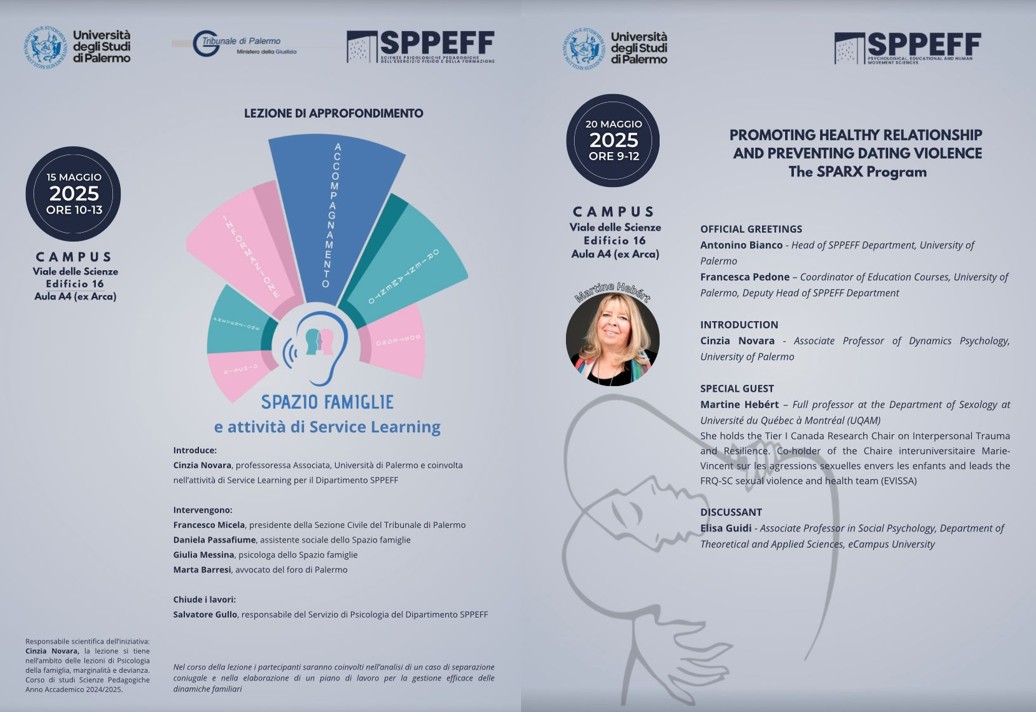
Cinzia Novara is an Associate Professor in the Department of Psychological, Pedagogical, Physical Exercise and Training Sciences at the University of Palermo. She is actively engaged in teaching and research, focusing on community psychology, family dynamics, intercultural education, and youth mental health. Her teaching includes courses such as Family Psychology, Marginality and Deviance, and Network Interventions in Community Work. Her research interests center on community wellbeing, migration, school inclusion, and the psychological impact of digital technologies. She explores how social support, school climate, and intercultural dynamics influence the lives of adolescents, migrants, adopted children, and LGBTQ+ individuals. Her work often integrates participatory methods and service learning to foster social transformation. Her recent publications (2023–2025) show a strong focus on emotional intelligence, vulnerable narcissism, social media use, and the psychological effects of the pandemic on university students. The research consistently emphasizes community resilience, inclusion, and the role of educational environments in shaping psychological outcomes. Themes such as sense of community, coping strategies, and identity in multicultural families recur across her work. Scientific Projects: PRIN 2022 - CURA: Children as vulnerable users of IoT and AI-based technologies T@les at home - Multilingual Families Erasmus K2 Project “CARE” CORI 2017 & 2019: Civic engagement and migrant acculturation Micropolis: Community welfare model Prevention of pathological addictions among university students Work Addiction and Community Psychology Family Space and Service Learning She supervises internships and thesis work, advising students through direct engagement and institutional portals. She leads initiatives under the Third Mission of Unipa, including the UNIPA Parents' Service and Family Space, promoting community-based learning and social inclusion. Her projects often involve cross-cultural collaboration, particularly with Spain, and focus on building inclusive educational cultures.
Tristan Wallhead is a Professor in the Division of Kinesiology and Health within the College of Health Sciences at the University of Wyoming, specializing in Physical Education Teacher Education (PETE). Originally from England, he joined the university after completing his PhD at The Ohio State University in 2004 and was promoted to Professor in 2017. He currently serves as Vice President of the international AIESEP organization and leads the Pedagogical Sciences Research Lab. His educational credentials include: Ph.D. in Sport and Exercise Education from The Ohio State University (2004) M.S. from Leeds Metropolitan University (2000) B.S. (Hons) from Loughborough University (1997) Wallhead's research centers on sport pedagogy , particularly the impact of instructional models like Sport Education on student motivation and physical activity participation. His work investigates physical literacy development , teacher occupational socialization, and innovative pedagogical approaches across K-12 and university settings. He examines how emotional experiences, cognitive achievement, and physical outcomes intersect in physical education environments. Analysis of his 2022-2023 publications reveals consistent focus on Sport Education implementation, teacher professional development, and physical literacy assessment. His research frequently involves international collaborations (notably in Hong Kong) and addresses practical applications through multi-institutional studies examining student outcomes, teacher dispositions, and program effectiveness. His distinguished awards include: SHAPE Research Fellow (2013) Central District SHAPE Scholar Award (2016) Multiple Outstanding Reviewer recognitions (2014-2018) CHS Meritorious Service Award (2021) Wallhead mentors Master's students in PETE and has secured substantial research funding, including a $125,719 Outride Foundation grant on Riding for Focus in Physical Education (2020-2023) and two Hong Kong-based projects totaling over $122,000 investigating Sport Education's impact on physical literacy. His grant work emphasizes community partnerships and cross-cultural applications of pedagogical models. He directs the Pedagogical Sciences Research Lab, which develops evidence-based physical education practices through empirical research on instructional models, teacher development, and student engagement metrics across diverse educational contexts.