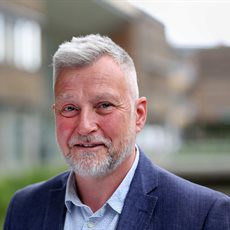
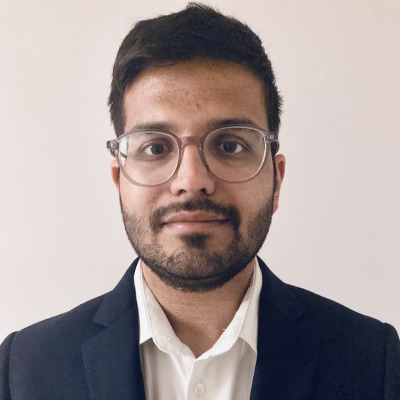
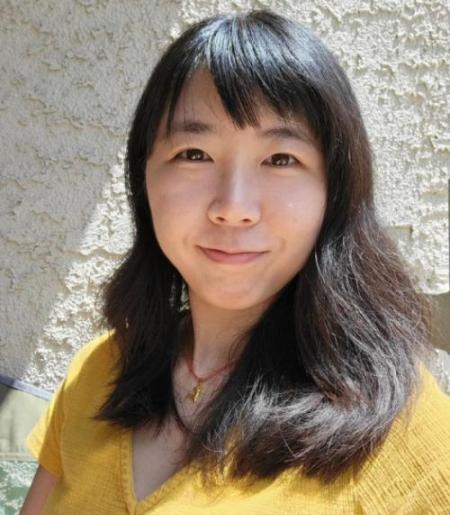
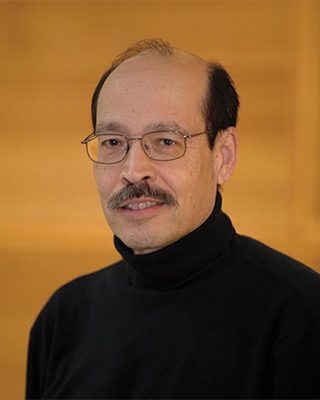
Dr. Daniel Read is a Senior Lecturer at the Institute for Sport Business , Loughborough University London. His interdisciplinary research addresses critical integrity issues in sport through qualitative and quantitative methodologies, focusing on athlete welfare, governance, sponsorship, fan behavior, and digital media. PhD in Sport Business (Loughborough University London) MRes in Psychology BSc in Sports Science and Physiology Dan's current projects examine: Athlete welfare (care-seeking behavior, medicine misuse, education) Commercial innovation vs. sporting tradition Digital divide impacts on sport access 21st-century sport governance He collaborates with organizations such as the World Anti-Doping Agency , FIFA , World Rugby , and the Professional Footballers’ Association . His teaching expertise spans research methods, data analytics, sport integrity, and digital media, alongside PhD supervision.
Scott McCabe is a Professor of Marketing at Birmingham Business School, University of Birmingham. He earned his PhD from the University of Derby in 2001, focusing on visitor motivations in the Peak District National Park, and holds an MA in Leisure and Tourism Studies from the University of North London (1993) and an HND in Leisure Studies from the University of Salford (1991). Current co-editor in Chief of the Annals of Tourism Research Editorial board member of Tourism Management Elected fellow of the International Academy for the Study of Tourism (2019+) His research spans social tourism , responsible tourism , tourist emotions , and socio-linguistic methodology , with significant work on wellbeing outcomes from supported holidays for disadvantaged families. He has contributed to Annals of Tourism Research , Journal of Travel Research , and other top-tier journals. Recent publications address topics like qualitative research sampling , tourism theory , dark tourism motivations , and smart destination engagement . His work combines tourism policy critique , consumer behavior analysis , and methodological innovation . Scientific awards include fellowships and leadership roles in international tourism research committees. He has served as VP for the International Sociological Association's Tourism Research Committee and co-chairs the Academy of Marketing's Tourism Marketing SIG.
Dr. Todd D. Murphey is a Professor of Mechanical Engineering at Northwestern University's Robert R. McCormick School of Engineering and Applied Science. He serves as Director of Transformative Research and Director of the Master of Science in Robotics Program at Northwestern, leading initiatives in computational dynamics, control systems, and robotics. His work bridges engineering, neuroscience, and biomedical applications, with a focus on developing systems that interact effectively with humans and their environments. Dr. Murphey received his Ph.D. in Control and Dynamical Systems from the California Institute of Technology in 2002, with a thesis titled "Control of Multiple Model Systems." Prior to that, he earned a B.S. in Mathematics, summa cum laude, from the University of Arizona in 1997. Dr. Murphey's research centers on computational methods in dynamics and control, with applications spanning neuroscience, health science, robotics, and automation. His work in the Interactive & Emergent Autonomy Lab focuses on computational models of embedded control, biomechanical simulation, dynamic exploration, and hybrid control. The group develops mathematical approaches that lead to orders of magnitude improvement in computational efficiency for real-time implementation. Key application areas include assistive exoskeleton control, stabilization of energy networks, bio-inspired active sensing, entertainment robots, robotic exploration, and software-enabled stroke rehabilitation. Analysis of Dr. Murphey's recent publications reveals a strong emphasis on human-swarm interaction, algorithmic matter, and control of cyber-physical systems in uncertain environments. His work increasingly integrates information theory with physical systems, exploring how both autonomous and biological systems interact with environments to learn and improve behaviors. Recent trends show growing applications in rehabilitation technology, with particular focus on human-machine interaction in biomedical devices and embodied intelligence. Dr. Murphey has received numerous honors and awards for his contributions to robotics and engineering: Named Director of Transformative Research at Northwestern University (2025) Appointed IEEE Robotics and Automation Society Vice President of Publication Activities (2022) Co-recipient of Best Paper Award for IEEE Transactions on Robotics (2020) Appointed to Air Force Scientific Advisory Board (2019) Recipient of ABB Best Student Paper Award for CPL-SLAM research (2019) Cole-Higgins Award from Northwestern Engineering (2015) Dr. Murphey has supervised numerous graduate students including Taosha Fan, Giorgos Mamakoukas, and Ian Abraham, with research spanning robotic exploration using electrosense and mechanical contact, human-in-the-loop control, and shared control for rehabilitation devices. His lab has secured significant funding from the National Science Foundation, DARPA, and industry partners including Siemens and Ekso Bionics, supporting research in algorithmic matter, emergent behavior, and human-swarm collaboration. The Interactive & Emergent Autonomy Lab, led by Dr. Murphey, investigates how both autonomous systems and biological systems interact with their environments to learn and improve behaviors. Current projects include active learning and data-driven control, active perception in human-swarm collaboration, algorithmic matter and emergent computation, control for nonlinear and hybrid systems, cyber physical systems in uncertain environments, harmonious navigation in human crowds, information maximizing clinical diagnostics, reactive learning in underwater exploration, robot-assisted rehabilitation, and software-enabled biomedical devices. The lab collaborates with researchers across Northwestern and institutions including Georgia Tech, MIT, and industry partners.
Thorsten Koch serves as Head of the Department of Applied Algorithmic Intelligence Methods within the Division of Mathematical Algorithmic Intelligence at Zuse Institute Berlin (ZIB). His research spans mathematical optimization, energy systems modeling, quantum computing applications, and scientometrics. Koch leads significant research projects including FAN (focusing on AI in scholarly communication), UNSEEN (energy scenarios), HPO-NAVI (research software visibility), and Multi-Energy Models for European Energy System Planning. Koch's research interests center on developing advanced optimization algorithms for complex systems, particularly in energy networks and scientific data analysis. His work bridges theoretical mathematics with practical applications in gas network optimization, wind farm design, portfolio management, and quantum computing. He has pioneered methods for large-scale mixed-integer programming, scenario generation, and the integration of machine learning with traditional optimization techniques. His recent publications demonstrate growing emphasis on quantum optimization, scientometrics, and the application of AI to scientific communication infrastructure. His publication trends reveal a strategic expansion from traditional mathematical optimization into quantum computing applications and scientific data infrastructure. Recent work shows increasing collaboration across disciplines - connecting energy systems analysis with financial modeling, integrating machine learning with optimization solvers, and applying computational methods to scientometrics. The 15 most recent articles highlight three major thrusts: quantum optimization (33%), energy systems modeling (27%), and scientific data infrastructure (40%), reflecting his leadership in both theoretical algorithm development and practical implementation for societal challenges. Koch actively contributes to research infrastructure through leadership roles in projects like KOBV (Berlin-Brandenburg Cooperative Library Network), HDC (Humanities Data Centre), and CIB (future library networks). His work on the DeepGreen initiative focuses on establishing legally secure workflows for implementing open-access components in scientific publication licensing agreements, demonstrating his commitment to open science principles and research data management.
Michael Cottingham is an Associate Professor of Sport Administration in the Department of Health and Human Performance at the University of Houston's College of Liberal Arts and Social Sciences. He serves as the Director of Adaptive Athletics at UH, leading a comprehensive disability sport program and research lab that has produced over 50 publications and secured more than $1.3 million in external funding. Dr. Cottingham teaches senior-level undergraduate classes and is involved in the Sport Administration graduate program. B.A. in Political Science, Minor in Sociology at The University of Arizona, 2002 M.S. in Recreation Administration at The University of Southern Mississippi, 2008 Ph.D. in Human Performance concentration Sport Management at The University of Southern Mississippi, 2012 Dr. Cottingham's research focuses on disability sport, particularly examining perceptions of athletes with disabilities, spectatorship and sponsorship in disability sport, and broader topics in sport consumer behavior. His work explores promotional strategies in sport and how these apply specifically to disability contexts. He has conducted extensive research on wheelchair rugby, power soccer, and wheelchair tennis, examining consumer motivations, marketing approaches, and the experiences of athletes and spectators in these sports. Analysis of Dr. Cottingham's recent publications reveals a strong emphasis on disability sport consumer behavior across multiple disciplines including sports marketing, psychology, rehabilitation science, and sociology. His research spans both theoretical frameworks and practical applications, with particular attention to how disability sport programming impacts Latinx populations with mobility impairments. The publications demonstrate interdisciplinary collaboration with researchers in community health, rehabilitation, and sport management fields. As Director of Adaptive Athletics at UH, Dr. Cottingham oversees a program that hosts large-scale disability sport events including the annual Cougar Open wheelchair tennis tournament. The program partners with The Institute for Research and Rehabilitation and runs the Community Healthcare Worker Model Study, which examines the impact of disability sport programming on Latinx with mobility impairments. Through Adaptive Athletics, Dr. Cottingham has developed programs for wheelchair rugby and adaptive tennis, with plans to expand to power soccer and wheelchair basketball. The program has received funding from the National Institute on Disability, Independent Living, and Rehabilitation Research (NIDILRR) and has established partnerships with organizations including Houston Parks and Recreation, United States Quad Rugby Association, United States Tennis Association, Halliburton Charitable Foundation, and One Step Closer Foundation.
Gareth Hall is a Senior Lecturer in Psychology at Aberystwyth University's Department of Psychology, where he has been an established member since the department's founding in 2007. He holds a PhD from Glamorgan University and is a Chartered Member of the British Psychological Society (BPS) and a Fellow of the Higher Education Academy (FHEA). His academic career includes significant administrative roles such as Examinations Officer (2007-2014, 2016), Senior Tutor (2014), and Acting Director of Admissions and Recruitment (2009, 2011). Dr. Hall's research focuses on social psychology with particular expertise in social identity theory applied to real-world contexts. His work spans sport psychology, examining sport for development programs, intergroup behavior in fandom, and well-being in physical culture communities like CrossFit. He has pioneered research testing laboratory theories in real-world settings, challenging traditional experimental paradigms through creative methodologies that incorporate digital technologies and interdisciplinary approaches. His publication record shows consistent output since 2006, with significant contributions in 2019-2023 focusing on sport psychology applications in Brazil, forensic psychology, and educational technology. His work demonstrates a clear trajectory toward interdisciplinary collaboration, particularly in sport for development contexts and the application of social identity theory to complex social issues. Scientific Awards and Recognition: Teaching and Learning Improvement Award from Aberystwyth University (2011) Active editorial roles including for Frontiers in Sports and Active Living (2021) and Bulletin of Latin American Research (2019) Dr. Hall has secured research funding from prestigious organizations including the Economic and Social Research Council (2018) and British Council (2015). His external engagements include committee membership with the British Psychological Society's Undergraduate Education Committee (2015-present), AQU Catalunya (2022-2023), and visiting researcher positions at the University of Padua (2017-2018). His work contributes to multiple UN Sustainable Development Goals, particularly those related to social development and inclusion.
Ho Lok Victor Fan is a Research Professor in Film and Media Philosophy at King's College London's Department of Film Studies. He previously served as Assistant Professor at McGill University's Department of East Asian Studies (2010–2012), where he also chaired the Equity Subcommittee on Queer People. His expertise spans Chinese cinema (including Shanghai, Hong Kong, and Cantonese film histories), queer theory, Hollywood studies, and Buddhist film philosophy. His work contributes to UN Sustainable Development Goal 4 (Education) through academic research and pedagogy. Education: PhD: Film Studies, Yale University (2010) MFA: Film & TV Production, USC (1999) Bachelor of Music: University of Rochester (1996) Research Interests: Fan explores comparative world cinemas, Chinese film theory, Sino-Hollywood co-productions, queer theories, and Buddhist media philosophy. His work interrogates spatiality in Chinese cinema and the intersections between film and Buddhist thought. Recent talks include lectures on 'Karma: Cinematic Technicity-Consciousness' and 'Extraterritorial Life in Hong Kong Cinema.' Notable Works: His 2000 thesis film The Well won international acclaim. His 2022 book Cinema Illuminating Reality redefines media philosophy through Buddhist frameworks. Recent articles analyze Hong Kong's media politics and labor narratives in hybrid film-anime forms. Awards: Third Prize, Fort Lauderdale International Film Festival (2000) Grants/Advising: Supervised 8 academic works (details omitted). Active in editorial and peer-review roles for film studies journals. Engaged in interdisciplinary projects bridging media philosophy and cultural studies. Labs/Teams: Collaborates with King's College's Queer@King's initiative and global film studies networks. Research focuses on East Asian cinematic histories and transnational media dynamics.
Kshitij Sabnis is a Lecturer in Aerospace Engineering at the School of Engineering and Materials Science, Queen Mary University of London. He serves as Admissions Lead and Outreach & Recruitment Lead for Aerospace Engineering, and Deputy Director of Industrial Engagement (Graduate Attributes). He is affiliated with the Centre for Intelligent Transport and conducts experimental research in high-speed aerodynamics. Education: PhD in Experimental Aerodynamics, University of Cambridge Master’s in Physics Dr Sabnis's research focuses on experimental aerodynamics across various speed regimes, particularly shock/boundary-layer interactions, vortex dynamics, and supersonic flows. His work involves wind tunnel experiments on simplified models to understand complex fluid mechanics in applications ranging from racecar wings to supersonic aircraft intakes. He employs advanced diagnostics and develops novel experimental setups to enhance physical insight into flow phenomena. His recent publications (2019–2025) reflect a strong emphasis on high-speed flow behavior, including shock-induced separation, vortex interactions, and nacelle aerodynamics. Key themes include flow control, wind tunnel design, and validation of turbulence models. His work bridges fundamental fluid dynamics with practical aerospace engineering challenges. Scientific Awards: FHEA (Fellow of the Higher Education Academy) Dr Sabnis actively supervises PhD students and leads externally funded research projects. He has secured grants from EPSRC and the Royal Society, supporting work on schlieren imaging enhancement and small-scale wind turbines for rural energy. He teaches advanced aerodynamics modules and contributes to curriculum and industrial engagement. He leads a research group focused on experimental high-speed aerodynamics and is involved in developing new diagnostic techniques and test rigs. His team investigates vortex interactions and aerodynamic performance under extreme flow conditions.
Professor Heather Wardle is a distinguished social scientist at the University of Glasgow's School of Social and Political Sciences, holding dual appointments in Urban Studies & Social Policy and the School of Health & Wellbeing. With nearly twenty years of experience, she specializes in gambling research, policy, and practice, serving as co-director of Gambling Research Glasgow and leading the prestigious Lancet Public Health Commission on Gambling. Her work is supported by major funding bodies including the ESRC, Wellcome Trust, and NIHR. Professor Wardle's research explores the evolving relationship between gambling and gaming behaviors, particularly how technological changes create new risks and opportunities. She investigates how policy evidence is framed and developed, with a strong emphasis on incorporating lived experience into decision-making processes. Her work bridges academic research, public health policy, and practical interventions, focusing on understanding gambling's impact on individuals' lives and developing effective solutions. Her extensive publication record demonstrates significant contributions to understanding gambling consumption patterns, gambling harms, sports betting culture, and the intersection between gaming and gambling. Recent work shows increasing attention to mental health impacts, policy development, and evidence-based interventions, particularly regarding vulnerable populations and specific contexts like football fan culture. Professor Wardle has played leadership roles in major research initiatives including the Health Survey for England and the British Gambling Prevalence Survey. She has developed innovative approaches to measuring gambling harms and has contributed significantly to shaping gambling policy through her evidence-based recommendations. Her work extends to developing practical tools like the 'Words Matter' language guide for respectful reporting on gambling. She leads Gambling Research Glasgow and has established significant collaborations across academic, policy, and practice domains. Her research team has conducted important studies on gambling harms in social care settings, esports betting, and the relationship between gambling marketing and unplanned gambling spend. Current projects include longitudinal studies of gambling careers during the pandemic and interventions targeting at-risk male sports bettors.
Dr Leon Davis is a Senior Lecturer in Marketing and Events Management at Teesside University International Business School. He holds a PhD in Sports Event Sociology from Teesside University (2020), an MA in Sport, Culture and Community from Sheffield Hallam University (2012), and a Bachelor’s in Sports Sociology (2007). His research focuses on fandom, sports marketing, live event management, and prosumption. Notable projects include critical analysis of fan roles at PDC darts events and the impact of digital technologies on live spectacles. He has also explored EDI provisions at events and accessibility in sports venues. Recent publications (2023-2025) examine topics like fan engagement policy reforms, sportswashing in elite sports, and accessibility innovations at live events. His work has been published in journals like Managing Sport and Leisure and Cultural Trends . Leon is a Senior Fellow of the Higher Education Academy (SFHEA) and has extensive teaching experience across modules including Strategic Marketing and Research Methods. He supervises PhD, DBA, and postgraduate research projects.
Professor Alec Wilson holds the position of Professor in Computational Aeroacoustics at the University of Southampton, where he serves as Director of the Rolls-Royce University Technology Centre (UTC) in Propulsion Systems Noise within the Faculty of Engineering and Physical Sciences. His career spans academic research and industrial collaboration, focusing on aeroengine noise sources, sound propagation modeling, and computational fluid dynamics (CFD) applications for aerospace systems. University of Southampton (2016–present): Professor in Computational Aeroacoustics Rolls-Royce (prior to 2016): Technical specialist in aeroengine noise and CFD Research Interests: Alec’s work centers on advancing eigen analysis techniques for acoustic propagation in complex duct geometries and mean flows. His research addresses challenges in next-generation aircraft noise modeling, including boundary layer effects, transonic fan optimization, and multi-disciplinary design approaches. Key contributions include developing fast, computationally efficient methods for noise prediction and sensitivity analysis in propulsion systems. Recent Research Trends: His 2024 publications focus on tone noise propagation and buzz-saw noise under flow distortion, while earlier works (2019–2022) explore non-uniform duct modeling, adjoint optimization for blade design, and error quantification in eigen analysis. Scientific Awards: Rolls-Royce Engineering Fellowship (Associate Fellow in Aerodynamics, Hydrodynamics, and Computational Fluid Dynamics) Teaching & Supervision: Alec supervises PhD students and teaches in acoustics, aerodynamics, and mechanical engineering. He currently advises Joseph Stephen Paul Binns, focusing on aeroacoustic modeling and optimization. External Roles: Vice-chair of CEAS/ASC (Council of European Aerospace Societies, Aeroacoustics Subcommittee).
April Wei is an Assistant Professor in the Department of Computational Biology at Cornell University, where she leads the Wei Lab in Computational Genetics. Her research focuses on developing scalable computational methods to analyze massive genomic datasets, addressing fundamental questions in evolutionary processes and human genetics. B.Sc. in Biology, Fudan University (2013) Ph.D. in Computational Biology, University of Michigan (2018) Postdoctoral Research at UC Berkeley and UCLA Joined Cornell in January 2022 The Wei Lab explores diverse areas such as population genetics , computational genetics , and natural selection , with applications in human evolution , gene conversion , and complex traits . Their work leverages graph-based data structures and deep learning to improve genomic analysis scalability. April's research trajectory, as reflected in her publications, emphasizes genomic data compression , selective sweep detection , and ancestral recombination graph (ARG) analysis . Her lab's outputs span algorithm development for biobank-scale data, evolutionary modeling of overlapping genes, and statistical frameworks for gene conversion landscapes. April mentors a team of Ph.D. students and postdoctoral researchers, including current advisees Ziqing Pan, Meera Chotai, Jinmin Li, Aditya Girish, and Lin Yuan, with notable alumni such as Siddharth Avadhanam (2023). The lab is supported by NIH and NSF grants. Lab culture prioritizes collaboration , inclusivity , and scientific curiosity , with social activities like lab barbecues, game nights, and group hikes. April is also a passionate fan of Star Wars and water sports.
Steve Tanimoto is a Professor at the Paul G. Allen School of Computer Science & Engineering at the University of Washington, with an adjunct appointment in the Department of Electrical & Computer Engineering. His work focuses on human-centered computing, particularly in educational technology and collaborative problem-solving environments. He has made significant contributions to the understanding of liveness in programming environments and their application to education, including a keynote at the International Conference on Live Coding (2015) that traced historical influences leading to widespread use of liveness in modern software environments. Dr. Tanimoto's research spans several interconnected domains: Novice programming environments and educational technology Collaborative problem-solving environments and tools Technology for educational assessment, particularly using pattern-recognition methods for teaching written language on tablets Liveness in programming environments and its applications Image processing from interdisciplinary perspectives (as detailed in his MIT Press book "An Interdisciplinary Introduction to Image Processing: Pixels, Numbers, and Programs") His recent publications demonstrate a consistent focus on the intersection of computing education, human-computer interaction, and collaborative problem-solving. A notable trend is the exploration of "liveness" in programming environments and how this concept can enhance educational experiences. His work increasingly integrates AI technologies with educational applications, particularly in the areas of writing instruction and collaborative problem-solving, with significant NIH funding support (P50 HD071764 and U54 HD083091). His notable recognition includes: VL/HCC Best Showpiece Award in 2015 for "Solving Problems by Drawing Solution Paths" Dr. Tanimoto has advised several graduate students through to completion, including Robert Thompson (2019), Sandra Fan (2013), and Tyler Robison (2012). He currently advises Emilia Gan (co-advised with B. Mako Hill) and Edward Misback. His research has been supported by NIH grants for work on computerized writing and reading instruction for students with learning disabilities. His CoSolve research group has developed experimental facilities for collaborative problem-solving, exploring tools that support problem formulation, visualization of problem spaces, and team collaboration dynamics, with applications in education, design, and various problem-solving domains.
Dr. Darren Elliott-Smith serves as Senior Lecturer in Film & Gender Studies within the Communications, Media and Culture department at the University of Stirling's Faculty of Arts and Humanities. He currently teaches across all levels in film, television and gender studies, and holds the position of Programme Director for the MLitt/MSc (Applied) in Gender Studies. His research focuses primarily on representations of queerness, gender, sexuality and psychoanalysis in horror film and television. This work extends to curation theory in film and visual art programming, cult and experimental film studies, adaptation studies, and queer theory. His scholarly output includes a monograph, numerous journal articles, and significant contributions to edited collections across multiple academic presses. Elliott-Smith's research output demonstrates a consistent focus on queer perspectives within horror media, with particular attention to marginalized identities and alternative cinematic narratives. His work bridges theoretical analysis with practical applications through videographic film projects and video essays. Tutor of the Year 2018 (University of Hertfordshire) Professionally, he maintains active roles as Fellow of the Higher Education Academy and Founding Member of BAFTSS Horror Studies Special Interest Group. His industry experience includes previous work as Film Curator and Programmer for the BFI, Mainline Pictures, The Odyssey Cinema, and as Film Manager for the Film Education Consortium for Hertfordshire (2007-2010). He is also recognized online as the Queer Horror Doctor through his digital presence. His academic journey includes a BA (Hons) in Communication Studies from the University of Sunderland, an MA in the History of Film and Visual Media from Birkbeck College, University of London, and a PhD in 'New Queer Horror in Film and Television' completed at Royal Holloway, University of London in 2013 under the supervision of Prof. Mandy Merck.
Nicole Files-Thompson is an Associate Professor in the Mass Communications Department at Lincoln University. Formerly a television producer and writer, she brings industry experience to academia. She earned her PhD in Mass Communications and Media Studies from Howard University, where she also obtained graduate certificates in Women’s Studies, Distance Learning, and Preparing Future Faculty. Her interdisciplinary research explores marginalized groups through the lenses of Communication Studies, Gender Studies, and Cultural Theory. Key areas include: Sexual identity formation and negotiation Intersectionality in media representations Queer theory applications in tourism spaces Critical pedagogy in digital environments Race/ethnicity dynamics in mass communication Her publications engage with popular media texts like Beyoncé’s Formation, Noah’s Arc, and Love & Hip-Hop. These works examine power dynamics, identity performance, and cultural critique through feminist and queer frameworks. Scientific achievements include: Outstanding Ph.D. Dissertation award (Fethiye, Turkey) Leadership roles in National Communications Association (NCA) and Eastern Communications Association (ECA) Pioneering curriculum development for students of color As an educator, she has developed 24 communications courses, mentored students through research initiatives, and implemented pathways to graduate school. Her professional engagement spans both academic leadership and intersectional analyses of media systems.