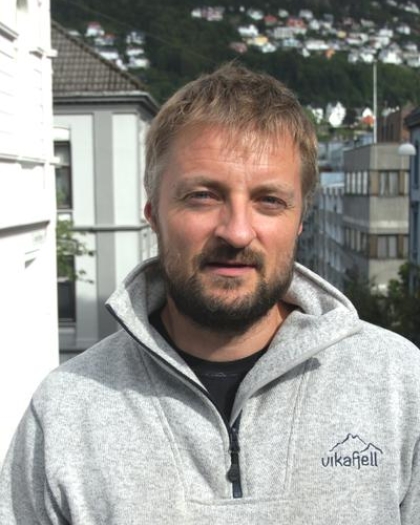
Kjetil Rommetveit is a tenured Professor at the University of Bergen 's Faculty of Humanities , specializing in the governance of technoscience through interdisciplinary lenses. His work bridges Science, Technology and Society (STS) with Theory of Science , analyzing digitalization's impact on energy systems, biometric surveillance, and climate policy. PhD in Biotechnology and Bioethics Coordinated EU/Norwegian projects: CoPol, MAGIC, CANDID Developed Norway's first interdisciplinary sustainability master's program His research focuses on epistemic networks connecting politics, expertise, and everyday life, particularly in smart electricity transitions and post-truth dynamics . Key contributions include techno-regulatory imaginary frameworks and analyses of digital sovereignty . Recent publications examine AI's role in political discourse , energy transition ethics , and activism in scientific practice . He actively engages in public debates through op-eds in Klassekampen , Aftenposten , and University World News . As a PI for projects like CoPol: Digital Contact Tracing Policy and SUPER MoRRI , he integrates responsible research methodologies across European collaborations. Teaching emphasizes interdisciplinary sustainability education involving four university faculties.
Professor Paul Formosa serves as the Research Training Director in the School of Humanities at Macquarie University, where he belongs to the Discipline of Philosophy. He previously held leadership positions including Head of the Department of Philosophy, founding co-Director of the Macquarie University Ethics and Agency Research Centre, and Director of the Centre for Agency, Values and Ethics (CAVE). Formosa has been an elected member of the University Senate and Faculty of Arts Board, and served as Department PhD and MRes Director. His research expertise spans multiple philosophical domains with particular depth in: Moral and political philosophy Kantian ethics and moral psychology Human dignity and autonomy Philosophy of technology focusing on AI, social media, and video games Formosa has produced nearly 100 research outputs with over 2,000 citations, demonstrating significant scholarly impact. His recent publications reveal a clear trajectory toward examining ethical implications of emerging technologies, particularly artificial intelligence. His work consistently bridges traditional philosophical frameworks with contemporary technological challenges, especially in AI ethics, video game morality, and digital citizenship. His notable recognitions include: Australian Research Council DECRA Fellowship Chief Investigator on three ARC Discovery Projects Macquarie University Research Fellow As an academic leader, Formosa has supervised numerous graduate students across philosophy and computing disciplines. He has secured significant research funding including the ARC Discovery Project 'Generative AI and Creative Industries: Ethical, Legal and Work Implications' (2025-2028, $480,554). His editorial contributions include Games and Culture journal and Educational Philosophy and Theory. Formosa remains actively engaged with the Macquarie University Ethics and Agency Research Centre and continues to advance interdisciplinary research at the intersection of philosophy, technology, and ethics.
Phil Tetlock is the Leonore Annenberg University Professor in Democracy and Citizenship at the University of Pennsylvania, holding professorships in Management (Wharton School), Psychology (School of Arts & Sciences), and a secondary appointment in Political Science. His work bridges decision-making, forecasting, and interdisciplinary collaboration. He is renowned for research on expert judgment accuracy, adversarial collaboration, and AI applications in prediction. Tetlock’s recent focus includes improving forecasting methodologies through machine learning and mitigating cognitive biases in geopolitical analysis. Research interests emphasize decision science, political psychology, and the intersection of technology with human judgment. Notable contributions include developing forecasting proficiency tests and analyzing the efficacy of adversarial collaboration in behavioral science. His work often addresses societal challenges like existential risk assessment and scientific censorship. Publications highlight trends in AI-driven forecasting, geopolitical prediction accuracy, and ethical dilemmas in research. Tetlock advocates for robust accountability systems in intelligence analysis and policy-making, emphasizing calibration of confidence and depolarization of attitudes through structured debate.
Peter Reichl is a Professor in the Faculty of Computer Science, leading the Research Group Cooperative Systems. His work spans interdisciplinary research in Human-Computer Interaction, IoT systems, and Digital Ethics. He actively contributes to the UN Sustainable Development Goals through innovative technology solutions. Key projects include the European Distributed Data Infrastructure for Energy, COMPASS, and symbIoTe. Research interests include mobile computing, tangible interfaces, quantum computing education, and ethical implications of digital transformation. Over 134 publications since 2008 reflect his work in music technology, IoT frameworks, and socio-technical systems analysis. Recent articles highlight creative tech solutions like LEGO-based music sequencers and philosophical explorations of Digital Humanism. He has organized major events like the Dagstuhl Workshop on Quality of Experience (QoE Vadis?) and contributed to policy discussions on digital democracy in Austria. Key Projects: symbIoTe (2016-2018), COMPASS (IoT solutions), European Energy Data Infrastructure (2023-2025) Notable Activities: Panellist on Digital Transformation Ethics (2024), Poster Presenter for Muco app (2022) Labs/Teams: Research Group Cooperative Systems focuses on IoT interoperability and human-centered tech design.
Michael Funk is a Professor in the Faculty of Computer Science, affiliated with the Research Group Cooperative Systems. His work bridges philosophy, technology ethics, and transdisciplinary studies. He holds a Doctorate (Dr.) alongside B.A. and M.A. degrees. His research critically examines technological impacts on society, focusing on ethics of AI, robotics, synthetic biology, and digital humanism. Recent talks include discussions on AI ethics in criminal law, climate-tech integration, and responsible AI development. Education: B.A. M.A. Dr. (Doctorate) Research interests emphasize ethical frameworks for autonomous systems, digital societal transformation, and philosophical foundations of technology. His work engages with UN Sustainable Development Goals, particularly addressing ethical challenges in AI and robotics. Key contributions include analyzing military drone ethics, synthetic biology methodologies, and Wittgensteinian approaches to technology philosophy. Publications span 57 works including books like *Ethik künstlicher Intelligenz: Eine Topographie zur praktischen Orientierung* (2024) and *Nichtwissen ist Macht!* (2024). Recent articles explore AI's societal roles, robot interaction ethics, and transdisciplinary integration. Key Themes: Robot Ethics AI Governance Techno-Cultural Critique Epistemological Methodology Led activities include organizing interdisciplinary conferences on robot philosophy and presenting at science-public forums. His research group focuses on cooperative systems and anthropological-technological intersections.
Prof. Dr. Friederike A. Eyssel is a Professor in the Department of Psychology at the Faculty of Psychology and Sport Science, Bielefeld University. She leads the research group "Applied Social Psychology and Gender Studies" at the Center for Cognitive Interaction Technology (CITEC), a central interdisciplinary research institute. Her work bridges psychology, robotics, and gender studies, focusing on human-technology interaction. Her research interests include social robotics, anthropomorphism, dehumanization, and gender dynamics. She explores how humans perceive and interact with robots and AI systems, combining experimental social psychology with cutting-edge technology. Her interdisciplinary approach is central to Bielefeld's strategic research area on the Socio-Technical World. Her recent work involves major interdisciplinary projects such as CRC TRR 318 "Constructing Explainability," PREDICT, and Bots Building Bridges (3B), reflecting her engagement with the societal implications of AI and intelligent systems. She has also contributed to initiatives like AI Academy OWL and the New Center for Co-constructive Artificial Intelligence. Bielefeld University Equality Prize (2021) Karl-Peter Grotemeyer Prize for Excellence in University Teaching (2021) IEEE-RAS Distinguished Lecturer Award (2022) Prof. Eyssel is actively involved in academic governance, serving as Chairwoman of the Ethics Commission and the Equal Opportunities Commission at Bielefeld University. She has held visiting professorships at institutions including New York University Abu Dhabi, TU Dortmund, and the University of Cologne. Her leadership in interdisciplinary research and commitment to equality and teaching excellence underscore her significant contributions to academia. She is affiliated with key research centers including CITEC, CoR-Lab, and the Interdisciplinary Center for Gender Studies (IZG), and collaborates with strategic partners such as Miele, Bertelsmann, and Honda. Her research is supported by major funding bodies including the DFG, ERC, BMBF, and VolkswagenStiftung.
Cécile Piret is an Associate Professor in the Department of Mathematical Sciences at Michigan Technological University (MTU). Her research focuses on developing and analyzing high-order numerical methods for solving partial differential equations (PDEs) and fractional PDEs, with a particular emphasis on the Radial Basis Functions (RBF) method. Applications span computational fluid dynamics, atmospheric, and oceanic sciences. She holds a PhD and has been affiliated with MTU since at least 2010. Her work bridges applied mathematics and computational science, addressing challenges in numerical approximation and stability. Research interests include numerical analysis, scientific computing, and the RBF method’s application to complex systems. Recent articles highlight advancements in meshfree methods for PDEs on surfaces, least squares approximations, and GPU-accelerated modeling. She has also contributed to interdisciplinary studies in sociology and political theory, though these appear less central to her primary mathematical focus. No awards or grants are explicitly mentioned, and no advisees are listed. Her work often involves collaborations in computational geosciences and engineering, reflecting her department’s interdisciplinary strengths. The articles suggest a sustained focus on improving numerical techniques for heterogeneous systems and fractional calculus applications.
Marcy Shieh is an Assistant Professor in the Department of Political Science at Miami University, Ohio. She holds a PhD from the University of Wisconsin–Madison (2023) and specializes in American politics with a focus on judicial politics, examining the interplay between courts, political elites, public opinion, and advocacy groups. PhD, Political Science – University of Wisconsin–Madison, 2023 MA, Political Science – University of Wisconsin–Madison, 2018 BA, Political Science and Philosophy (minor in Statistics) – University of California, Davis, 2014 Her research centers on judicial behavior in state and federal courts, particularly how media coverage , public opinion , and interest group activity shape judicial legitimacy and decision-making. She employs advanced methodologies including text analysis and survey experiments to explore political communication dynamics around the judiciary. Her recent publications appear in Research & Politics , Political Research Quarterly , American Politics Research , Social Science Quarterly , and Open Judicial Politics , with a chapter in the Research Handbook of Judicial Politics . These works reflect a consistent trend toward understanding the politicization of courts and public perceptions of judicial fairness using mixed-method empirical approaches. Scientific contributions include peer-reviewed journal articles and handbook chapters that advance the study of judicial politics through innovative data and experimental designs. Though no formal awards are listed, her placement in top journals and postdoctoral fellowship indicate strong scholarly recognition. Marcy Shieh teaches POL 333 – Constitutional Rights and Liberties. She served as a Postdoctoral Fellow at the University of North Carolina at Charlotte during 2023–2024, supporting her transition into a tenure-track role. While specific advisees are not mentioned, she is likely mentoring undergraduate and graduate students in political science. No grants are explicitly referenced, but her publication record suggests active research funding or institutional support. There is no mention of a lab or formal research team in the provided text.
Friedemann Vogel is a full Professor of Socio- and Discourse Linguistics at the University of Siegen, Faculty I (Arts and Humanities), within the German Department. His work bridges linguistics, media studies, and cultural science, focusing on the interplay between language, knowledge, and power. He leads multiple research projects and platforms, including the Diskursmonitor and the DFG-funded subproject on mayoral communication within the Collaborative Research Center 'Transformations of the Popular'. University: University of Siegen School: Faculty I Department: German Department Email: friedemann.vogel@uni-siegen.de Office: HD 4203, Hölderlinstr. 3, 57076 Siegen Education: Dr. Phil. (summa cum laude), University of Heidelberg (2011) Studies in German Linguistics, Psychology, and Philosophy, University of Heidelberg (completed with distinction) Technical High School, Carl-Engler-Schule, Karlsruhe Friedemann Vogel's research centers on discourse analysis, strategic communication, and digital media. He investigates how language shapes collective knowledge, legal systems, and democratic participation. His methodological approach combines empirical analysis with computational tools such as NLP and corpus hermeneutics. Key areas include legal linguistics, computer-assisted analysis of large language datasets, and the role of digital platforms in shaping public discourse. He has pioneered research on authentication practices, online access control, and right-wing discourse in social media. His recent publications reveal a strong trajectory in analyzing political discourse, particularly during crises, and in developing theoretical frameworks for discourse intervention and public discourse cultivation. Themes of linguistic democracy, freedom of expression, and digital citizenship recur across his work, reflecting a commitment to socially engaged scholarship. The integration of digital tools and open-access platforms underscores his innovative approach to linguistic research. Scientific Awards and Honors: President of the International Language and Law Association (ILLA) Appointed to the Board of Trustees of Grimme Research College, University of Cologne (2022) Advisory Board member, virTUos project (TU Dresden) Vertrauensdozent, Rosa-Luxemburg-Stiftung Founder and coordinator of CAL² (Computer Assisted Legal Linguistics) Friedemann Vogel has secured significant research funding from institutions including the German Research Foundation (DFG), the Federal Ministry of Justice, the Hans Böckler Foundation, and the State of North Rhine-Westphalia. He advises students and leads interdisciplinary research teams, fostering collaboration between linguistics, law, and digital humanities. His projects often involve international cooperation, such as with Beijing Foreign Studies University. He is actively involved in academic service, serving on editorial boards and steering committees. He leads the Diskursmonitor research group and the CAL² international research network, both of which function as collaborative platforms for interdisciplinary discourse analysis. His work emphasizes open science, digital education, and public engagement, exemplified by initiatives like the 'Reclaim your data' MOOC and virtual privacy awareness projects.
David G. Rand is a Professor of Information Science and Marketing & Management Communications at Cornell University. His research focuses on computational social science and cognitive science, exploring how human-AI dialogues can correct misinformation, why people share falsehoods, and strategies to reduce political polarization and promote cooperation. He leads studies on AI-driven interventions against conspiracy theories and misinformation, emphasizing scalable solutions like personalized AI dialogues. His work bridges behavioral science, technology ethics, and public policy. Key research themes include the psychological underpinnings of misinformation sharing, the efficacy of accuracy prompts, and the societal impacts of AI-generated content. He has contributed to understanding how digital platforms can mitigate polarization through design features like warning labels and source transparency. His interdisciplinary approach integrates experiments, computational modeling, and large-scale data analysis. Notable outputs include landmark studies on AI reducing conspiracy beliefs and AI's role in climate change communication. While no specific awards are mentioned, his prolific publication record (over 150 articles listed) highlights sustained impact in his field. His lab collaborates with tech companies and policymakers to deploy evidence-based strategies against misinformation.
John Paul Gibson is an Associate Professor in the Department of Informatics at Telecom SudParis. His research focuses on formal methods, software engineering, and ethics in computing, with notable contributions to e-voting systems, formal verification, and digital ethics. He has authored and co-authored numerous papers in prestigious journals and conferences, including Formal Aspects of Computing , International Journal of Advanced Computer Science and Applications , and Journal of Information, Communication and Ethics in Society . His academic career includes leadership in interdisciplinary projects like the EU-funded Inclusion4EU initiative and ETHICS4EU, addressing inclusive software design and digital ethics education. He actively contributes to advancing ethical considerations in technology through studies on technical debt, AI ethics, and the political economy of Big Tech. His work bridges theoretical formal methods with practical applications, emphasizing the societal impact of computing systems. Gibson's research also extends to mobile crowdsensing optimization and cybersecurity, with publications in IEEE Transactions on Systems, Man, and Cybernetics and collaborations on cardiovascular risk studies. He has co-edited special issues on e-voting and digital ethics, showcasing his role in shaping academic discourse in these fields. His professional activities include organizing conferences like the International Workshop on Requirements Engineering for Electronic Voting (RE-Vote) and contributions to pedagogical initiatives such as problem-based learning in software engineering education. His lab affiliations include SAMOVAR, where he explores the intersection of formal methods and real-world system development.
Gaurav Sinha is an Associate Professor in the Department of Geography at Ohio University, part of the College of Arts and Sciences. He holds a PhD in Geography from the University at Buffalo, SUNY, and a B.Sc. in Geological Sciences from the Indian Institute of Technology (IIT) Kharagpur. His academic work is deeply rooted in Geographic Information Science (GISc), where he contributes as a researcher, educator, and curriculum leader. B.Sc., Geological Sciences, Indian Institute of Technology (IIT) Kharagpur, India (1996–1999) M.A., Geography, University at Buffalo–SUNY (2000–2005) Ph.D., Geography, University at Buffalo–SUNY (2000–2007) His research centers on geospatial ontologies, terrain analysis, and the cognitive and computational representation of geographic information. He investigates how landscapes are conceptualized and modeled, particularly through topographic ontologies and semantic frameworks for landforms and surface water. His interdisciplinary work spans environmental science, education, public health, and urban policy. The publications he has authored or co-authored reflect a strong trend in foundational GIScience, with emphasis on semantic modeling, spatial reasoning, and participatory methods. His recent work advances the automated extraction of terrain features using ontologies, integrates GIS into K–12 education, and applies geospatial analysis to issues like media deserts and transportation safety. Co-PI, Media Deserts Research Project, Democracy Fund/Duke University ($25,000) Co-PI, Tree Canopy Impact on Pavement, Ohio DOT/FHWA ($72,803) Co-PI, Mathematical Modeling and Spatial Reasoning (Modspar), Ohio Department of Higher Education ($175,598) Co-PI, Participatory GIS in Northern Tanzania, NSF ($571,859) He teaches core GIS courses including Introduction to GIS, Principles of GIS, Advanced Spatial Analysis, and a graduate seminar in GIScience. He also directs both the undergraduate and graduate GIS certificate programs at Ohio University, shaping curriculum and mentoring students. His collaborations extend across departments and institutions, involving researchers from geography, education, civil engineering, journalism, and the USGS.
Marthe Holum is an Associate Professor in the Department of Computer Science at the Norwegian University of Science and Technology (NTNU). Her research spans political science, public administration, sociology, and sports management, focusing on topics such as ethnic discrimination, citizen trust, municipal cooperation, and economic-environmental policy intersections. Key research areas: Ethnic studies, sports participation dynamics, public sector efficiency Recent publications analyze athlete dropout due to discrimination, career preferences in business students, and environmental policy impacts Teaching includes courses on business intelligence, economic analysis, and digital transformation
Professor Dr. Martina Klausner is a full-time faculty member at the Institute for Cultural Anthropology and European Ethnology, Goethe University Frankfurt am Main, within the Faculty of Linguistics, Cultures and Arts. She holds the professorship in Digital Anthropology and Science and Technology Studies, leading major interdisciplinary research initiatives including the Research Training Group Fixing Futures. Technologies of Anticipation and the Center for Critical Computational Studies. Her educational background includes studies in European Ethnology and Cultural Studies at Humboldt University in Berlin, where she also completed her PhD. Her research agenda centers on digital transformation processes in governance, healthcare, and urban environments, with a strong methodological focus on digital and collaborative ethnographic methods. Her research interests span Digital Anthropology , Science and Technology Studies (STS) , datafication in urban governance , AI regulation , digital health technologies , and participation rights of people with disabilities . She investigates how digital data infrastructures shape political processes, such as in the Verkehrswende (transport transition) in Frankfurt, and how AI is regulated across sectors like finance. Her work emphasizes the political dimensions of data production and the ethical, legal, and infrastructural challenges of digital technologies. Her recent publications from 2022–2024 reveal a strong trend toward critical data studies , digital ethnographic methods , and interdisciplinary governance of AI . Articles such as 'A More-than-digital Anthropology' and 'Digitalität und Ethnografie' advocate for methodological innovation in ethnography, while others analyze AI in financial systems and data politics in urban mobility, reflecting a cohesive research trajectory at the intersection of technology, power, and participation. She is actively involved in scientific leadership, serving as PI of major research groups and as an ERC Panel Member for Social Sciences & Humanities. She also contributes to academic discourse through editorial roles and collaborative publications. Martina Klausner supervises doctoral researchers, including Matthias Kloft, whose dissertation builds on her research on AI regulation in finance. She has secured significant research funding, including DFG and ZEVEDI grants, and leads collaborative projects involving law, computer science, and philosophy. Her work is deeply embedded in interdisciplinary networks, including the Laboratory: Anthropology Environment | Human Relations. She is affiliated with the Laboratory: Anthropology Environment | Human Relations , a long-standing research collective she was part of during her early career, and continues to engage in collaborative and co-laborative research models. Her current DFG-funded project on data politics in Frankfurt exemplifies her ongoing commitment to ethnographic inquiry into digital governance and civic participation.
Brian Turner serves as an Associate Professor in the Department of History at Portland State University's College of Liberal Arts and Sciences, with his office located in CH 441U. His contact information includes phone (503) 725-3992 and email brian.turner@pdx.edu. He specializes in the Ancient Mediterranean world, particularly Roman history, military history, and historical geography, teaching courses such as HST 309U (Roman Republic), HST 310U (Roman Empire), HST 390U (Global History of Warfare), and HST 416 (Geography and Worldview in the Ancient Mediterranean). His educational background features a PhD from the University of North Carolina at Chapel Hill, an MA from Queen's University, Canada, and a BA (Honours) from Queen's University, Canada. This foundation underpins his scholarly contributions to ancient historical studies. Turner's research explores Roman military psychology, worldview construction through mapping, and commemoration of victories/defeats. His 2022 monograph Pliny the Elder's World (Cambridge) examines geographical knowledge in antiquity, while his 2018 edited volume Brill's Companion to Military Defeat pioneered analysis of Roman loss narratives. His work bridges historical methodology with sociological and geographical frameworks. Analysis of his 15 most recent publications reveals a core focus on Roman history (e.g., military cohesion, Batavian Revolt) but unexpectedly spans public health (SARS-CoV-2 pediatric studies), surgery (robotic cholecystectomy), political science (Paraguay's democracy), environmental science (invasive predators), and AI (image generation). This diversity suggests interdisciplinary collaborations despite his history department affiliation, particularly in medical/public health fields where multiple 2021-2023 papers share co-authors. Scientific Awards: No scientific awards were listed in the provided text. Turner advises potential Master of Arts students in Roman history at Portland State University, inviting them to review expanded field descriptions. While no specific grant funding is mentioned, his international cohort study (2023) indicates cross-institutional partnerships. His editorial work on Brill's Companion highlights leadership in academic collaborations. No dedicated laboratories or research teams were referenced. However, his involvement in international surgical studies, editorial projects, and Paraguay-focused political analysis implies participation in multi-institutional networks. His Google Scholar profile suggests active engagement in both primary historical research and applied interdisciplinary projects.