Ståle Holgersen is a part-time lecturer at the School of Humanities, Education and Social Sciences at Örebro University , Sweden. His work focuses on the intersections of capitalism, class struggle, and environmental crises, particularly in urban contexts. Holgersen critiques neoliberal urban planning, housing policies, and climate governance, emphasizing the need for ecosocialist alternatives. Academic Rank: PartTime Lecturer Email: stale.holgersen@oru.se Research Interests include political ecology, far-right environmentalism, urban sustainability critiques, housing justice, and Marxist theory. His recent publications analyze Sweden's climate policy shifts, urban housing crises, and the rise of eco-fascism. The 15 most recent articles (2021–2025) span themes like far-right ecologies , urban capitalism , class-based housing struggles , and ecosocialist strategies . These works often employ dialectical and critical theoretical frameworks.
Fabian Ferrari is an Assistant Professor in Cultural AI at Utrecht University, working in the Department of Media and Culture Studies within the Humanities faculty. He is affiliated with the Centre for Digital Humanities and is a member of the focus area Governing the Digital Society . Previously, he served as a Postdoctoral Researcher (2022-2024) in the same focus area and was a Visiting Scholar (2021-2022) at the Milieux Institute for Arts, Culture and Technology in Montréal. Dr. Ferrari's research focuses on the intersection of artificial intelligence, digital platforms, and society. His work examines AI governance, algorithmic power, digital labor, and the infrastructural geographies of AI systems. He investigates how public investments in AI infrastructure can reconcile competitiveness with public value creation, particularly through his upcoming NWO-funded Veni project Conditional Computing: Reimagining the Governance of Public AI Infrastructure , which begins in January 2026. His publication record demonstrates significant scholarly impact, with articles in top journals including Nature Machine Intelligence , Cultural Studies , New Media & Society , Big Data & Society , and Competition & Change . He has also co-edited the open-access book Digital Work in the Planetary Market published by MIT Press. Ferrari's work is frequently cited and has influenced policy discussions, as evidenced by multiple policy citations across his publications. NWO Veni grant for research on public AI infrastructure Dr. Ferrari's research collaborations span multiple institutions and international teams. He has frequently co-authored with scholars including Mark Graham, José van Dijck, and Anne Helmond. His work bridges technical, social, and policy dimensions of AI systems, with particular attention to labor implications and governance frameworks. He is actively engaged in both academic and public discourse on AI's societal implications, contributing to progressive policy visions for generative AI.
E. Geoffrey Love is an Associate Professor of Business Administration at the University of Illinois at Urbana-Champaign, part of the Gies College of Business. He serves as Academic Co-Director of the Hoeft Technology and Management Program and Academic Director of the Carle Executive Education Program. With a PhD in Organizational Behavior from Harvard University (1997) and an AB in Applied Mathematics (1982), Love specializes in organizational innovation, corporate reputation, and institutional change. His research explores how firms navigate social evaluations, strategic innovation, and leadership dynamics. Education: PhD in Organizational Behavior (Harvard, 1997); AB in Applied Mathematics (Harvard, 1982) Positions: Academic Co-Director, Hoeft T&M Program (2024–present); Associate Professor (2016–present); Assistant Professor (2009–2016) Love's research interests span organizational design, leadership, and the impact of CEOs on corporate reputation. His work integrates institutional theory, strategic management, and behavioral insights. Notable studies include the dynamics of corporate reputation following downsizing, CEO succession, and the role of chief innovation officers. His recent articles highlight attention-based strategic leadership and innovation ecosystems across G-20 nations. Awards: Dean’s Impact Award (2022), Excellence in Graduate Teaching Award (2022) Love advises on multi-functional leadership and innovation strategy, emphasizing interdisciplinary education through programs like Hoeft T&M. His grants include funding for 'Attentional Control and Organizational Intelligence' (2024–2026). He teaches courses on strategic innovation, organizational behavior, and entrepreneurial management, leveraging over two decades of academic and industry insights.
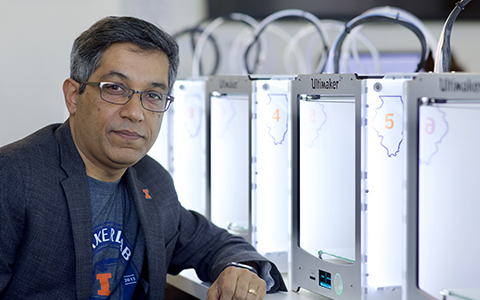
Vishal Sachdev is a Clinical Associate Professor of Business Administration at the University of Illinois at Urbana-Champaign's Gies College of Business. He serves as Director of the MS Analytics program, Director of Illinois MakerLab, and DPI Faculty in Residence. His academic roles span teaching, research, and leadership in educational technology and innovation. Education: B.A. in Mathematics, St. Stephen's College, New Delhi (1993) M.S. in International Business, Indian Institute of Foreign Trade (1996) Ph.D. in Information Systems, University of Texas at Arlington (2007) Research Interests: Dr. Sachdev focuses on technology's role in enabling collective action, cooperative production, and gamification in education. His work explores blockchain-based DAOs, 3D printing in educational settings, and the intersection of Web3 with decentralized business models. He emphasizes scalable peer-learning environments and online/blended education frameworks. Awards: Emerging Award for Excellence in Public Engagement (UIUC) List of Excellent Teachers (UIUC, multiple years) Research Excellence Award (Gies BADM, 2023) Grants & Labs: He leads Illinois MakerLab, a pioneering academic makerspace. Notable grants include Blockchain Analytics (Gies, 2023-2025), US Competitiveness in Web3 (Solana Foundation, 2022-2024), and Autodesk grants for Fusion 360 workshops. His work bridges technology, education, and innovation through applied research. Courses: Teaches courses like Blockchain Analytics, Database Design, and Digital Making Seminar, emphasizing hands-on, industry-relevant learning.
Liyan Shi is an Assistant Professor of Economics at Carnegie Mellon University's Tepper School of Business, holding the Shubham Singhal and Jenny Cordina Endowed Career Development Chair since July 2024. She is also a Research Affiliate at the Centre for Economic Policy Research in London. Dr. Shi joined CMU as an Assistant Professor in January 2022 after serving as an Assistant Professor at the Einaudi Institute for Economics and Finance in Rome from 2020-2021. Dr. Shi's educational background includes a PhD in Economics from UCLA (2012-2018), an M.Sc. in Financial Economics with Distinction from Oxford University (2018-2020), and a B.A. in Finance from Peking University (2005-2009). Prior to her academic career, she worked as an Analyst in Fixed Income and Economic Research at Credit Suisse in London (2010-2012). Her research spans macroeconomics, firm dynamics, labor economics, and contract theory, with particular focus on noncompete contracts, executive compensation structures, pandemic policy optimization, and market inefficiencies. Her work frequently appears in top economics journals including Econometrica , Journal of Finance , and Economic Journal . Dr. Shi's publications reveal a strong emphasis on policy-relevant economic modeling, particularly in labor markets and contract design. Her recent work on noncompete contracts has provided quantitative evidence supporting regulatory interventions in executive labor markets, while her pandemic policy research demonstrated how testing can serve as an efficient substitute for lockdowns. Economic Journal Referee Prize (2021) Dr. Shi actively contributes to the academic community through seminar presentations at leading institutions including Duke University, University of Rochester, Princeton, and Cornell. She serves as a referee for top economics journals including American Economic Journal series, Econometrica , Journal of Political Economy , and Economic Journal . At CMU, she teaches courses in Intermediate Macroeconomics, Macroeconomics II, Macroeconomics III, and AI, Technology, and Work. Her professional network extends across multiple institutions as evidenced by her frequent seminar invitations and conference participations at major economic gatherings including the NBER Summer Institute, World Congress of the Econometric Society, and various specialized macroeconomics workshops.
Zhengtian Xu is an Assistant Professor in the Department of Civil & Environmental Engineering at George Washington University , affiliated with the School of Engineering & Applied Science . His research focuses on optimizing urban transportation systems through mathematical modeling and data-driven analysis, emphasizing emerging mobility services and vehicle technologies. Education: B.S., Tsinghua University (2014) M.S., University of Florida (2016) Ph.D., University of Michigan (2020) Research interests include urban transportation systems, mathematical modeling, operations research, and sustainable mobility solutions. His work addresses challenges such as electrification of ride-hailing services, driver labor dynamics, and last-mile delivery optimization. Recent publications explore topics like drone delivery networks and platform competition in autonomous vehicle markets. No academic awards or student advisees are listed. His articles highlight trends in electrification strategies, behavioral driver dynamics, and urban logistics optimization. He has not disclosed grants or lab affiliations in the provided information.
Debanjan Mitra is the Voya Financial Fellow and Professor of Marketing at the University of Connecticut School of Business. His research focuses on consumer perception processes, innovation, and the development of metrics for organizations, products, and customers to evaluate their short-term and long-term impact. He employs analytical and econometric methods to study these effects across organizations, product categories, and brands. His educational background includes a Ph.D. in Business Administration (Marketing) from New York University (2004), a Post Graduate Diploma in Management (P.G.D.M.) from the Indian Institute of Management (1990), and a Bachelor of Technology (B.Tech.) from the Indian Institute of Technology (1988). Prior to his doctoral studies, he gained industry experience in marketing positions at Coca Cola and Diageo. Professor Mitra's research interests are multifaceted, covering Innovation, Consumer Perception, Quality Management, New Product Development, Marketing Analytics, Marketing Strategy, and Regulatory Marketing. His work in marketing analytics has provided insights into customer behavior and brand performance, while his research on regulatory marketing explores how firms navigate marketing regulations, particularly in financial markets. He has also made significant contributions to understanding quality from a customer perspective and its role in merger analysis. His publications appear in premier journals such as the Journal of Marketing, Journal of Marketing Research, Marketing Science, and Management Science. The trajectory of his recent work (from 2012 to 2021) shows a consistent focus on the interplay between marketing metrics, regulatory constraints, and innovation, with increasing emphasis on data-driven approaches to marketing strategy. Professor Mitra's scholarly contributions have been recognized with numerous awards: Marketing Science Institute Scholar American Marketing Association’s Varadarajan Award for Early Career Contributions to Marketing Strategy Research Harold H. Maynard Best Paper Award Excellence in Global Marketing Research Award Marketing Science Institute’s Robert D. Buzzell Award INFORMS’ John D. C. Little Award Finalist INFORMS’ Frank M. Bass Award Finalist Academy of Marketing Science’s Emerging Distinguished Scholar He has served as an Associate Editor for the Journal of Marketing and his research has received media coverage in The Wall Street Journal, The Financial Times, Business Week, Forbes, and CNN. Professor Mitra has consulted for many Fortune 500 firms and high-tech start-ups, applying his academic insights to real-world business challenges. In the classroom, he teaches graduate courses including 'Customer Insights', 'Brand Management', and 'Marketing Analytics', as well as PhD courses on 'Marketing Strategy Research' and 'Multivariate Analysis'. His industry experience and academic rigor provide a unique perspective for his students. At the University of Connecticut, Professor Mitra is a core faculty member in the Marketing department within the School of Business, where he continues to advance research in marketing strategy and analytics while mentoring the next generation of marketing scholars and practitioners.
Michael W. Klein is the William L. Clayton Professor of International Economic Affairs at The Fletcher School of Law and Diplomacy, Tufts University, and holds a joint appointment in the Department of Economics. He previously served as Chief Economist at the U.S. Department of the Treasury (2010-2011) and is a Research Associate at the National Bureau of Economic Research (NBER). He founded EconoFact, a nonpartisan economic analysis platform. His research focuses on international macroeconomics, including exchange rates, capital flows, and labor market impacts of globalization. He has authored over two dozen articles and three books, supported by grants from the Upjohn Institute and the Bill & Melinda Gates Foundation. Education: PhD in Economics, Columbia University (1987) BA, Brandeis University (1980) Research Interests: Explores world capital markets, exchange rate policy, foreign direct investment, and the effects of international factors on U.S. labor markets. His work emphasizes policy analysis of capital controls and global economic integration. Recent studies include analyses of Cuba's economic potential and the implications of trade deficits. Grants & Awards: Recent funding includes grants from the Alfred P. Sloan Foundation, Peter G. Peterson Foundation, and Smith Richardson Foundation for EconoFact. His work bridges academic research with policy-relevant insights on fiscal policy, inflation, and currency dynamics. Teaching & Professional Activities: Teaches International Finance, Macroeconomics, and Policy Analysis. Has presented at institutions like the Bank of England, IMF, and Federal Reserve Banks. Serves as Executive Editor of EconoFact and reviews for journals such as the Journal of International Economics and Review of Economics and Statistics . Labs/Teams: Leads EconoFact, a collaborative platform for economists to address policy issues. Engaged in interdisciplinary research on global economic challenges through NBER and international think tanks.
Tamar Kugler is an Associate Professor of Management and Organizations at the Eller College of Management, University of Arizona, with a specialization in behavioral decision-making. She holds a PhD in Experimental and Social Psychology (2004) from Hebrew University of Jerusalem. PhD in Management Organizational Behavior Laboratory Economic Science Laboratory Center for Trust Studies Behavioral Decision Making Think Tank Econ Affiliated Faculty Her research focuses on interactive decision-making , group decision dynamics , emotional influences on decisions , and trust mechanisms . She has pioneered work on disgust's paradoxical effects on prosocial behavior and developed innovative methods for measuring emotions in digital environments. Her publications span high-impact journals like Social Psychological and Personality Science and Games and Economic Behavior , covering topics from the Braess paradox in traffic networks to asymmetric participation games. Recent work explores guilt's role in ethical behavior and default options in conflict resolution. National Science Foundation grant for emotion research Binational Science Foundation grant with Eyal Ert Eller College Small Grant Program awards Journal editorial board memberships Kugler's methodological expertise includes behavioral experiments, game theory applications, and virtual reality simulations for studying social interactions.
Dr. Christian Lerch is a prominent researcher and coordinator at the Fraunhofer Institute for Systems and Innovation Research ISI in Karlsruhe, specializing in innovation management, industrial transformation, and digitalization. He holds a PhD from Freie Universität Berlin and lectures at Zeppelin University and the University of Applied Sciences Karlsruhe, focusing on service economics and business model innovation. His work bridges academic and applied research, emphasizing servitization, Industry 4.0/5.0, and sustainability in manufacturing. Affiliations: Fraunhofer ISI (since 2008), Zeppelin University (lecturer), University of Applied Sciences Karlsruhe (lecturer). Education: PhD in Innovation Management from Freie Universität Berlin (2014), studies in Economics Engineering at Karlsruhe Institute of Technology (KIT). Research Interests: His work centers on innovation dynamics in manufacturing industries, digital transformation, AI-readiness, platform-based business models, and resilience strategies. He explores how firms adapt to trends like servitization, Industry 5.0 human-technology synergy, and green economy challenges. Recent studies focus on policy implications of China's industrial strategies and the role of competence management in fostering innovation. Articles Trends: His publications emphasize the interplay between technological advancements and human-centric approaches, particularly in Industry 5.0. Key themes include AI-driven resilience, platformization pathways, and the evolution of production paradigms. He also analyzes digital servitization maturity models and the socio-economic impact of collaborative economy models in manufacturing. Awards: Recognized with a Best Paper Award (2015) for research on digitalization's role in manufacturing's service transformation. Active in professional societies like the Deutsche Gesellschaft für System Dynamics. Grants & Labs: Led projects on AI-readiness, Digital Maturity Checks, and the economic relevance of B2B platforms. Involved in the European Manufacturing Survey (EMS) network. Coordinates the Business Unit Industrial Change and New Business Models at Fraunhofer ISI.
Maxim Ivanov serves as Associate Professor in the Department of Economics at McMaster University, where he teaches advanced courses including Microeconomic Theory II (ECON 722), Introduction to Game Theory (ECON 3M03), and Industrial Organization (ECON 784/3S03) through 2025. His research centers on strategic information transmission and game-theoretic modeling in economic contexts. His academic credentials include a PhD in Economics from Penn State University, a Master's in Economics from the New Economic School (Moscow), and a Master of Science (Cum laude) in Electrical Engineering from Tomsk State University of Control Systems and Radio Electronics. This interdisciplinary foundation supports his rigorous analytical approach. Ivanov's scholarly work focuses on Microeconomic Theory, Game Theory, and Industrial Organization, with particular emphasis on information design, cheap talk models, and strategic communication mechanisms. His research investigates how private information structures and communication protocols shape economic outcomes in competitive and organizational settings. His 10 journal publications (2010-2024) in outlets like Economic Theory , Games and Economic Behavior , and Journal of Economic Theory reveal a cohesive trajectory: evolving from foundational studies on information revelation (2010-2013) to sophisticated analyses of Bayesian persuasion and private information design (2021-2024). The work consistently addresses equilibrium selection and welfare implications in strategic communication. No scientific awards are documented in the available institutional records. Professor Ivanov maintains an active teaching schedule with no recorded advisees or graduate supervision in the provided data. The VIVO database indicates no active research grants, and co-author networks show exclusively solo publications within McMaster's system since 2015. No laboratory affiliations or research teams are mentioned in the institutional profiles.
Alessia Isopi is a Senior Lecturer in Economics at the University of Manchester, where she has been since 2011. She holds a PhD from Università di Roma 'Tor Vergata' and a bachelor's degree from LUISS 'Guido Carli' University in Rome. Her research focuses on Development Economics, Asymmetries in Information, and Experimental Economics, with particular attention to topics such as market structures, property rights, and international aid allocation. She teaches Development Economics at both undergraduate and postgraduate levels. Her research explores critical issues like the origins of organized crime through economic lenses, the impact of consultation processes on decision-making, and the mechanisms behind donor-NGO funding dynamics in developing countries. Recent work includes studies on Nigerian polygamous households' resource allocation and Ugandan NGO funding patterns. Dr. Isopi has contributed to UN Sustainable Development Goals related to poverty reduction and equitable development. Her work spans 15+ peer-reviewed articles and working papers, with notable contributions in journals like Theory and Decision and Review of International Organizations . Her research has been highlighted in media outlets such as The Conversation, reaching broader audiences.
Professor Meredith Crowley is a Professor of Economics and Deputy Chair of the Faculty at the University of Cambridge, where she also serves as a Research Fellow at CEPR (London). She is a Fellow of St. John's College and serves as a Research Coordinator for the Janeway Institute's Transmission Mechanisms and Economic Policy Research Theme. Professor Crowley has established herself as a leading expert in international trade and trade policy, with extensive engagement with international institutions including Bruegel, CEPII, and the Kiel Institute. Professor Crowley's educational background includes: PhD (2001) and MS (1999) in Economics from the University of Wisconsin-Madison MPP (1996) in International Trade and Finance from Harvard University AB (1990) in Asian Studies and Chemistry from Bowdoin College Professor Crowley's research focuses on international trade and trade policy, with particular expertise in trade agreements, trade remedies, currency invoicing, and the economic impacts of Brexit. Her work examines how trade policy uncertainty affects firm behavior, how trade agreements shape market competition, and how exchange rate movements influence trade flows. She has made significant contributions to understanding pricing-to-market dynamics, the role of dominant currencies in trade, and the challenges facing the global trading system, frequently using detailed firm-level data in her empirical analyses. Analysis of Professor Crowley's recent publications reveals a consistent focus on the intersection of trade policy and firm behavior. Her work demonstrates how trade policy uncertainty influences market entry decisions, how trade agreements create competitive effects across markets, and how currency invoicing patterns respond to major economic events like Brexit. Her research combines rigorous empirical methods with deep policy relevance, often using detailed firm-level data to examine how international trade operates in practice, with particular attention to the impacts of trade disputes, tariff threats, and exchange rate fluctuations. Professor Crowley has received significant recognition for her work, including being elected as a Research Fellow at the Centre for Economic Policy Research (CEPR) in 2016. She has secured multiple research grants, including a UK in a Changing Europe Fellowship from the Economic and Social Research Council (2019-2022) and a Data Impact Fellowship from JISC (2017). She also received an ESRC grant for research on 'The impact of trade policy and exchange rate shocks on trade' (2017-2018). Professor Crowley has supervised several PhD students, including Chuan-Han Cheng (International Macroeconomics, Trade, and Monetary Policy) and Yi (Amanda) Wang (International Trade, Innovation, Productivity), and advised others such as Deniz Atalar (Inter-Sectoral Trade Linkages in Aggregate Fluctuation) and Ana Lleo-Bono (Behavioral, Experimental, and Organizational Economics). She serves as co-investigator for the publicly-funded Centre for Inclusive Trade Policy and has been actively involved in policy discussions, serving on the Trade and Economy Panel of the UK Department for International Trade and providing scientific advice to international institutions. Professor Crowley is a key member of the Janeway Institute for Economics at Cambridge and actively contributes to the Centre for Inclusive Trade Policy. Her research group focuses on empirical microeconomics, particularly examining international trade phenomena through detailed firm-level data analysis. She has established herself as a leading voice in trade policy discussions, with over 100 media appearances including BBC, The New York Times, Financial Times, and The Economist, where she explains complex trade issues to the public and policymakers.
Paul Milgrom is the Shirley and Leonard Ely Professor of Humanities and Sciences in the Department of Economics at Stanford University , with courtesy appointments in the Department of Management Science and Engineering and the Graduate School of Business . As co-founder and chairman of Auctionomics , he applies auction theory to high-stakes bidding scenarios. Co-recipient of the 2020 Nobel Prize in Economic Sciences for auction theory advancements Distinguished Fellow of the American Economic Association (2020) 2018 John J. Carty Award (with Kreps and Wilson) Milgrom's research spans Auction Theory , Market Design , Game Theory , and Industrial Organization . His work on radio spectrum auctions has reshaped global telecommunications policy. Key award trends: 2018 : CME Group-MSRI Prize, John J. Carty Award 2014 : Golden Goose Award 2012 : BBVA Foundation Frontiers of Knowledge Award 2008 : Nemmers Prize His publications reveal expertise in mathematical economics , organizational theory , and telecommunications policy , with recent focus on AI/ML applications to market design and combinatorial auction complexity .
Charles Murry is an Associate Professor of Economics at the University of Michigan and a Research Associate at the National Bureau of Economic Research (NBER). He holds a Ph.D. from the University of Virginia (2014) and a B.S. in Economics from the University of Delaware (2006). His research focuses on empirical industrial organization and antitrust economics, with a particular emphasis on market power dynamics in industries like automobiles, airlines, and broadband. He has also contributed to econometric methodologies for analyzing market outcomes. Previously, Murry held positions at Boston College (2018–2024) and Pennsylvania State University (2014–2018). His work examines topics such as bundling strategies in public procurement, price discrimination in international markets, and regulatory impacts on market structure. He has published in top journals like the Quarterly Journal of Economics , Review of Economic Studies , and International Economic Review . Murry’s research bridges theoretical models and empirical evidence, addressing real-world policy issues such as competition enforcement and market design. He is actively involved in academic service, including contributions to antitrust-related amicus briefs and participation in policy panels.