Rianne Lousمشاهده پروفایل
استادیار
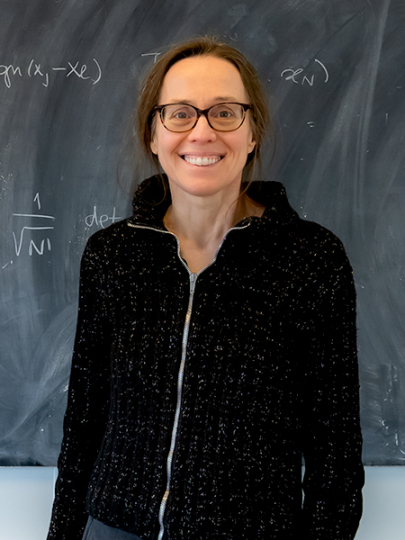
Rianne Lous is an Assistant Professor at Eindhoven University of Technology (TU/e) in the Department of Applied Physics and Science Education. She leads the SIntAQS (Sensing Interactions in Atomic Quantum Systems) research group within the Center for Quantum Materials and Technology Eindhoven and the Coherence and Quantum Technology group. Her work focuses on quantum technologies, particularly hybrid ion-atom systems for quantum simulation, quantum computing, and quantum chemistry. Rianne received her academic training through the following path: Bachelor's degree in Natural Sciences and Physics and Astronomy at Radboud University, Nijmegen, Netherlands Master's degree (with honors) in Nanoscience at the University of Groningen, Netherlands, including an internship at ITAMP (USA) Ph.D. and first PostDoc at the University of Innsbruck and IQOQI (Institute of Quantum Optics and Quantum Information) of the Austrian Academy of Sciences, working with ultracold quantum gases PostDoc at the University of Amsterdam with Yb+ ions in a bath of lithium atoms, supported by a Marie-Sklodowska Curie European fellowship Rianne's research centers on understanding and controlling interactions among atoms, ions, and molecules for quantum simulation applications. She is establishing an experimental setup combining trapped ions with ultracold atoms to create quantum simulators for studying interacting quantum systems. Her work spans quantum sensing, quantum chemistry, and quantum computing with a focus on ion-atom mixtures and Rydberg atom systems. She investigates impurity physics, quantum chemistry and sensing, and quantum simulation & computation with ultracold atoms & ions. Her experimental approach has a two-fold objective: building quantum computers to calculate properties of quantum many-body systems and developing quantum simulators to improve fundamental understanding of these phenomena. Rianne is involved in the Rydberg Atom Quantum Computing project, which aims to develop a scalable quantum computing platform based on Rydberg atoms in optical tweezers. This project is part of the Quantum Delta NL program and has received funding from the European Union's NextGenerationEU. Her scientific achievements include: Marie-Sklodowska Curie European fellowship from the EU Horizon 2020 research and innovation program Rianne actively mentors students and leads research projects. Her SIntAQS group currently includes PhD candidates Claudia Galantini and Luc Verwaal, along with several BSc and MSc students. She has previously supervised multiple MSc and BSc students including Iris Podbevsek, Rogier Venderbosch, and Luuk van Leendert. Her research is supported by various grants including funding from the European Union's Horizon programs. The SIntAQS laboratory focuses on building an ultra-high vacuum setup where hybrid atom-ion systems can be controlled and studied using electric, magnetic, and optical fields. This experimental platform enables research in quantum simulation of many-body physics, quantum computation, quantum sensing, and quantum chemistry. The lab benefits from the spatial localization and addressability of ions combined with the long coherence times and scalability of atoms.