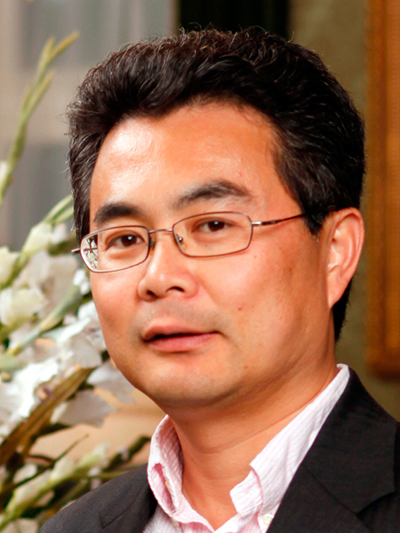
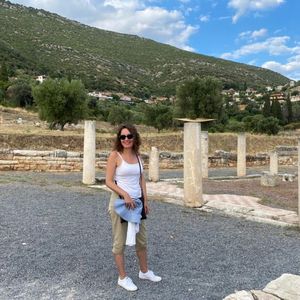
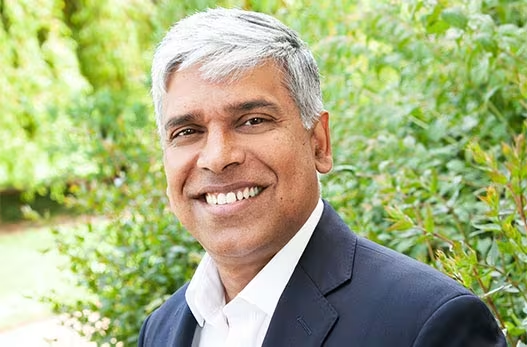
Susan Diana Owen is a Senior Lecturer in Geography at NUS, specializing in environmental policy and adaptation governance. Her research examines science-policy interfaces in coastal management and climate adaptation planning. Owen investigates community responses to environmental change, participatory governance models, and the translation of scientific knowledge into policy frameworks. Current work focuses on coastal vulnerability, adaptation strategies for island communities, and institutional responses to sea-level rise. Teaching includes 'Methods for Environmental Studies', 'Environmental Management in Singapore', and field-based courses integrating physical and social science approaches to environmental challenges.
Harrison Steel is an Associate Professor of Engineering Science at the University of Oxford and Tutorial Fellow at Harris Manchester College. He holds a BEng in Mechanical Engineering and BSc in Physics and Mathematics from the University of Sydney, followed by a DPhil at Oxford as a Monash Scholar. His research focuses on synthetic biology, control engineering, and bioprocess optimization, with a particular emphasis on microbial systems and genetic circuit design. Dr. Steel’s work integrates computational modeling, experimental biology, and control theory to engineer robust biological systems. His contributions include advancements in genome editing via SIBR-Cas systems, cybernetic control of microbial co-cultures, and the development of open-source platforms like Chi. Bio for automated biological experimentation. His recent publications highlight innovations in directed evolution strategies, modular biomolecular control architectures, and the application of machine learning to fitness landscape analysis. He has pioneered approaches for stabilizing genetically engineered cell populations and enhancing bioprocess efficiency through adaptive control systems. Dr. Steel’s research is supported by collaborations across engineering, biology, and computational disciplines. He actively contributes to academic leadership through his role at Harris Manchester College and maintains an experimental focus on bridging theoretical models with practical biological implementations.
Jiebo Luo is the Albert Arendt Hopeman Professor of Engineering and Professor of Computer Science at the Hajim School of Engineering & Applied Sciences, University of Rochester. He holds a PhD and has been affiliated with the Department of Computer Science since 2011, following a 15-year career at Kodak Research. His research spans computer vision, natural language processing, machine learning, data mining, computational social science, and digital health. Luo is an ACM Fellow, AAAI Fellow, IEEE Fellow, SPIE Fellow, and IAPR Fellow. Education: PhD (specific discipline not explicitly stated in text). Research interests include computer vision, machine learning, data mining, social media analysis, biomedical informatics, human-computer interaction, and ubiquitous computing. He co-authored the book Deep Neural Network for Medical Image Computing: Principles and Applications (Elsevier, 2022). His work has led to nearly 600 technical papers and 90+ U.S. patents. Research Trends: Recent work focuses on large language models (LLMs), multimodal systems, AI-driven social media analysis, and healthcare applications. Key areas include bias analysis in political simulations, video understanding, and benchmark development for AI-generated content evaluation. His research bridges theoretical advancements with practical applications in healthcare, social sciences, and multimedia systems. Awards: ACM SIGMM Technical Achievement Award (2021), IEEE Region 1 Technological Innovation Award (2018), Eastman Innovation Award (2004), and multiple best-paper recognitions at top conferences. Service & Leadership: Served as program co-chair for ACM Multimedia 2010, IEEE CVPR 2012, ACM ICMR 2016, and IEEE ICIP 2017. Currently Editor-in-Chief of IEEE Transactions on Multimedia (2020–2022). Editorial board roles include several IEEE Transactions journals and conferences. Labs & Teams: Leads research groups in computer vision and multimodal computing at the University of Rochester, collaborating on projects like UroSAM (kidney stone classification) and computational social science initiatives.
Dr. Immo Warntjes is the Ussher Associate Professor in Early Medieval Irish History at Trinity College Dublin's Department of History. His research focuses on early medieval scientific thought, particularly computus (time-reckoning), the transition from Latin to Arabic science, and the role of vernacular languages in monastic education. He also examines Irish kingship, hagiography, and medieval burial practices, including the separate burial of organs in European nobility. Warntjes has held academic positions at the University of Greifswald (2007–2013) and Queen’s University Belfast. He teaches courses on early Irish Christian history, medieval chronology, and palaeography. His edited volumes include key works on computus scholarship and medieval burial practices. His research outputs include monographs and articles analyzing manuscripts like the Munich Computus and Computus Einsidlensis, exploring their impact on Carolingian science and Irish-Frankish intellectual exchanges. He emphasizes the continuity of late antique learning into the early medieval period, particularly through Irish scholarly milieus influencing Bede and the Carolingian Renaissance. Warntjes' work bridges multiple disciplines: history of science, cultural history, and textual analysis. His studies on Visigothic scientifica and the transmission of Easter tables reveal cross-cultural knowledge transfer mechanisms in pre-modern Europe.
Steven Hijmans is a Professor in the Department of History, Classics, & Religion at the University of Alberta's Faculty of Arts. His research focuses on Roman art and religion, with a particular emphasis on solar symbolism, Mithraic studies, and the intersection of art and religious practices. He holds a PhD and has authored numerous scholarly works analyzing ancient iconography, imperial imagery, and religious syncretism. His work often bridges archaeological evidence with textual analysis to explore cultural, political, and religious dynamics in antiquity. Key research areas include the role of art in religious expression, the evolution of imperial portraiture, and the material culture of Roman cults. His recent publications (2010–2024) address topics ranging from solar deities in Greco-Roman contexts to the reinterpretation of ancient urban spaces. Hijmans is also engaged in interdisciplinary projects examining the reception of classical antiquity in modern scholarship. His academic contributions are marked by meticulous attention to iconographic detail and contextual analysis. He has participated in archaeological fieldwork in Greece and Turkey, contributing to site documentation and interpretation. Hijmans' work is frequently cited in studies of late antique religion, Hellenistic art, and the socio-political dimensions of Roman religious practices.
Vijay K. Shah is an Assistant Professor in the Electrical and Computer Engineering Department at North Carolina State University, leading the NextG Wireless Lab. His research focuses on advancing wireless communication and network technologies for beyond 5G/6G systems, including O-RAN architecture, spectrum management, and AI-driven network optimization. Education: Ph.D. in Computer Science, University of Kentucky (2019) Bachelor's in Computer Science and Engineering, National Institute of Technology, Durgapur (2013) Research emphasizes open radio access networks (O-RAN), mmWave testbeds, and cross-layer optimization. Recent work highlights include ORAN-Bench-13K (LLM benchmarking), ZT-RIC (zero-trust security frameworks), and Milli-O-RAN (reconfigurable mmWave networks). His contributions span O-RAN applications (xApps/rApps), satellite-terrestrial coexistence, and AI-driven positioning systems. Experimental validations include 3GPP-compliant 5G positioning and adversarial attack defenses. Publications reflect expertise in O-RAN architecture evolution, spectrum policy tools (ASCENT), and UAV-based network coordination (GLIDE). Current projects explore LEO satellite constellations and resilient disaster response networks. Labs/Teams: Head of the NextG Wireless Lab at NC State, focusing on prototype development in O-RAN, 6G, and secure AI-driven networks.
Paulinus Ikechukwu Odozor, C.S.Sp., is a Professor of Theology at the University of Notre Dame's Department of Theology within the College of Arts and Letters. A Spiritan priest, he holds a Th.D from the University of Toronto and STD from Regis College. His research focuses on foundational Christian ethics, history of Catholic moral theology, African Christian theology, and sociopolitical issues in Africa. He has authored/edited nine books and numerous peer-reviewed articles globally. Education: Th.D, University of Toronto STD, Regis College, Toronto Research Interests: Explores virtues in African contexts, ecumenical perspectives on sexuality, and African theological inculturation. He emphasizes ethical frameworks that harmonize Christian teachings with African cultural realities, addressing contemporary challenges like marriage, family dynamics, and societal transformation in Africa. Key Contributions: His publications synthesize Catholic tradition with African cultural and historical contexts, notably through works on Vatican II's moral theology renewal and African mission priorities. He served as President of the Spiritan International School of Theology (2005–2017) and was a papal expert for the 2009 Synod of Bishops for Africa.
Senem Aydin Ozden is an Assistant Professor (Lecturer) of Strategy at Bayes Business School, City St George's, University of London. She joined the faculty in 2019 and previously held a Post-doctoral Research Associate position at Northeastern University. She holds a Bachelor’s in Architecture and an MBA from Middle East Technical University (METU) and a Ph.D. in Business Administration and Management from Bocconi University, with a focus on Strategy and Technology and Innovation Management. Her research explores two core areas: inter-organizational technology transfer and competitive dynamics in nascent platform ecosystems. Her work on patent enforcement and technology markets earned the 2016 TIM Division Best Student Paper Award and recognition in Academy of Management proceedings. She also investigates strategic implications of platform-mediated markets in emerging industries like smart home technology. At Bayes, she teaches Business Strategy Analysis (BSc), Advanced Strategy Analysis (MSc), and Technology and Innovation Management (Ph.D.). She is affiliated with the Academy of Management, Strategic Management Society, and DRUID, and serves as a reviewer for journals like Strategic Management Journal and Research Policy.
Daniel A. McAdams is the Robert H. Fletcher Professor in Mechanical Engineering at Texas A&M University and serves as the NSF Program Director of Convergent Activities. His research develops design theory and methodology with focus on functional modeling, bio-inspired design, and technology evolution. Educational Background: PhD in Mechanical Engineering from University of Texas at Austin MS in Mechanical Engineering from California Institute of Technology BS in Mechanical Engineering from University of Texas at Austin His research investigates innovation in concept synthesis through computational methods, bio-inspired design approaches, and technology evolution applied to product development. Current projects include function-sharing principles in biological systems, digital twin architectures, and patent mining for technology forecasting. Recent publications explore applications of speculative fiction in design ideation, graph-theoretic approaches for digital twins, and automated assessment in engineering education, demonstrating cross-disciplinary innovation across design science. Awards and Honors: ASME Design Theory and Methodology Award Distinguished Achievement Award for Student Relations Multiple Faculty Fellow awards Design Studies Best Paper Award Outstanding Faculty Mentor Award He leads the Product Synthesis Engineering Lab, advancing design methodologies for complex engineered systems through computational approaches and biological analogies.
Ian Gilby is an Associate Professor at the School of Human Evolution and Social Change, Arizona State University. His research focuses on the social behavior, ecology, and cognition of wild chimpanzees, particularly within the context of long-term studies at Gombe National Park, Tanzania. Gilby investigates topics such as cooperative hunting, dominance hierarchies, social bonding, and the influence of ecological factors on primate behavior. His work bridges primatology, evolutionary biology, and conservation science, with a strong emphasis on understanding the adaptive strategies of chimpanzees in complex social environments. Key themes in Gilby’s research include the evolution of cooperation, reproductive strategies, and the ecological drivers of social behavior. He has contributed significantly to studies on chimpanzee aggression, hunting tactics, and the role of vocal communication in group coordination. His findings highlight the intricate relationship between social structure, ecological conditions, and individual success in primate communities. Notably, Gilby is involved in the Gombe Chimpanzee Project, analyzing long-term datasets to address questions about data sharing in conservation science and the impacts of environmental changes on wildlife. While no formal awards or grants are explicitly mentioned in the provided texts, his extensive publication record underscores his expertise in primate behavior and ecology.
Nikoletta Kanavou is an Associate Professor of Ancient Greek Literature at the University of Athens. She has taught at prestigious institutions including Oxford, Cyprus, Crete, Heidelberg, and the Cypriot/Hellenic Open Universities. Her research spans fictitious prose narratives, archaic poetry, comedy, literary theory, papyrology, epigraphy, and onomastics. BA, MSt, DPhil in Classics (Athens, Oxford) Recipient of IKY, Leventis, Voudouri, IPEP, Humboldt, and DFG fellowships Published 3 monographs, 2 co-authored books, and ~50 peer-reviewed articles Her work analyzes the intersection of Greek novel traditions, satirical elements, and legal narratives in antiquity. She explores intertextuality in Homeric adaptations and the evolution of comedic naming conventions. Scientific awards include: IKY scholarship A.G. Leventis foundation Lilian Voudouri foundation Humboldt fellowship DFG fellowship
Prof. Felix Motzoi is an Associate Professor at the University of Cologne and Division Leader & Head of the 'Automatic Optimization, Control and Design' group at the Peter Grünberg Institute (PGI-8) in Jülich. His research focuses on advancing quantum technologies, including superconducting and semiconducting architectures, trapped cold atoms/ions, Rydberg qubits, and long-range entanglement. He leads theoretical efforts in quantum control theory, machine learning applications, hardware co-design, and error mitigation strategies. Key research areas include developing optimal control methodologies (e.g., DRAG, STA), numerical optimization, and dynamics modeling for quantum systems. His work bridges theoretical frameworks with experimental implementations, emphasizing practical solutions for scalable quantum computing. Recent publications highlight innovations in quantum gate design, error suppression via pulse shaping, and hybrid optimization techniques combining machine learning with physics-driven approaches. His team collaborates across disciplines to address challenges in qubit coherence, entanglement stabilization, and robust quantum processing.
Josh Schmerge is an Instructional Assistant Professor of Biology at the University of Mississippi. He holds a PhD in Geology from the University of Kansas (2015) and teaches courses such as BISC 102 and BISC 104. His research focuses on vertebrate paleontology, particularly the functional anatomy of burrowing rodents and the taxonomic validity of theropod dinosaurs like Nanotyrannus lancensis . He has published extensively on dinosaur morphology and phylogeny, arguing for Nanotyrannus ' distinct status from Tyrannosaurus rex based on dentary groove analysis. Education : B.S. Geology (University of Wyoming, 2007), M.S. Geology (University of Kansas, 2011), Ph.D. Geology (University of Kansas, 2015) His work integrates morphological studies with phylogenetic analysis, emphasizing anatomical features like dentary grooves to resolve taxonomic debates. Key contributions include clarifying groove morphology in tyrannosaurids and describing new castorid species. Awards include the 2015 Erasmus A. Haworth Award and teaching nominations.
Sendil Ethiraj is a Professor of Strategy and Entrepreneurship at London Business School (LBS) and serves as Deputy Dean (Faculty). Originally from India, he earned his PhD in Management from The Wharton School at the University of Pennsylvania. Prior to joining LBS, he spent over a decade as faculty at the Ross School of Business, University of Michigan. His research focuses on strategic management, covering innovation processes, competitive strategy, organizational design, human capital management, and technology-driven industry transformation. He has extensively studied innovation in complex systems across sectors like oil and gas, mutual funds, and healthcare insurance. His work addresses organizational structures for capability development, employee goal alignment, and platform governance in digital ecosystems. At LBS, he contributes to academic leadership as a member of the Governing Body since 2022. His initiatives emphasize designing reward systems to attract global research faculty and advancing diversity, inclusion, and belonging through the LBS Advisory Board. He teaches core courses in LBS's Master's, Executive Education, and PhD programs. Key research areas: Innovation in unconventional industries Human capital dynamics Platform governance Strategic response to technological disruption Organizational design for complex systems Contact: sethiraj@london.edu
Bonnie Keeler is an Associate Professor at the University of Minnesota's Humphrey School of Public Affairs, where she co-directs the Center for Science, Technology, and Environmental Policy (STEP). She is affiliated with the Institute on the Environment, the Natural Capital Project, and serves as a co-director of the CREATE Initiative. Her research bridges sustainability science and environmental economics, focusing on water management, policy, and equity. PhD in Natural Resources (University of Minnesota, 2013) MS in Ecology, Evolution, and Behavior (University of Minnesota, 2007) BA in Biology (Colorado College, 2001) Keeler's work centers on water policy, environmental economics, and sustainability science. Her lab specializes in ecosystem services, food-water-energy policy, conservation, biodiversity protection, and environmental justice. Current projects address climate change impacts on water resources, green gentrification mitigation, and quantifying water's economic value. Her publications highlight interdisciplinary approaches to sustainability challenges, with a focus on water equity, ecosystem valuation, and policy analysis. Articles span environmental economics, urban ecology, and regulatory frameworks, emphasizing stakeholder engagement and geospatial methodologies. McKnight University Professor Fellowship Earth Leadership Fellow Fellow of the Institute on the Environment University of Minnesota Award for Excellence in Academic Unit Service (2023) McKnight Presidential Fellowship (2021) Keeler advises state and federal agencies on water planning and serves on the EPA's Board of Scientific Counselors. She leads the Great Lakes Technical Assistance Center and co-founded the Beyond the Academy network to reform academic models for sustainability research. Labs and teams include the CREATE Initiative for water equity and her research lab integrating economics, conservation science, and geospatial analysis to address natural resource management challenges.