معرفی
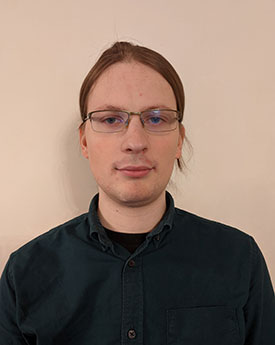
Viktor Tsepelin is a Professor in Condensed Matter Physics at Lancaster University, where he serves as Head of the Lancaster Ultra Low Temperature Group. His research focuses on low temperature physics, particularly studying matter in the vicinity of absolute zero to reveal quantum mechanical effects. He teaches undergraduate courses including Integration (PHYS112), Low Temperature Physics laboratory (PHYS352), Statistical Physics (PHYS322), and Master projects (PHYS451/451).
Dr. Tsepelin received his Master's degree from Tartu University in Estonia, studying oscillators at liquid helium temperatures. He earned his doctorate from the Low Temperature Laboratory at Helsinki University of Technology, where he measured morphology and growth kinetics of helium-3 crystals below 1 mK using optical interferometry. Following his doctorate, he spent three years at Stanford University with Nobel laureate Doug Osheroff researching magnetization of superfluid Helium-3. He joined Lancaster University as a postdoc in 2004 and was awarded an EPSRC Advanced Research Fellowship in 2006.
Professor Tsepelin's research explores the properties of matter near absolute zero, where quantum mechanical effects become dominant. His current research directions include investigating pure quantum turbulence in superfluids, building and cooling detectors based on micro and nano-electromechanical systems, developing compact refrigerators for quantum computing platforms, and searching for dark matter using properties of superfluid He3. His work bridges fundamental quantum phenomena with potential applications in quantum technologies and cosmology.
Analysis of Professor Tsepelin's recent publications reveals a strong focus on quantum turbulence in superfluid helium, particularly in He-3 and He-4. His research spans both theoretical and experimental approaches, with an increasing emphasis on quantum technologies and dark matter detection in recent years. The work involves sophisticated instrumentation including nanoscale probes, torsional oscillators, and superconducting resonators operating at ultra-low temperatures.
Professor Tsepelin has received significant recognition for his work:
- International Union of Pure and Applied Physics Young Scientist Prize (2008) for contributions to quantum crystals and quantum turbulence
He has successfully supervised numerous PhD students to completion and examined PhD theses at various institutions. His research is supported by multiple grants including "Creation and evolution of quantum turbulence in novel geometries" (2023-2027), "LANCQTFP: Quantum Enhanced Superfluid Technologies for Dark Matter and Cosmology" (2020-2025), and the "European Microkelvin Platform" (2019-2023).
Professor Tsepelin leads the Lancaster Ultra Low Temperature Group, which specializes in experimental studies of quantum fluids and solids at temperatures approaching absolute zero. The group develops cutting-edge instrumentation for ultra-low temperature measurements and collaborates internationally on projects related to quantum turbulence, superfluidity, and quantum technologies.