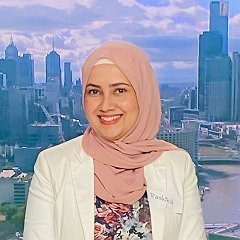
Rashina Hoda
استاد · Human aspects of Software Engineering
Max Planck Institute for Security and Privacyمعرفی
Rashina Hoda is a Professor of Software Engineering at Monash University's Faculty of Information Technology in Australia. She serves as the Associate Dean for Equity, Diversity and Inclusion, where she has introduced an intersectional lens to the EDI portfolio. Recognized as the 2025 Top Researcher in Software Systems in Australia by The Australian, Professor Hoda is an award-winning researcher, educator, and mentor who champions women and girls in STEM.
Her research focuses on the human and socio-technical aspects of Software Engineering, Artificial Intelligence, and Digital Health. Professor Hoda developed Socio-Technical Grounded Theory, which she presented in her 2024 Springer book Qualitative Research with Socio-Technical Grounded Theory. Her work bridges the gap between technical systems and human factors in software development, with particular emphasis on agile methodologies, AI collaboration, and ethical considerations in technology.
An analysis of her recent publications reveals a consistent focus on human-centered approaches to software engineering. Her research spans agile methodology adaptation, socio-technical grounded theory applications, AI ethics awareness, and the exploration of stereotypes in software engineering through large language models. She has been instrumental in developing frameworks that integrate human factors with technical systems, particularly in agile environments and AI-assisted development.
Scientific Awards and Recognition:
- 2025 Top Researcher in Software Systems in Australia by The Australian
- Guiding Star Mentorship Award at the 2024 Women of Colour in STEM Awards
- Superstars of STEM 2021-22 cohort by Science and Technology Australia
Professor Hoda actively contributes to the academic community through leadership roles in major conferences including ASE, ICSE, and ESEC/FSE. She has served as SE In Practice Co-Chair, Workshops Co-Chair, Program Chair for CHASE, and General Chair for multiple conference tracks. Her mentoring work, particularly for women in STEM, has been widely recognized, including her selection as a visible role model through the Superstars of STEM program.
As an educator, she has developed technical briefings on qualitative research methods and socio-technical grounded theory, contributing significantly to research methodology education in software engineering. Her work on teaching software ethics to future engineers demonstrates her commitment to responsible technology development.