معرفی
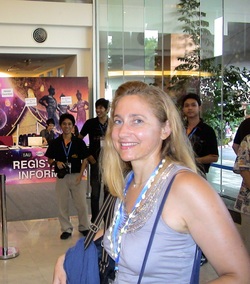
Nectaria Gizani is an Assistant Professor at the School of Science and Technology, Hellenic Open University, Patra, Greece. She serves as the Chief Radio Astronomer and Co-Principal Investigator of the Hellenic Radio Telescope THERMO pYlae project, contributing significantly to radio astronomy research in Greece. Her academic responsibilities include tutoring in both undergraduate and postgraduate physics programs.
Research Interests:
Her primary research areas are Radio Astronomy and Astroparticle Physics, with a focus on the structure of matter and the universe. She is involved in cutting-edge observational projects and data analysis through her work with the THERMO pYlae Radio Telescope. Her research intersects with fundamental physics and cosmology, aiming to deepen understanding of cosmic phenomena.
Key Research Trends:
Although no specific articles are listed, her work is aligned with modern trends in radio astronomy, including large-scale data archiving, signal processing, and multi-messenger astrophysics, particularly through her association with Breakthrough Listen at UC Berkeley.
Scientific Affiliations and Experience:
- Visiting Scholar, Department of Astronomy, Breakthrough Listen Lab, UC Berkeley
- Co-PI, Hellenic Radio Telescope THERMO pYlae
- Coordinator and Tutor, Postgraduate Module: 'The Structure of Matter and Universe'
- Tutor, Undergraduate Module: Classical Physics II (Mechanics and Electromagnetics)
Advising and Grants:
While no formal advisees or grant details are listed, her leadership role in THERMO pYlae implies involvement in research funding and team coordination. She likely mentors students through course instruction and research projects, particularly within the postgraduate physics program.
Labs and Research Teams:
Nectaria is actively involved with the Breakthrough Listen Research Group at UC Berkeley and leads the THERMO pYlae Radio Telescope project in Greece. These affiliations place her within international networks focused on detecting extraterrestrial signals and advancing radio astronomy infrastructure in Europe.