معرفی
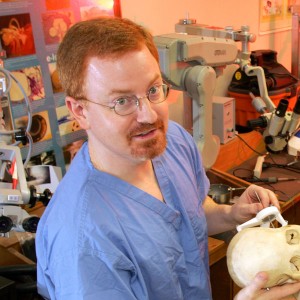
Jack H. Noble is an Assistant Professor at Vanderbilt University, holding appointments in the departments of Electrical and Computer Engineering, Computer Science, Biomedical Engineering, and Head and Neck Surgery. He directs the Biomedical Image Analysis for Image-Guided Interventions Laboratory (BAGL) and co-chairs the VISE Symposium Series. His research focuses on medical image processing, particularly in computer-aided surgery and cochlear implant optimization.
- Assistant Professor, Electrical and Computer Engineering (Primary)
- Assistant Professor, Computer Science
- Assistant Professor, Biomedical Engineering
- Assistant Professor, Head and Neck Surgery
- Director of Graduate Student Recruitment, Vanderbilt School of Engineering
Education:
- Ph.D., Electrical Engineering, Vanderbilt University (2011)
- M.S., Electrical Engineering, Vanderbilt University (2008)
- B.E., Electrical Engineering, Vanderbilt University (2007)
Research Interests: Dr. Noble specializes in medical image analysis for surgical applications, combining deep learning, statistical shape models, graph search algorithms, and augmented reality to enhance precision in procedures like cochlear implantation. His work bridges engineering and clinical practice, emphasizing patient-specific modeling and real-time intra-operative guidance.
- Deep learning for medical imaging
- Statistical shape modeling of ear anatomy
- Augmented reality in surgery
- Image-guided cochlear implant programming
- Neural activation simulation
- Micro-CT to CT translation
Article Trends: His publications (2011–2023) highlight advancements in automated segmentation, deep learning architectures (e.g., Cycle GANs, cGANs), and augmented reality systems. Key themes include cochlear implant optimization, auditory nerve health estimation, and surgical precision through image analysis.
Advising & Grants: Dr. Noble mentors graduate students and postdocs, with alumni contributing to fields like medical imaging and surgical robotics. His work is funded by NIH grants R01DC014037 and R01DC022099, focusing on patient-specific cochlear implant models and augmented reality-guided surgery.