معرفی
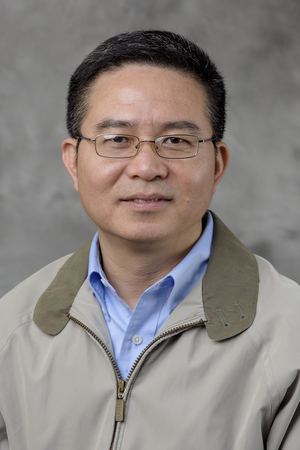
Fuqiang Wang is a Professor in the Department of Physics and Astronomy at Purdue University. He holds a B.S. in Physics from the University of Science and Technology of China (1988), and M.S. (1990) and Ph.D. (1996) in Physics from Columbia University. His research focuses on relativistic heavy-ion physics, quantum chromodynamics, and the quark-gluon plasma, primarily through participation in the STAR experiment at RHIC and the CMS experiment at the LHC. He has been recognized with awards including Fellow of the American Physical Society (2010) and University Faculty Scholar at Purdue (2008-2013).
Education History:
- B.S., Physics, University of Science and Technology of China, 1988
- M.S., Physics, Columbia University, 1990
- Ph.D., Physics, Columbia University, 1996
Research Interests:
- Relativistic heavy-ion collisions and quark-gluon plasma dynamics
- Experimental studies using STAR and CMS detectors
- Chiral magnetic effect and collective flow phenomena
- Jet quenching and energy loss mechanisms
Recent Work Trends: His 2024-2025 publications emphasize advancements in understanding quark-gluon plasma properties via azimuthal anisotropy measurements, chiral magnetic effect validation, and high-energy jet interactions in heavy-ion collisions. Key collaborations include the STAR and CMS experiments.
Grants & Labs: Leads the High Energy Nuclear Physics (HENP) group at Purdue, contributing to the sPHENIX experiment at RHIC and planning for the Electron-Ion Collider (EIC). Active in detector development for future collider facilities.
Awards: Highlighted achievements include DOE Outstanding Junior Investigator Award (2002-2007) and Feynman Scholarship (1994).