معرفی
Prof. Dr. Eva Liebau is a Professor and Group Leader at the Institute for Integrative Cell Biology and Physiology, University of Münster, Germany, specializing in Molecular Physiology. She leads an active research group investigating glutathione metabolism, oxidative stress response, and parasitic nematodes, with significant involvement in the SãMBio German-Brazilian double degree program with the University of São Paulo.
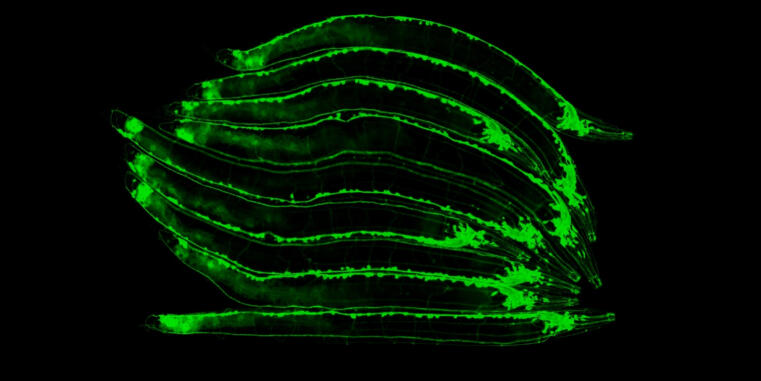
Her research focuses on the molecular mechanisms of genetic adaptation to xenobiotic compounds and oxidative stressors, using Caenorhabditis elegans as a model organism. Her work spans environmental stress response, thiol-based redox signaling, glutathione-related enzymes, regulation of translation, and the secretome of parasitic nematodes. She has made significant contributions to understanding the UFM1 cascade, a posttranslational modification system highly conserved in multicellular organisms.
Prof. Liebau's recent publications reveal a strong trend toward anthelmintic drug discovery using natural compounds and plant extracts, with particular emphasis on understanding the mechanisms of action against parasitic nematodes. Her work bridges basic molecular research with applied parasitology, contributing to both fundamental understanding of stress responses and potential therapeutic applications.
She actively supervises PhD and MSc students including Emma Schröder and Luka Ressmann, and collaborates extensively with international partners including the Institute of Biomedical Sciences at the University of São Paulo, the Institute of Pharmaceutical Biology and Phytochemistry at the University of Münster, and the Redox Homeostasis Group at the Institute of Biomedicine of Seville.
Prof. Liebau is affiliated with multiple research networks including Cells in Motion, CRC 1009 (Breaking Barriers), CRC 1348 (Dynamic Cellular Interfaces), CRC 1459 (Intelligent Matter), and CRC 944 (Physiology and Dynamics of Cellular Microcompartments), and participates in several PhD programs including CiM-IMPRS, IRTG Graduate School, and SP BioSciences.