معرفی
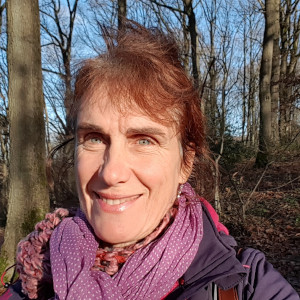
Claire Damesin is a Professor at the University of Paris-Saclay, affiliated with the Plant Ecophysiology team at the Laboratoire Écologie, Société et Évolution (IDEEV). Her work bridges plant physiology, ecology, and interdisciplinary studies with art, focusing on tree carbon dynamics and human-nature relationships.
Her educational background includes:
- Admission to Ecole Normale Supérieure (ENS Lyon) in 1988
- French national agrégation in Life and Earth sciences in 1991
- Master of General Ecology (DEA) from University Paris Sud in 1992
- PhD from the Center of Functional and Evolutionary Ecology in Montpellier (1993-1996)
Professor Damesin's research centers on tree ecophysiology, particularly in carbon functioning of woody parts (ring growth, reserve dynamics, stem respiration, and stem photosynthesis), stable carbon isotope composition (13C/12C) in leaves and rings, and tree responses to drought and climate variations. She pioneers art-science collaborations exploring intimacy with trees and interdisciplinary approaches to human-nature relationships, integrating ecology, art, anthropology, and philosophy. Her methodology combines field studies on mature forest trees and potted plants.
Analysis of her publications reveals a strong focus on carbon cycling in trees using stable isotopes to understand climate responses and tree decline across species like beech, oak, and pine. A notable evolution is her expansion into human-nature relationship studies through art-science projects, reflecting interdisciplinary innovation.
She actively contributes to academic leadership as co-manager of the EVEF sector in the Master BEE program and manager of the 'Adaptations to change' teaching unit. Her teaching spans all levels from undergraduate to master's programs, covering botany, plant anatomy, soil-vegetation relationships, and field trainings, with recent innovations in creativity workshops and human-nature relation courses.
Professor Damesin leads the Plant Ecophysiology team within IDEEV laboratory, driving research on tree responses to environmental changes and fostering science-art collaborations that redefine ecological engagement.