معرفی
Barry Hibbs is a Professor in the Department of Geosciences and Environment within the College of Natural & Social Sciences at California State University, Los Angeles. Based in office ASCL 161, he directs a comprehensive hydrogeology program focused on groundwater resources and environmental systems across diverse landscapes.
His academic credentials include:
- B.S. in Geology from Arizona State University (1985)
- M.S. in Hydrogeology from the University of Nebraska - Lincoln (1989)
- Ph.D. in Hydrogeology from the University of Texas at Austin (1993)
Dr. Hibbs' research integrates numerical modeling, isotope techniques, and geophysical methods to investigate groundwater systems. His work spans arid basins in the southwestern US/Mexico, urban southern California, and Pacific coastal wetlands, with emphasis on contaminant transport, hydrochemical processes, and watershed dynamics. Key methodologies include vadose zone analysis, stream-aquifer interactions, and field-based hydrogeological assessments.
Recent publications (2024-2025) demonstrate concentrated focus on the Salton Sea region, fossil groundwater systems, and brine contamination. His work consistently bridges theoretical hydrogeology with practical environmental applications, particularly in water-scarce regions facing climate change pressures and anthropogenic impacts.
Notable scientific recognition includes:
- Elected Fellow of the Geological Society of America (2012)
- CSULA Outstanding Professor Award (2014)
- National Ground Water Association's Keith E. Anderson Award (2023)
- Multiple conference paper/poster awards (2007-2018)
- Outstanding Graduate Mentor Award (2018)
As Principal Investigator on major federal grants, Dr. Hibbs leads research initiatives totaling over $2 million, including:
- $680,000 Department of Energy watershed analysis project (2023-2026)
- $750,000 USDA-NIFA undergraduate training grant (2023-2028)
- $300,000 USDA Salton Sea water availability study (2024-2027)
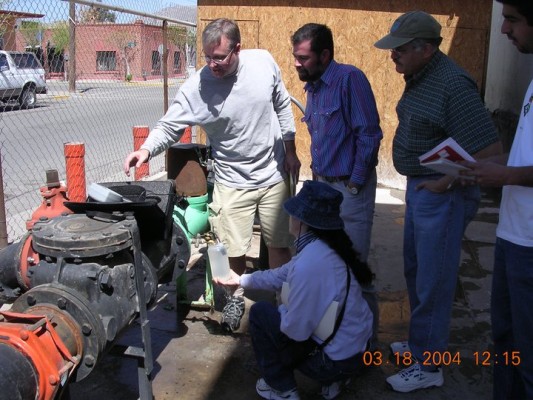
Dr. Hibbs directs field-based research teams conducting hydrogeological investigations across complex environments, with particular emphasis on integrating geophysical techniques with traditional hydrological methods to address contamination and water resource challenges in dynamic ecosystems.