معرفی
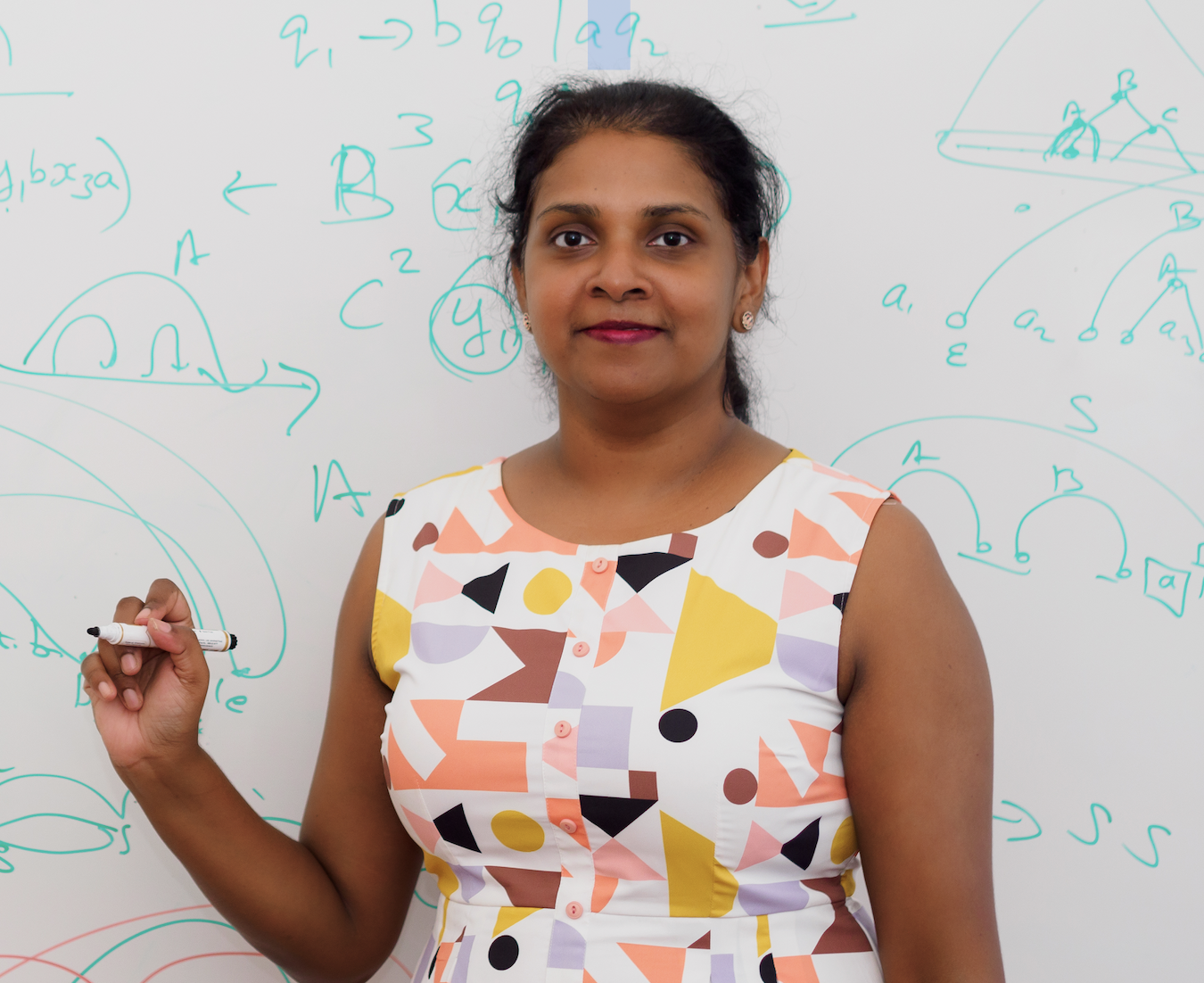
Aiswarya Cyriac is an Associate Professor in the Theoretical Computer Science Group at Chennai Mathematical Institute (CMI), India, with active roles including program committee co-chair for FSTTCS 2025 and ICLA 2025. She is a member of ReLaX, an international research lab established by CNRS (France), fostering cross-border collaboration in foundational computer science. Her office is located at CMI's H1, SIPCOT IT Park campus in Siruseri, Chennai.
Educational Background:
- Ph.D. from École normale supérieure de Cachan, France (2014)
Her research specializes in automata theory and its applications to the verification of infinite state systems, concurrent models, and distributed algorithms. She develops formal mathematical frameworks for string constraints with subword ordering, finite state transducers, and treewidth-based verification techniques, addressing decidability and complexity challenges in system analysis. Current projects focus on verification of communicating Datalog programs and string constraint satisfiability.
Publication trends (2020-2024) reveal a concentrated effort on verification methodologies for communicating systems, string constraint analysis, and transducer theory. These works consistently appear in premier venues like STACS, ICALP, LICS, and PODS, demonstrating her leadership in automata-theoretic approaches to system verification and formal language applications.
Educational Leadership:
- Ph.D. advising: Soumodev Mal (ongoing, co-advised with Prakash Saivasan), Sahil Mhaskar (ongoing, co-advised with M. Praveen)
- Master's supervision: Kushal Prakash ("Unbounded Distributed Graph Automata", 2018), Adwitee Roy ("Graph Automata and Tree-Width", 2017)
- Short internships: Anupa Sunny (NFA learning, 2017), Rao Shrisha Shripathy (weighted automata learning, 2017), Nisarg Patel (finite state models, 2016)
She maintains strong institutional ties through the Theoretical Computer Science Group at CMI and ReLaX (CNRS), driving collaborative research on formal verification and automata theory. Her work bridges theoretical foundations with practical applications in database-driven systems and distributed algorithms, supported by consistent conference participation and editorial service.