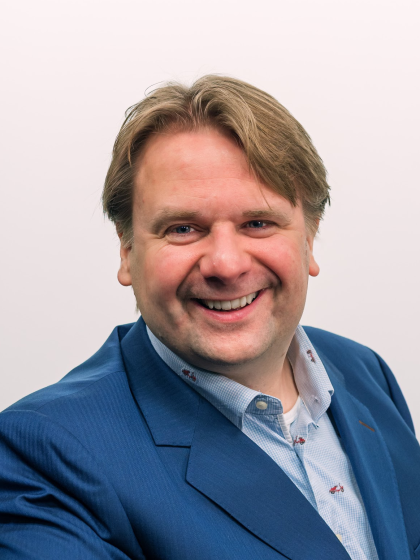
Massimo Mischi is a Full Professor at the Faculty of Electrical Engineering of the Eindhoven University of Technology (TU/e) and chairs the Signal Processing Systems (SPS) Division , the largest division at TU/e with over 250 researchers. He founded the Biomedical Diagnostics (BM/d) Lab in 2012, which now includes 180 researchers and clinical/industrial advisors, focusing on biomedical signal processing for diagnostics and monitoring.
Dr. Thijs Broekhuizen is an Associate Professor at the University of Groningen's Faculty of Economics and Business, specializing in Innovation Management & Strategy. He currently serves as Scientific Director of the University of Groningen Business School, Coordinator of the Northern-Netherlands Innovation Monitor, and Programme Director of the Executive MBA. His research focuses on digital transformation, value creation in innovation, and digital business models, with interdisciplinary insights bridging strategy, innovation, and digitalization. Education: PhD in Marketing (University of Groningen, 2006) MSc in Marketing (University of Groningen, 2001) Research Interests: Broekhuizen explores value appropriation in technology-driven contexts, digital business models, and strategic responses to disruptive technologies. His work emphasizes SMEs' digital transformation challenges, organizational identity during technological change, and AI-driven innovation management. Key areas include digital platforms, motion picture industries, and social media dynamics. Grants & Projects: TALENT4S3 (€165K, Interreg 2024-2028) SIRM (€189K, Interreg 2023-2027) NWO-funded studies on construction industry profitability and online customer journeys Awards: Best Paper Award at ISoF 2021 Best Short Paper Award Nomination 2021 Teaching & Leadership: Broekhuizen teaches strategy and digitalization in executive programs and has led the MScBA and EMBA initiatives. His educational roles include Programme Director of the Executive MBA (Energy Transition, Health, Sustainable Business Models tracks) and member of the Groningen Digital Business Centre. Labs/Teams: He coordinates the Northern-Netherlands Innovation Monitor (surveying 10,000+ SMEs) and collaborates with the Groningen Digital Business Centre to advance digital strategy research.
Maria C.W. Peeters serves as a Full Professor at Eindhoven University of Technology (TU/e) within the Department of Industrial Engineering and Innovation Sciences, specifically the Human Performance Management Group. She concurrently holds an Associate Professor position at Utrecht University in the Department of Social, Health and Organizational Psychology, reflecting her dual institutional engagement in Work and Organizational Psychology. Her educational background includes: MSc in Health Sciences from Maastricht University PhD from Radboud Universiteit Nijmegen (dissertation: effect of social support on work stress) Peeters' research investigates sustainable workforce performance through the critical lens of worker diversity in high-tech environments. She specializes in worker (ill)health and well-being, work engagement, sustainable employability, job crafting interventions, work-life balance dynamics, and tailored technological innovation implementation. Her work emphasizes adapting technologies to accommodate older workers, those with lower educational levels, and disabilities to extend labor market participation. Recent publications (2025) analyze psychosocial safety climate and the DISC model for office workers, while earlier studies (2018-2015) focused on job crafting transmission and intervention efficacy. Her research consistently employs quantitative methodologies like regression analysis within the Job Demands-Resources framework, addressing sustainable performance threats from rapid technological implementation. No specific scientific awards or prizes are documented in the provided text. Peeters has published over 100 national and international articles and book chapters, with 75 research outputs listed in TU/e's repository. She co-edited the textbook "An Introduction to Contemporary Work Psychology" (Wiley Blackwell, 2014) and serves on editorial boards for Work & Stress and Gedrag en Organisatie (Dutch Journal of Behaviour in Organizations). Her academic leadership includes presidency of the Dutch Association of Work & Organizational Psychology since 2018. She operates within the Human Performance Management Group at TU/e, which studies workforce optimization through health, engagement, and sustainable employability metrics in digitized workplaces.
Prof. Karst Geurs is a Full Professor of Transport Planning at the Department of Civil Engineering and Management, Faculty of Engineering Technology, University of Twente. He chairs the examination board of Civil Engineering and Management and serves as department portfolioholder for education. His research focuses on accessibility analysis, land-use-transport interactions, sustainable mobility, and transport policy evaluation. Geurs holds a PhD (cum laude) from Utrecht University (2006) and has led major projects like the SmartHubs initiative. He is currently vice-chair of NECTAR (Network of European Communications and Transport Activities Research), previously chair from 2014–2024, and served as Editor-in-Chief of the European Transport Research Review (2017–2023). His work addresses cycling safety, mobility hubs, and urban resilience. Key contributions include studies on shared mobility, 15-minute city concepts, and post-pandemic transport trends. He has published over 200 articles and datasets, including work on accessibility equity in São Paulo favelas. Awards include the Gouden RAI Wiel (2015). Geurs actively engages in policy dialogues, media appearances (e.g., Radio 1 interviews), and international conferences. Research interests span transport innovation, spatial equity, and smart infrastructure. Recent projects explore digital mobility skills, teleworking impacts, and cycling safety metrics. His work integrates interdisciplinary approaches to address urban challenges, emphasizing sustainable and equitable mobility solutions.
Paul Moritz Wiegmann is an Assistant Professor in the Department of Industrial Engineering and Innovation Sciences at Eindhoven University of Technology (TU/e), where he is part of the ITEM group. He currently serves as President of the European Academy of Standardisation (EURAS). His academic career includes visiting research positions at TU Berlin (2014 & 2015), Yonsei University, Seoul (2018), and the University of California, Davis (2023). Paul holds a PhD from Rotterdam School of Management, Erasmus University, alongside additional degrees from Erasmus University and the University of Warwick. His educational background emphasizes interdisciplinary training, reflected in his research and teaching. His research focuses on the role of standardization in innovation ecosystems, particularly how explicit and implicit rules enable value creation and capture. He employs mixed-methods approaches, including case studies, grounded theory, choice experiments, and conjoint analysis. His work aligns with UN Sustainable Development Goals, addressing societal challenges like sustainability and smart technologies through collaborative frameworks. Notable awards include the Industria Education Award 2022-2023 for Best Teacher Talent (2023) and the ISPIM Dissertation Award 2020 (2020). These recognize his contributions to both education and research in standardization and innovation. In advising and grants, Paul has supervised 30 works (names not listed) and leads the Measuring societal impact of standards project (2021–2022). He also coordinates the FIQCS: FIeldlab Quantum Cryptography Solutions for Safe Society initiative (2023–2028). His activities include organizing conferences like EU-SPRI 2025 and delivering invited talks on topics ranging from standardization governance to quantum technologies. Paul teaches courses such as Methodology for IE research and Patents design rights & standards exploration course , reflecting his expertise in standardization and research methods. He contributed to the Standardization literature database (2024), an interdisciplinary review, and engages in media discussions on topics like AI adoption in SMEs and quantum threat mitigation in public safety.
Rianne Conijn is an assistant professor in the Human-Technology Interaction group at Eindhoven University of Technology (TU/e), Netherlands. Her research bridges data-driven methodologies (machine learning, statistical modeling) with human-centered design to enhance learning analytics, explainable AI, and writing process analysis. She holds a joint PhD (cum laude) from Antwerp University and Tilburg University, and an MSc (cum laude) in Human-Technology Interaction from TU/e. Academic Background: MSc (2015, TU/e, cum laude), PhD (2020, Antwerp University & Tilburg University, cum laude). Research Focus: Learning analytics, keystroke logging, explainable AI for education, data dashboards, and self-regulated learning dynamics. Teaching: Courses in Advanced Research Methods, Human-AI Interaction, Behavioral Research Methods, and AI ethics in education. Her recent publications explore parallel language planning in writing, longitudinal self-regulated learning strategies, and generalizability of academic performance prediction models. She leads an NWO Veni project on Human-Centered AI in education, emphasizing tailored explanations for student-AI collaboration. Scientific awards include cum laude distinctions for her MSc and PhD, and the NWO Veni grant. Collaborative work spans institutions in the Netherlands, Norway, and the U.S., with applications in intelligent tutoring systems and ethical AI deployment in exams. Key trends across her work: integration of machine learning with educational theory, leveraging keystroke data for cognitive process insights, and prioritizing actionable, explainable AI systems for student support. Publications span journals like the Journal of Experimental Psychology: General , Computers and Education , and IEEE Transactions on Learning Technologies . Scientific Awards: NWO Veni grant for Human-Centered AI in education Cum laude for MSc and PhD Grants & Collaborations: National Science Foundation grants (2016868, 2302644) for biometric feedback in writing UK Research and Innovation grant (ES/W011832/1) for real-time AI scaffolding TU/e Boost! Program grant for self-regulated learning analysis Labs & Teams: EAISI Foundational (Eindhoven AI Systems Institute) Human Technology Interaction group at TU/e Collaboration with Norwegian Reading National Center (University of Stavanger) Project teams for Waterproof ITS and ProWrite grants
Khadicha Amarti serves as an External PhD Candidate at Vrije Universiteit Amsterdam's Faculty of Behavioural and Movement Sciences within the Clinical Psychology department. Her research bridges artificial intelligence and mental healthcare, with particular focus on reinforcement learning applications for improving mental health treatment adherence and outcomes. Her research interests center on Reinforcement Learning (100% specialization), Mental Health Applications (54%), and Cognitive Behavioral Therapy (50%) as evidenced by her research fingerprint. She investigates how machine learning algorithms can personalize digital mental health interventions, particularly for depression treatment and anxiety management. Her work explores multimodal data analysis including text, audio, and video inputs to predict mental health conditions and optimize treatment protocols. Amarti's publication record demonstrates consistent growth in AI-driven mental health research, with increasing focus on practical implementation of reinforcement learning in healthcare settings. Her work shows strong interdisciplinary collaboration across computer science and clinical psychology domains, with particular emphasis on translating theoretical AI models into clinically viable digital health tools. She has contributed to significant research projects including the e-Mental Health Innovation and Transnational Implementational Platform NW-Europe (2016-2020), where she served as a Project Researcher. Amarti also teaches the course eMental Health, Praktijk en Onderzoek scheduled for the 2025-2026 academic year, demonstrating her role in academic knowledge transfer.
Loes Keijsers is a Full Professor in Clinical Child and Family Studies at the Department of Psychology, Education and Child Studies, Erasmus School of Social and Behavioural Sciences, Erasmus University Rotterdam. Her work focuses on adolescent development, parent-adolescent relationships, and the application of advanced methodological approaches such as Experience Sampling Methods to study daily emotional and behavioral dynamics in teens. Her research interests include: Clinical Child and Family Studies Adolescent mental health and well-being Parenting dynamics and autonomy support Statistical modeling and longitudinal analysis Digital interventions and e-health tools for youth Her recent publications highlight a strong trend in using intensive longitudinal data and mobile technology to understand heterogeneity in adolescent development and family processes. She emphasizes preregistered research and robust statistical models to enhance scientific rigor. Her work increasingly integrates digital tools such as smartphone apps and serious games (e.g., the Grow It! App) to promote adolescent mental health. Notable contributions include: Developing and evaluating e-health applications for adolescent depression Advancing ecological momentary assessment in family research Translating psychological research into public impact through TEDx talks and the book Waarom tieners zo irritant kunnen zijn Contributing to UN Sustainable Development Goals related to well-being and mental health She actively supervises research and has contributed to multiple datasets in the areas of social media use, adolescent well-being, and intensive longitudinal methods. Her collaborative network spans interdisciplinary teams working on youth mental health innovation. Loes leads the research project PROJECT ADAPT (www.projectadapt.nl), which aims to develop and implement personalized digital tools to support adolescent mental health and family functioning. She is also active on social media (Twitter: EUR_ADAPT) and engages in public science communication through platforms like TEDx and Universiteit van Nederland.
Krist Vaesen is an Associate Professor in the Philosophy of Innovation at Eindhoven University of Technology (TU/e), within the Department of Philosophy & Ethics in the School of Industrial Engineering and Innovation Sciences. He is a founding member of the Eindhoven Meta-Science Center (META/e) and maintains an external position as a Research Fellow at Leiden University's Human Origins Group, Faculty of Archaeology. Dr. Vaesen earned his degrees in Applied Biology (1998) and Philosophy (2003) from the University of Leuven, Belgium, and completed his PhD at TU/e in 2008 with a dissertation on artifacts and norms. His academic career progressed from post-doctoral researcher (2008-2012) in the NWO program 'Things that make us smart' to Assistant Professor (2012), and eventually to his current Associate Professor position. He received a prestigious NWO Vidi grant in 2014 for his research on cultural evolutionary theory. Vaesen's research spans multiple interconnected domains including the philosophy of innovation, meta-science, cultural evolution, and the philosophy of scientific models. His current work focuses extensively on meta-scientific questions examining science funding practices, interdisciplinary research challenges, PhD attrition causes, academic research values, and research integrity. He is preparing a book titled 'Neophilia--why our obsession with innovation leads to bad science' addressing replication crises in science. His publication record shows consistent scholarly output, with 49 research outputs documented through 2025, appearing in high-impact journals across multiple disciplines including Proceedings of the National Academy of Sciences, Behavioral and Brain Sciences, PLoS ONE, and various philosophy and anthropology journals. His work demonstrates a clear trajectory toward increasingly meta-scientific concerns, with recent publications focusing on research values, PhD attrition, and science funding ethics. NWO Vidi Award (2013) for 'The Darwinisation of culture' Excellence grant from TU/e's Executive Board for work on the 'Things that make us smart' program Elected member of the Eindhoven Young Academy of Engineering (2018) Vaesen has supervised multiple graduate students (with 4 supervised works documented) and secured significant research funding, including his Vidi grant for the 'Darwinizing culture' project (2014-2019). He has been actively involved in science policy discussions, particularly regarding research funding reform and interdisciplinary research assessment. His work has generated substantial media attention, with 127 press/media mentions including coverage by Times Higher Education, Volkskrant, and various radio outlets. As co-founder of the Eindhoven Meta-Science Center, Vaesen plays a key role in advancing meta-scientific research at TU/e. His external position at Leiden University's Human Origins Group demonstrates his interdisciplinary reach across philosophy, anthropology, and evolutionary studies. He teaches courses including 'Metascience' (since 2024), 'Philosophy of science and technology,' and 'Research methodology for the innovation sciences,' shaping the next generation of scholars in these critical areas.
Rick Kramer is an Assistant Professor at the Building Physics and Services unit within the Department of Built Environment at Eindhoven University of Technology (TU/e) in the Netherlands. His work focuses on advancing building automation and energy efficiency through innovative control strategies and fault detection systems for indoor environments. His educational background includes: MSc (with honors) in Building Services from Eindhoven University of Technology (2012) PhD (with honors) from Eindhoven University of Technology with dissertation on 'Energy efficient indoor climate control strategies for museums respecting collection preservation and thermal comfort of visitors' (2017) Rick Kramer's research centers on smart control of indoor environments and fault detection in HVAC systems. His work combines data-driven techniques with expert knowledge to develop algorithms that optimize energy efficiency while maintaining human wellbeing in offices, preserving collections in museums, and ensuring proper conditions in cleanrooms. He collaborates extensively with both large companies and SMEs on R&D projects aimed at accelerating market uptake of innovations to address societal challenges. His specific expertise spans low delta-T syndrome in cooling systems, cooling coil design and performance, automatic fault detection and diagnosis (AFDD), and the impact of indoor environmental conditions on human comfort and performance. His recent publications demonstrate a strong focus on cooling system optimization, particularly addressing low delta-T syndrome through advanced modeling techniques and practical solutions. His work bridges theoretical research with practical implementation in building systems, contributing significantly to energy conservation in the built environment. Rick has been recognized for his contributions to the field with: TVVL's BJ Max prize for his publications on the museum environment (2019) Best PhD dissertation award from the Department of Built Environment (2017) As an active member of the academic community, Rick serves as a reviewer for 20+ academic journals and has participated in several scientific committees for international conferences. Through his company DYSECO B.V., where he serves as co-founder, shareholder, and director, he bridges the gap between academic research and practical implementation in the building industry. Rick leads research within the EAISI (Eindhoven Artificial Intelligence Systems Institute) and EIRES (Energy Innovation and Research in the Built Environment) groups, focusing on applying AI and data science to building systems. His work contributes significantly to addressing sustainability challenges in the built environment through innovative technological solutions.
Renata Medeiros de Carvalho is an Assistant Professor at Eindhoven University of Technology (TU/e), affiliated with the Process Analytics and EAISI Health groups. She holds a PhD in Computer Science from Federal University of Pernambuco (Brazil), an MSc and BSc in Computer Engineering from University of Pernambuco, and has conducted postdoctoral research at UQAM (Canada). Her research focuses on adaptive and declarative business processes, with particular emphasis on healthcare and data privacy. Education: PhD in Computer Science, Federal University of Pernambuco (2015) MSc in Computer Engineering, University of Pernambuco BSc in Computer Engineering, University of Pernambuco Research Interests: Flexible business processes and Process Mining Declarative modeling (e.g., OCBC language) Healthcare process optimization GDPR compliance frameworks Key Projects: PATIENCE 2 : Patient-centric healthcare through nomadic sensing BPR4GDPR : GDPR compliance toolkit Awards: Xerox University Affairs Committee Grant NSERC Engage Grant Teaching & Leadership: Local coordinator for EIT Digital Data Science and Erasmus Mundus BDMA master programs Teaches courses like Advanced Process Mining and DBL Data Challenge
Aglaia Zedlitz is an Assistant Professor of Clinical Neuropsychology in the Health, Medical and Neuropsychology unit at Leiden University's Faculty of Social and Behavioural Sciences. She also works as a psychotherapist at G-Kracht psychomedical institute. Dr. Zedlitz received her PhD in 2013 from the Donders Institute for Brain, Cognition and Behavior at Radboud University Nijmegen, focusing on fatigue after acquired brain injury. She completed her post-graduate education to become a licensed psychotherapist in 2020. Her research interests focus on improving treatments for neurological disorders (particularly fatigue) and neuro-psychiatric conditions. She specializes in developing new treatment delivery formats through eHealth and serious gaming applications. Her work bridges clinical practice with empirical research to develop evidence-based interventions. Her publications demonstrate a strong focus on innovative rehabilitation approaches, particularly the integration of cognitive therapy with physical activity training for post-stroke fatigue. Her research shows how digital health solutions can be effectively implemented in neuropsychological rehabilitation. Revalidatiefonds grant (2015) for eHealth application development Johanna Kinderfonds grant (2015) for children's eHealth application Adriaanfonds grant (2015) for children's eHealth application As an educator , Dr. Zedlitz coordinates the Intervention Strategies in Clinical Neuropsychology course for MSc students and lectures in Diagnostics in Clinical Neuropsychology (MSc) and Clinical Neuropsychology (BSc). She has supervised multiple PhD candidates including Yvonne Maas, Janice Sandjojo, Miel Vugts, and John Molenaar. Her work on the eCOGRAT project represents a significant contribution to developing evidence-based treatments for fatigue after acquired brain injury, combining cognitive therapy with graded activity training.
Ioulia Ossokina is an Associate Professor of Urban Economics for Technological Innovation at Eindhoven University of Technology's Department of Built Environment . Her research focuses on data-driven mathematical models to predict urban behavior, particularly for vulnerable groups in energy transitions, and integrates big data, AI, and behavioral games into cost-benefit analyses for policy-makers. Education : PhD in Mathematical Economics and Econometrics (Erasmus University Rotterdam, 2003); 13-year tenure as senior researcher at CPB Netherlands Bureau for Economic Policy Analysis before joining TU/e in 2016. Research Highlights : Develops tools for inclusive city planning and energy-efficient housing targeting low-income populations Leads the UBeX Urban Behaviour eXtended Reality Lab for immersive urban preference studies Co-developed the LUCA spatial equilibrium model for analyzing transportation and urban development Innovates in senior living concepts through econometric analysis and architectural design integration Article Trends : Her publications span energy transition impacts (15/20 articles), transportation economics (6/20), and senior housing (5/20), with methodological focus on stated choice experiments , spatial modeling , and digital behavioral twins . Advising & Grants : Supervises 30+ junior researchers Secured major grants from NWO , RVO , and Netspar for energy poverty and senior living projects Collaborates with housing associations (Woonbedrijf, Atriensis) and TU Delft architects Lab & Collaborations : Founder of TU/e's Urban Economics cluster (since 2016) Co-leads EAISI Mobility and Health in the Built Environment initiatives Organized interactive workshops like Science meets Public Housing with 100+ participants
Addie van der Sluis is a Researcher at Wageningen University & Research within the Food, Health & Consumer Research group of Wageningen Food & Biobased Research. Her work critically addresses food security, safety, and sustainability through interdisciplinary research spanning protein quality assessment, food legislation, and waste reduction strategies. With 52 research outputs including reports, articles, and conference presentations, she bridges scientific inquiry with practical policy applications in global food systems. Her research interests focus on protein quality metrics (amino acid scoring, digestibility), EU food legislation for novel foods, and systemic food waste reduction. She investigates how cosmetic standards in produce marketing impact waste streams and develops AI-driven methodologies for protein quality assessment. Her work integrates nutrition science, environmental sustainability, and regulatory frameworks to tackle food security challenges, with particular emphasis on sustainable protein sources like seaweed and policy interventions for waste prevention. Analysis of her 15 most recent publications reveals a strong trajectory toward AI-assisted literature synthesis for protein quality assessment and increasingly sophisticated analysis of food waste policy impacts. Her work demonstrates consistent focus on translating scientific findings into actionable regulatory guidance, particularly regarding novel food approvals and cosmetic standard reforms. The interdisciplinary nature of her research spans food science, environmental engineering, and socio-economic policy analysis. Dr. van der Sluis has secured and led significant research projects including 'Verlaging medicijngebruik agv voeding' (2009) focused on reducing medication use through nutrition in care facilities, and 'Interventies voedingswaarde' (2008-2011) developing nutritional value interventions. Her grant work emphasizes practical implementation of research findings into food policy and industry practice. She actively collaborates within Wageningen Food & Biobased Research's Food, Health & Consumer Research group and maintains international networks through conference participation. Her recent activities include presentations on EU novel food legislation (2021) and microbial food cultures regulation (2020), demonstrating engagement with evolving food safety frameworks.
Dr. Sascha Struijs is an Assistant Professor at the Vrije Universiteit Amsterdam, affiliated with both the Faculty of Behavioural and Movement Sciences (Clinical Psychology department) and the APH - Mental Health unit. Their research focuses on mental health interventions, college student wellbeing, and psychological treatment efficacy, with a particular emphasis on LGBTQ+ populations and digital health solutions. They collaborate internationally on large-scale studies like the World Mental Health International College Student (WMH-ICS) initiative. Research interests include: Depression and anxiety treatment outcomes Internet-based cognitive behavioral therapy (CBT) Sexual orientation and mental health disparities Sleep and circadian rhythm interventions Obsessive-compulsive disorder (OCD) treatment meta-analyses Mental health during pandemics Recent work examines: Global mental health trends in university students Effectiveness of brief interventions for addiction and mood disorders Guided self-help programs for sleep improvement Teaching focuses on low-intensity mental health treatments for common disorders. Ancillary activities include working as a mental health specialist at De Autisme Specialist in Bilthoven since 2022.