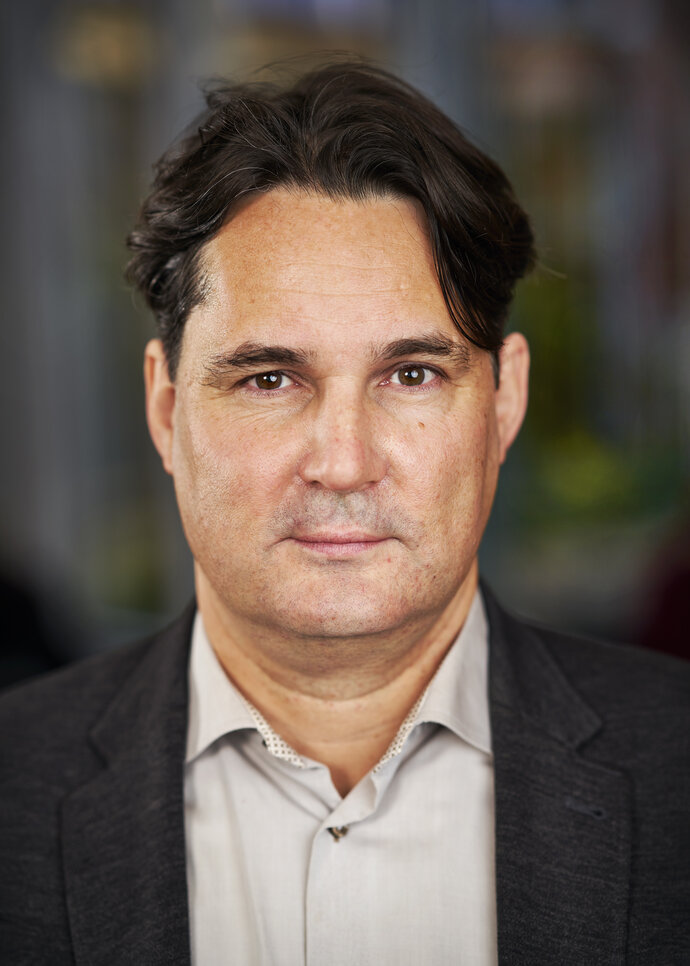
David Dunér is a Professor at the Department of History of Ideas and Sciences, within Lund University's College of Humanities and Theology. He serves as Manager of Research and Postgraduate Education, focusing on the history of science and philosophy in Sweden (17th-18th centuries), astrobiology's history and philosophy, and cognitive history. Educated in Sweden, he defended his thesis on Swedenborg's natural philosophy in 2004. His key publications include Tankemaskinen (2012), Human Lifeworlds (2016), and Cognitive History (2019). Research trends include: Transdisciplinary analysis of apocalyptic themes through the At the End of the World program. Integration of cognitive science into historical research methodologies. Epistemological studies of biosignature detection in astrobiology. Scientific awards: Royal Swedish Academy of Letters Prize (2006) Einar Hansen Legacy Award (2010) Royal Gustavus Adolphus Academy Prize (2023) Editorial roles encompass leading the Ugglan: Lund Studies in the History of Ideas and Sciences series and serving on multiple international journal boards. He participates in academic networks like the Royal Physiographic Society and the New Society of Letters at Lund.
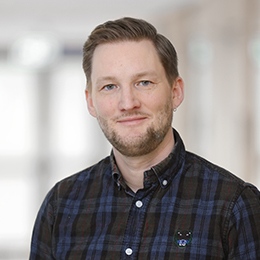
Hampus Bejnö is an Associate Professor and postdoctoral researcher at the Department of Special Education , Stockholm University. He also serves as Program Director for the Special Educator Program (specialpedagogprogrammet). Role: Associate Professor, Postdoctoral Researcher, Program Director Focus: Learning and participation of children with autism Key projects: APERS adaptation, TRAS evaluation, PANS qualitative studies Research Themes Improving educational environments for children with ASD Enhancing neuropsychological report readability Assistive technology for neurodiverse populations Awards & Collaborations While no explicit awards are listed, Bejnö contributes to interdisciplinary networks focused on neurodiversity and neuropsychiatric disabilities. His work bridges clinical practice with educational policy and technological innovation.
Dr. Rachel Chapman is an Associate Professor in the Department of Anthropology at the University of Washington, with adjunct appointments in Global Health and Gender, Women & Sexuality Studies. She is a Black feminist activist anthropologist using decolonizing methodologies to address health disparities through transformative justice frameworks. PhD in Anthropology, University of California, Los Angeles (1998) MA in Anthropology and African Studies from UCLA and Yale University Her research focuses on: Racial and ethnic health disparities in global contexts Intersectionality in reproductive health and HIV/AIDS Political economy of austerity policies in Africa Black feminist and decolonizing methodologies Community-driven responses to structural violence Recent publications analyze: COVID-19 perinatal disparities HIV treatment retention in Mozambique NGO impacts on health equity Decolonizing global-local paradigms Scientific awards include: Writing @ UW Fellowship Grants and projects: NIH RO1 grant for maternal HIV treatment UW Population Health Initiative's Mama Amaan Project Royalty Research Fund grant for birthing diversity She leads liberation-oriented pedagogy through: Alter/Native Anthropology Embodied Pedagogy of Engagement Community-based doula interventions
Ben Gardner is an Associate Professor in the School of Interdisciplinary Arts & Sciences at the University of Washington Bothell, where he serves as Faculty Coordinator for Global Studies. He also chairs the African Studies Program in the Henry M. Jackson School of International Studies and holds an adjunct position as Associate Professor in the Department of Geography at UW Seattle. His academic work bridges cultural studies, geography, and environmental politics with a primary focus on African contexts. Dr. Gardner earned his B.A. in Anthropology from Connecticut College, followed by an M.E.S. from Yale University's School of Forestry and Environmental Studies, and completed his academic training with a Ph.D. in Geography from the University of California, Berkeley. His teaching philosophy centers on creating student-centered classrooms where students actively engage as ethnographers and critical thinkers, examining relationships among culture, power, and political-economic change. His research program focuses on three interconnected areas: the cultural politics of the environment, the political economy of development, and the post-colonial state. Through ethnographic research on transnational and trans-local aspects of development, Gardner illuminates how grounded struggles shape global phenomena. His work primarily examines Tanzania, investigating the complex intersections of tourism, conservation policies, land rights, and community politics, particularly among Maasai communities. Gardner's publications reveal a consistent scholarly trajectory examining how global conservation efforts and tourism are deeply embedded in local political and cultural contexts. His research challenges simplistic narratives about environmental protection and development, highlighting the political dimensions of landscape commodification and the enduring influence of colonial discourses on contemporary conservation practices. University of Washington Bothell Distinguished Teaching Award (2014) University of Washington undergraduate research mentor award (2017) As an educator, Gardner has received significant recognition for both teaching excellence and mentoring undergraduate research. He teaches diverse courses including Africa on Film, Globalization, Environmental Politics, and Critical Perspectives on Ecotourism in Tanzania. His commitment to public scholarship is evident through his work with the Humanities Washington Speakers Bureau, where he presents on topics related to tourism, conservation, and cultural politics. Currently, Gardner is working on projects examining how social media influences conservation ideas and policies, as well as collaborating on 'Pedagogies of Reciprocity,' which investigates the political economy and cultural politics of study abroad in higher education, building on his critical perspective about the 'romance of study abroad' experiences.
Dr. Cory L. Cobb is an Assistant Professor at Texas A&M University and a licensed psychologist in Texas. A prevention scientist trained in clinical psychology, he directs a community-centered research program focused on reducing mental-health disparities among Latino populations through culturally sensitive, technology-enabled interventions. Education Postdoctoral Research Fellow, Prevention Science – University of Texas at Austin, 2021 Ph.D., Counseling Psychology – University of Central Arkansas, 2019 M.S., Mental Health Counseling – University of Central Arkansas, 2016 B.A., Psychology – University of Central Arkansas, 2014 A.A., General Education – Pulaski Technical College, 2012 Research Focus Dr. Cobb’s scholarship integrates prevention science and clinical psychology to examine sociocultural determinants of mental and behavioral health in Latino communities. His multi-level investigations span individual, family, and community factors, with a strong emphasis on digital mental-health technologies for scaling evidence-based interventions. He is particularly interested in resilience mechanisms that can be leveraged to offset discrimination, acculturative stress, and limited access to services among underserved Latinos. Scientific Recognition NIMH R34 Grant: “Latino Youth and Family Study-III” APS Rising Star Award – 2025 APA Samuel M. Turner Early Career Award for Distinguished Contributions to Diversity in Clinical Psychology National APA Convention Research Award – 2015 Associate Editor, American Journal of Health Behavior (2023–present) Associate Editor, International Journal of Intercultural Relations (2022–present) Associate Fellow, Texas A&M Telehealth Institute Mentorship & Service Committed to lifelong mentorship, Dr. Cobb trains undergraduate, graduate, and postdoctoral scholars in research design, data analysis, and career development. He fosters inclusive mentoring environments that emphasize publication writing, professional networking, and dissemination of culturally informed science.
Professor Stefan Siebert is Head of the Department of Crop Sciences at the Agricultural Faculty of the University of Göttingen, a position he has held since October 2017. His academic career spans multiple prestigious institutions including the University of Bonn, University of Frankfurt, and University of Kassel, where he completed his doctoral studies. University of Göttingen (2017-present): Professor and Head of Crop Science/Agronomy University of Bonn (2016-2017): Temporary Head of Chair Crop Science University of Bonn (2009-2015): Habilitation in Crop Science and Resource Conservation University of Frankfurt (2004-2009): Postdoctoral Scientist University of Kassel (2002-2005): Ph.D. Student and Scientist Professor Siebert's research focuses on sustainable resource use in crop production, climate change impacts on plant growth, plant growth modeling, and drought risk assessment. His work integrates large-scale data analysis with modeling approaches to understand the complex interactions between resource use, crop management, and productivity. He has developed comprehensive datasets on water, soil, and nutrient use in agriculture and pioneered methods for analyzing irrigation systems globally. His recent publication trends reveal a strong emphasis on irrigation systems, climate change impacts on agriculture, and advanced crop modeling techniques. The analysis of his 15 most recent articles shows consistent focus on water resource management, spatial analysis of agricultural systems, and the effects of climate variability on crop production. His work frequently combines remote sensing data with ground-based measurements to create high-resolution datasets for agricultural decision-making. Professor Siebert leads several significant research projects including ZERN (Future of Nutrition in Lower Saxony, 2024-2029), Collaborative Research Center 1502 on Regional Climate Change (2022-2025), and OUTLAST (Development of a global drought hazard forecasting system, 2022-2025). He has been continuously developing and maintaining a global dataset on irrigated areas since 1997, establishing himself as a leading authority in agricultural water management. His teaching portfolio is extensive, covering scientific writing, field production exercises, general crop production, methodical work, plant biology, crop production and breeding, sustainability of production systems, and applications of data analysis to agronomy. Professor Siebert's work bridges theoretical research with practical applications in sustainable agriculture, making significant contributions to our understanding of how to maintain food security in the face of climate change.
Ruby C. Tapia is an Associate Professor of American Studies at the University of Virginia. She also serves as Associate Chair of American Studies and Director of the AMST Graduate Certificate. Her work intersects photography theory, feminist and critical race theory, and critical prison studies, with a focus on carceral aesthetics and reproductive justice. Ph.D. and M.A. in Ethnic Studies from the University of California, San Diego B.A. in English and Africana Studies from Cornell University Her research centers on the visual and material cultures of incarceration, exemplified by her book American Pietàs and the forthcoming The Camera in the Cage . She co-edits the University of California book series Reproductive Justice: New Visions for the 21st Century . Tapia is a lead faculty member for the Critical Carceral Visualities component of the Documenting Criminalization and Confinement project, supported by University of Michigan grants. She has facilitated creative writing workshops in correctional facilities through the Prison Creative Arts Project.
William (Bill) Buxton, OC, is a renowned designer, researcher, and advocate for human-centered innovation. Currently an Adjunct Professor at the University of Toronto's Department of Computer Science, he previously held roles including Partner Researcher at Microsoft Research (2005-2022), Chief Scientist at Alias|Wavefront/SGI, and faculty at the Ontario College of Art and Design. His work bridges art, design, and technology, emphasizing the social and cultural impact of interactive systems. Education: B.Mus. (Queen's University, 1973), M.Sc. Computer Science (University of Toronto, 1978) Research focuses on human-computer interaction (HCI), design thinking, and the history of innovation. He pioneered concepts like 'sketching in hardware' and contributed to foundational work on multitouch interfaces and natural user interaction. Recent talks include keynotes on ethics in technology, ubiquitous computing, and design philosophy. His writings (e.g., Sketching User Experiences ) and collections (e.g., The Buxton Collection of interactive devices) highlight his commitment to documenting design history. Honors include ACM SIGCHI Lifetime Achievement Award, Fellow of ACM, and Officer of the Order of Canada. Active in academia and industry, he advises on innovation policy and serves on design and technology boards.
Judith C Stroehle is an Assistant Professor of Sustainability Governance at the University of St Gallen (Switzerland) and an Associate Scholar at Saïd Business School, University of Oxford. Her work bridges accounting, finance, and sustainability, emphasizing how measurement systems can drive meaningful change. Previously, she co-founded and led the Oxford Rethinking Performance Initiative (2020) and holds a PhD in Economic Sociology from the University of Milan. She collaborates with non-profits, companies, and asset managers on ESG strategies, reporting, and measurement practices. Her research focuses on sustainability accounting, assurance, and performance metrics in the context of emerging regulations. She advises institutions like the Bertelsmann Foundation, Codespa Foundation, and esg2go Foundation. Her writing appears in journals such as the Harvard Business Review , Stanford Sustainable Innovation Review , and Organization & Environment .
Robert Woore is an Associate Professor in Applied Linguistics and Course Director of the MSc in Applied Linguistics and Second Language Acquisition (ALSLA) at the University of Oxford's Department of Education. He holds multiple advanced degrees from Oxford, including a DPhil in Applied Linguistics, and previously taught secondary school languages and outdoor education before joining academia in 2007. His research focuses on instructed foreign language learning, particularly in school settings, with emphases on reading strategies, phonological decoding, phonics teaching, and teacher professional development. He actively investigates the teaching of Languages Other Than English (LOTE), including Chinese and Arabic, alongside European languages like French and German. Woore teaches on the PGCE, MSc ALSLA, and doctoral programs. He leads funded projects such as the Qatar Foundation-supported studies on Arabic as an additional language and the Nuffield Foundation’s FLEUR project on L2 reading. His work bridges research and classroom practice, emphasizing evidence-based pedagogy and curriculum reform. Key grants include leadership roles in the Nuffield Foundation’s FLEUR initiative (2016–2018) and Qatar Foundation’s Arabic as Additional Language review (2022–2025). He collaborates widely, co-authoring influential books like Debates in Second Language Education and contributing to policy-relevant studies on language education outcomes.
Eva Hammar Chiriac is a Professor in the Department of Behavioural Sciences and Learning at Linköping University, specializing in the Division of Psychology. Her research focuses on group processes within educational systems, emphasizing cooperative learning, problem-based learning (PBL), and interprofessional problem-based learning (iPBL). She explores how group dynamics influence learning outcomes, particularly in contexts like classrooms and higher education settings. Her work also addresses challenges in assessing knowledge and abilities developed through group collaboration, as well as fostering positive school climates. Her academic journey includes a PhD in Psychology (2003) and becoming a full Professor at Linköping University in 2020. She leads research projects on group work assessment, classroom management, and school climate improvement, often employing qualitative methods like group observations and focus groups. Collaborations include national and international researchers in social psychology, pedagogy, and medical fields. Key research areas include: Assessment strategies in cooperative learning Interprofessional education dynamics Student and teacher perspectives on group work fairness School climate and teacher-student relationships Her teaching includes courses on group psychology, social psychology, and group observation techniques. She actively supervises PhD students, including Johan Forsell, and contributes to academic networks like the International Association for the Study of Cooperation in Education (IASCE).
Professor Jesper Kallestrup holds the Chair in Philosophy at the University of Aberdeen, part of the School of Divinity, History, Philosophy & Art History. He completed his PhD in Philosophy at the University of St Andrews (2001) and held previous academic roles at the University of Edinburgh and University of Copenhagen. His research focuses on epistemology, philosophy of mind, metaphysics, philosophy of language, and methodological issues in philosophy. He leads the AHRC-funded Digital Knowledge project and serves as Director of Research in his school. Key research interests include group knowledge dynamics, extended epistemology, and social epistemology. His publications span over 50 peer-reviewed articles and books, emphasizing collective epistemic processes and cognitive integration. He coordinates courses like Social Epistemology and supervises PhD students in related areas. Kallestrup is actively involved in interdisciplinary initiatives such as the Centre for Knowledge and Society, exploring digital epistemology and public pedagogy. Notably absent are formal awards or fellowships, though his extensive grant leadership reflects scholarly impact. He advises on doctoral research and maintains teaching responsibilities while contributing to institutional governance roles such as Programme Director for the MLitt in Philosophy and Society.
David Gelernter is a Professor of Computer Science at Yale University and Chief Scientist at Mirror Worlds Technologies. He holds a Ph.D. from SUNY Stony Brook and a B.A. from Yale University. His research spans distributed computing, artificial intelligence, and the intersection of technology with aesthetics and society. Notable contributions include the Linda system (introducing tuple spaces) and the 'Mirror Worlds' concept, which prefigured aspects of the World Wide Web and Java. His work on 'lifestreams' underpins Mirror Worlds Technologies' software, while his writings explore technology's cultural and philosophical implications. His essays and books, such as *The Muse in the Machine* and *Machine Beauty*, blend technical insight with broader humanistic themes. He is a Contributing Editor at the *Weekly Standard* and a member of the National Council of the Arts. Key talks include the Bradley Lecture at the American Enterprise Institute and keynotes at major tech conferences like Agenda 2003 and PC Expo.
Johannes Platschek is a full professor at the Ludwig Maximilian University of Munich , holding the Chair of Roman Law, Ancient Legal History and Civil Law . His academic career spans multiple institutions, including the Universities of Göttingen and Vienna. Research Interests : Roman law, ancient legal history, private law, papyrus research, and legal philology. Teaching : Courses on Roman private law, legal history, and civil law foundations. Publications focus on Roman legal doctrines, procedural law, contractual obligations, and comparative studies with modern German law. Key topics include actio Publiciana , condictio , and Hellenistic credit systems. Editorial Roles : Co-editor of the Handbook of Roman Private Law and Humans and Law: Case Studies on Legal Issues , among others. He contributes to series like Munich Contributions to Papyrus Research .
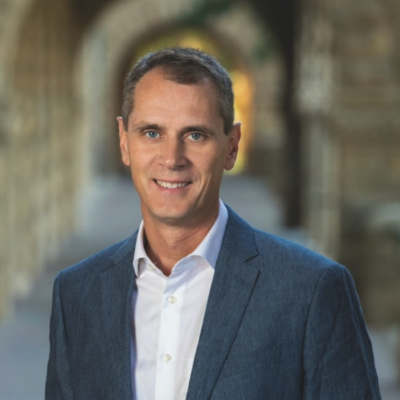
David M. Studdert is a Professor of Law and Health Policy at Stanford University, holding joint appointments in the Stanford Law School and the School of Medicine. He also serves as the Vice Provost and Dean of Research for Stanford University. His expertise spans health law, medical malpractice, public health law, and empirical studies. Studdert has authored over 250 articles and book chapters, focusing on the intersection of law and public health, including groundbreaking research on medical injury litigation, firearm violence prevention, and pandemic policy. He earned his law degree from the University of Melbourne and a doctoral degree in health policy from Harvard University. His research has been recognized with prestigious awards, including Australian Research Council Fellowships and election to the National Academy of Medicine (2024). Education: LLB, University of Melbourne ScD in Health Policy and Public Health, Harvard School of Public Health Research Interests: Studdert’s work examines how legal systems impact public health outcomes, particularly in domains like medical malpractice, gun violence, and pandemic response. His recent studies on firearm ownership and mortality risks have reshaped policy debates, while his analysis of medical negligence litigation has influenced tort reform discussions. Key Contributions: Launched the LongSHOT cohort study analyzing firearm-related mortality risks at scale. Co-authored seminal papers on physician behavior post-malpractice claims and nursing home negligence litigation. Advocated for evidence-based policy solutions through writings on vaccine passports, AI in healthcare, and pandemic governance. Awards: Alice S. Hersh New Investigator Award (AcademyHealth) Australian Research Council Federation Fellowship (2006) Australian Research Council Laureate Fellowship (2011) Elected to National Academy of Medicine (2024) Administrative Roles: As Vice Provost and Dean of Research, Studdert oversees Stanford’s research enterprise, fostering interdisciplinary collaboration (e.g., the Food@Stanford initiative). He previously held faculty roles at Harvard and the University of Melbourne, and advised Australia’s Health Ministry.