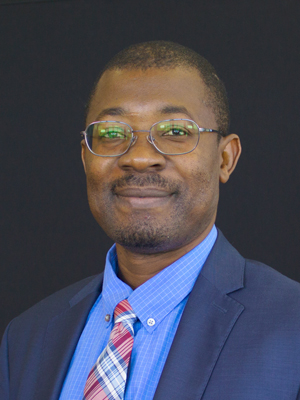
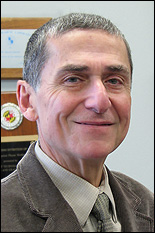
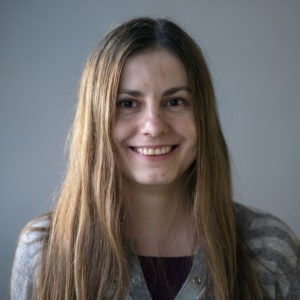
Dr. Lewis Ntaimo is a Professor and Department Head of Industrial & Systems Engineering at Texas A&M University. He holds a Ph.D. in Systems & Industrial Engineering (with a minor in Electrical & Computer Engineering) from the University of Arizona, alongside M.S. and B.S. degrees in Mining Engineering. His research focuses on stochastic programming, optimization methods, and their applications in healthcare, wildfire management, energy systems, and operations research. Notable awards include the Distinguished Educator Award (2022), INFORMS Computing Society Prize (2015), and the Marilyn and L. David Black Faculty Fellowship (2016). He is a Fellow of the Institute of Industrial and Systems Engineers (IISE). Key contributions include developing stochastic models for wildfire risk mitigation, healthcare scheduling under uncertainty, and carbon capture systems. His work bridges simulation and optimization, exemplified by the DEVS-FIRE wildfire modeling framework and the SIPLIB test problem library. Education: Ph.D., Systems & Industrial Engineering, University of Arizona (2004) M.S., Mining & Geological Engineering, University of Arizona (2000) B.S., Mining Engineering, University of Arizona (1998) Grants & Projects: Includes NSF-funded research on wildfire fuel treatment planning, space surveillance scheduling, and wind energy reliability. Labs/Teams: Leads research in stochastic optimization and discrete event simulation, collaborating on interdisciplinary projects with IISE and INFORMS.
Mohsen N. Soltani is an Associate Professor in Offshore Renewable Energy Systems at Aalborg University, Esbjerg. He holds a PhD in Electronics and Control Engineering (2008). His work focuses on renewable energy systems, offshore wind technology, and power electronics. He leads projects like FOSS (Floating Offshore Sub-Station), DynEfuel (reversible power-to-X), and BlueBARGE (blue bunkering solutions). He has supervised 9 PhD students and contributed to over 168 publications. Key research areas include wave energy converters, semi-submersible turbine damping systems, and energy optimization models. Education: PhD in Electronics and Control Engineering (2008). Research Interests: Offshore wind and wave energy systems Power electronics and grid integration Structural damping solutions for floating turbines Multi-carrier energy systems optimization Hydrogen production via electrolysis Renewable energy bunkering technologies Projects: Active in 4 ongoing projects (2023-2026) focusing on offshore infrastructure, hydrogen, and wave energy tools. Previously led 29 projects including W-Tools (wave converter analysis) and Crestwing device development. Grants and Advising: Secured funding from EU Commission and EUDP. Advised 9 PhD students in energy systems and offshore engineering. Collaborates with industry partners on prototype development and field testing. Labs: Involved in Renewable Energy Control Laboratory at Aalborg University Esbjerg, maintaining a wind-solar measurement database.
Professor Aris Christou is a distinguished faculty member at the University of Maryland, holding professorships in the Department of Materials Science and Engineering, Mechanical Engineering, and the Graduate Program in Reliability Engineering. He earned his Ph.D. from the University of Pennsylvania in 1971 and has established himself as a leading expert in materials science, semiconductor reliability, and device physics. As President of the Federation of Materials Societies in Washington D.C. and an IEEE Fellow, Professor Christou has made significant contributions to both academia and industry. Professor Christou's research spans multiple cutting-edge areas including Compound Semiconductor Reliability, Physics of Failure, Device Physics and Modeling, Electronic Materials, Flexible Electronics and Displays, Biomolecular Sensing, and New Device Development. His work focuses on understanding degradation mechanisms in electronic materials and devices, with particular emphasis on reliability issues in compound semiconductors like GaAs and GaN. He has pioneered research in flexible electronics, graphene applications, and reliability of LEDs for medical applications. His laboratory, the Laboratory for Reliable Nanoelectronics, is equipped with advanced facilities for semiconductor device process development and reliability testing. Professor Christou's recent publications demonstrate a consistent focus on reliability engineering across multiple platforms. His work bridges fundamental materials science with practical applications in flexible electronics, semiconductor devices, and photonics. A significant portion of his research addresses electromigration, fatigue properties of novel materials, and physics of failure mechanisms in next-generation electronic devices. His expertise spans from theoretical modeling to practical implementation in real-world applications. Professor Christou has received numerous prestigious awards throughout his career: 2012 Micro & Nano Scientific Society Award 2010 iNEER Award for Engineering Education 2007 ASM Burgess Memorial Award 2006 FMS Recognition Award 2004 iNEER Award for Achievement on International Engineering Education and Research 1999 University of Maryland Invention of the Year Award 1993 Fellow of the IEEE 1987 Millenium Medal from the University of Bologna Professor Christou has been actively involved in mentoring students and securing research funding. His recent Maryland Offshore Wind Energy Challenge Grant (2013) with Professor Pat McCluskey demonstrates his ability to secure significant funding for interdisciplinary research. He has served as an editor for multiple prestigious journals including IEEE Transactions on Device and Materials Reliability and IEEE Transactions on Electron Devices. His service extends to conference organization, with leadership roles in numerous international conferences on materials science and semiconductor reliability. At the University of Maryland, Professor Christou directs the Laboratory for Reliable Nanoelectronics, a state-of-the-art facility equipped with UHV Atomic Layer Deposition systems, high density plasma etch tools, and advanced analytical equipment. This laboratory supports research in semiconductor device process development, test structure design for reliability, and reliability measurements. The lab has been instrumental in advancing research in graphene electronics, flexible displays, and reliability of compound semiconductor devices.
Tetiana Bogodorova is a Senior Research Scientist in the Department of Electrical, Computer, and Systems Engineering at Rensselaer Polytechnic Institute (RPI). Her research focuses on modeling, data science, and artificial intelligence for power systems and complex systems, with expertise in system identification and control. She holds a B.Sc. and M.Sc. from Igor Sikorsky Kyiv Polytechnic Institute and a Ph.D. in Electrical Engineering from KTH Royal Institute of Technology. Notable awards include the Program of Excellence Award from KTH's Doctoral Program in Electrical Engineering. Dr. Bogodorova's academic roles include serving as a docent (Associate Professor) at the Ukrainian Catholic University's Department of Computer Science and Information Technology. She also has industry experience as a System Analyst at NetCracker Technology Corp. and a Data Scientist at ABM Cloud. Her work emphasizes interdisciplinary approaches, particularly leveraging Modelica for multi-domain simulations in power systems, microgrids, and energy systems. Her research portfolio includes developing open-source tools like OpenIPSL, ModelicaGridData, and OpenIMDML, which address challenges in power system stability, renewable integration, and data-driven modeling. These tools combine machine learning techniques with traditional engineering methods to enhance predictive accuracy and system resilience. Key Research Themes: Renewable energy modeling, deep learning for grid stability, microgrid control, and Modelica-based multi-domain simulation frameworks. Awards: Program of Excellence Award (KTH, 2017). Industry Collaboration: Experience in system analysis and data science roles, bridging academic research with real-world applications.
Alaeddin Burak İrez is an Assistant Professor in the Department of Mechanical Engineering at Istanbul Technical University (ITU), specializing in composite materials, structural optimization, and advanced manufacturing. His research focuses on developing novel composites for applications in aerospace, automotive, biomedical, and renewable energy sectors. He leads multiple projects funded by BAP (Scientific and Technological Research Council of Turkey) and has authored over 44 research outputs, including articles in prestigious journals like Defense Technology , Journal of Power Sources , and Polymers . Research Interests: Composite materials design and characterization Thermal and mechanical performance optimization Additive manufacturing of biomedical implants Self-healing materials for wind turbine applications Battery case structural integrity analysis Recent Research Trends: His 2024-2025 work emphasizes hybrid composites for electric vehicle batteries, biohybrid actuators, and tribologically enhanced wind turbine laminates. He has pioneered methods for hierarchical composite design using pellet extrusion additive manufacturing and numerical optimization frameworks for UAV wings. Awards: Best Presentation Award at an international conference (June 2022) Grants & Projects (as PI): Machine Learning for Wind Turbine Blade Damage Analysis (2023-2025) Thermal Conductive Hexagonal Boron Nitride Composites for EV Batteries (2022-2023) Self-Healing Multifunctional Composites for Offshore Wind Turbines (2022-2023) PEEK-based Spinal Implant Additive Manufacturing (2022-2023) Labs/Teams: Leads ITU's Composite Materials & Structural Optimization Lab, collaborating with industry partners on automotive and aerospace projects.
Caglar Karatug is an Assistant Professor in the Department of Marine Engineering at Istanbul Technical University. His research focuses on predictive maintenance strategies for ship machinery systems, energy efficiency in maritime transportation, and sustainable development goals related to marine engineering. He has contributed to advancements in renewable energy applications onboard ships, risk assessment methodologies for emission control technologies, and digital transformation in smart ship operations. Research interests include maintenance optimization for marine systems, emission reduction techniques for container vessels, and the integration of solar/wind energy systems with marine propulsion. His work addresses UN Sustainable Development Goals through innovations in energy efficiency and pollution prevention. Recent publications analyze hybrid predictive maintenance approaches, cost-benefit tradeoffs of emission reduction technologies, and reliability assessment methods for marine engines. His research emphasizes practical applications of advanced analytics and sustainability practices in the maritime sector.
Dr. Yuchen Zhang is a Lecturer and ARC DECRA Fellow at the School of Electrical Engineering & Robotics, QUT. He holds a PhD in Electrical Engineering from UNSW (2018), alongside Bachelor degrees in Engineering and Commerce. His research focuses on power system stability, renewable energy integration, wind farm planning, smart grid technologies, and AI applications in power engineering. His work bridges interdisciplinary approaches in energy systems and data-driven methodologies. Education: Bachelor of Engineering (2013) Bachelor of Commerce (2013) PhD in Electrical Engineering (2018), UNSW Research Interests: Power system stability assessment and control, grid integration of renewables, wind farm planning, smart grid technologies, smart city infrastructure, and AI-driven system development. Awards: 2020 Best Paper Award for IET Smart Cities for work on smart campus frameworks. Grants & Projects: Leads the ARC-funded project 'Data-driven Wide-area System Strength Monitoring under Weak Grid Conditions' (2024–present), focusing on enhancing power grid resilience through real-time monitoring and control strategies. Teaching: Coordinates courses on renewable energy systems and power systems management. Engages in industry collaborations across renewable energy, maritime services, and IEEE standards development. Future Work: Expanding research into electrified logistics integration, smart city energy systems, and AI-driven emergency control mechanisms for power grids.
Prof. Gert Jan Kramer is a Professor of Sustainable Energy Supply Systems at Utrecht University's Copernicus Institute of Sustainable Development. He leads the Energy & Resources group and focuses on the energy transition as a technical and socio-technical phenomenon. His work integrates agent-based modeling, CO2 system analysis, and Dutch industrial decarbonization. Education: MSc and PhD in Physics from Leiden University (1988). Career highlights include 28 years at Shell (1988–2016), where he advanced to Manager of Energy Futures, assessing future energy technologies. He held part-time professorships at TU Eindhoven (1998–2010) and Leiden University (2010–2016). Research emphasizes ex ante technology assessment, socio-technical energy transition dynamics, and荷兰工业转型. Key themes include BECCS, solar fuels, and hydrogen economy. He chairs the 'Deep Decarbonisation' hub under Pathways to Sustainability. Media presence includes frequent commentary on Dutch climate policy and energy debates. His book The Colors of Energy explores societal energy futures. No scientific awards are explicitly listed, but his work is widely cited in policy and academic circles.
Dr Robert Best is a Senior Lecturer in the School of Electronics, Electrical Engineering and Computer Science at Queen's University Belfast, within the Energy Power and Intelligent Control department. He specializes in areas such as electrical energy storage, smart grids, and power system operation with high renewable integration. His work also involves phasor measurement units and distribution network modernization. He has been actively involved in supervising PhD students and has contributed to numerous research projects since 2012. Research Interests: Dr Best’s research focuses on distributed generation, electrical energy storage systems, grid integration of renewables, and power system analysis. His work addresses challenges in modernizing distribution networks and enhancing grid stability through advanced technologies like battery energy storage and phasor measurement units. Awards and Recognition: Robert Best has received several accolades, including the 2017 Premium Award for Best Paper in IET Generation, Transmission & Distribution, the Best Graduate Student Poster Award (2021), and the Primary Engineer - Silver MacRobert Medal Award (2024). His contributions to energy storage and grid stability have been widely recognized internationally. Projects and Grants: He has led or collaborated on multiple projects, such as "SPIRE 2 - Storage Platform for the Integration of Renewable Energy" and initiatives focusing on very low frequency oscillations in power systems. His research often involves interdisciplinary approaches to tackle modern energy challenges. Labs and Teams: His involvement includes collaborative efforts with industry and academic partners, contributing to advancements in smart grid technologies and energy storage solutions. His team's work aligns with broader goals of achieving a 100% renewable energy system, particularly in Northern Ireland.
Dr. Xueqin Amy Liu is a Senior Lecturer at Queen’s University Belfast (QUB) in the School of Electronics, Electrical Engineering and Computer Science. She holds a Ph.D. from QUB (2009) through a joint program with Zhejiang University. Her research bridges power systems and data analytics, focusing on smart grid challenges, energy storage, and renewable integration. She leads industry-driven projects like the €6.7M INTERREG SPIRE2 initiative, advancing energy storage solutions and grid stability. Dr. Liu is a Senior Member of IEEE and serves as an Associate Editor for IET Energy Conversion & Economics. She has supervised 13 PhD students and 2 postdocs, many employed in energy sectors. Notable achievements include the Best Graduate Student Poster Award (2021) and the Outstanding Associate Editor Award (2024). Education: Ph.D., Electrical and Electronic Engineering, Queen’s University Belfast (2009), joint with Zhejiang University Research Interests: Smart Grid data analytics, machine learning for grid stability, energy storage optimization, and renewable integration. Her work addresses real-world challenges with industry partners like EirGrid and SONI, developing tools for grid oscillation detection and energy market strategies. Recent Articles: Focus on oscillation mode identification, dynamic mode decomposition for grid analysis, and machine learning for electricity price forecasting. These contributions enhance grid stability and renewable integration. Awards: EPSRC Impact Acceleration Award (2022) Outstanding Associate Editor Award (IET, 2024) Best Graduate Student Poster Award (IEEE PES, 2021) Advising & Grants: Supervised 13 PhD students (e.g., Javier Lopez Lorente, Mark Rafferty) and led projects totaling millions in funding. Active in the SPIRE2 project and EU INTERREG programs. Labs/Teams: Her team develops diagnostic tools for grid oscillations and behind-the-meter analytics, collaborating with transmission system operators to enhance grid visibility and flexibility.
Neal Pettigrew serves as a Professor of Oceanography at the University of Maine's School of Marine Sciences, where he leads the Physical Oceanography Group (PhOG). His research program focuses on coastal circulation dynamics and biophysical coupling processes, utilizing field studies combined with fluid dynamics theory across diverse marine environments from estuaries to marginal seas. Since 1997, he has directed the development of real-time ocean observing systems including the Gulf of Maine Observatory (NERACOOS) and Caribbean Integrated Ocean Observing System (CARICOOS). Dr. Pettigrew earned his Ph.D. through the prestigious WHOI/MIT Joint Program in Oceanography, establishing his foundation in advanced oceanographic research methodologies. His academic journey has centered on understanding coastal ocean processes through rigorous observational approaches. His research interests encompass the dynamics of coastal circulation features, biophysical interactions in marine ecosystems, and development of autonomous oceanographic instrumentation. Current projects involve deploying Slocum gliders and wind-powered surface vehicles to enhance observational capabilities in the Gulf of Maine and Caribbean regions. The integration of field measurements with statistical analysis and theoretical fluid dynamics characterizes his methodological approach across estuarine, shelf, and marginal sea environments. Analysis of his recent publications (2005-2009) reveals consistent focus on Gulf of Maine circulation patterns, larval transport mechanisms for ecologically and economically significant species like lobster, and technical innovations in ocean observing infrastructure. His work demonstrates strong interdisciplinary connections between physical oceanography, marine biology, and engineering disciplines, particularly in developing robust real-time monitoring systems. No specific scientific awards were documented in the source material, though his sustained contributions to operational oceanography through multi-institutional observing systems represent significant professional achievement in advancing coastal monitoring capabilities. Dr. Pettigrew actively mentors graduate students and manages a research team comprising eight professional staff members with expertise in electrical engineering, mechanical engineering, software development, and oceanographic research. His group's work is supported by grants enabling operation of multiple observing platforms including moored buoys, autonomous gliders, and emerging wind-powered surface vehicles, with current expansion to six gliders and two AUVs. The Physical Oceanography Group maintains specialized facilities for designing and testing oceanographic instrumentation, with current R&D efforts focused on expanding autonomous vehicle fleets, improving real-time data transmission capabilities, and enhancing the resilience of coastal monitoring systems for applications in environmental management and climate research.
Dr. Tomasz Michałowski serves as a Lecturer at the University of Gdańsk's Faculty of Economics, holding dual appointments in the Department of International Business and Department of International Economic Relations. Based in room A335 with direct contact numbers (+48 58 523 12 55, +48 58 523 13 62) and email tomasz.michalowski@ug.edu.pl, he maintains active student consultation schedules including online and in-person sessions during examination periods. His research expertise spans critical domains of global economic systems: International Trade dynamics and policy frameworks Monetary Economics with Eurozone focus Global Economic Relations between major powers Economic Development trajectories in emerging regions International Business strategies and challenges Climate change impacts on trade systems Analysis of recent publications reveals consistent scholarly engagement with evolving global trade architectures, particularly examining EU-China relations, BRICS economic positioning, and migration-trade interconnections. His work demonstrates methodological diversity through quantitative trade analysis, policy evaluation, and case studies of regional integration, often bridging theoretical economic models with practical policy implications for European and global institutions. Scientific Awards: No awards or honors were documented in available sources. Advising and Grants: Publicly accessible information does not specify doctoral supervisees, research grants, or funded projects. Labs and Teams: No dedicated research laboratories, centers, or collaborative teams are mentioned in institutional documentation.
Claudio Alanis Ruiz is a Researcher at the Building Physics department within Eindhoven University of Technology. His academic profile includes an MSc in Sustainable Energy Technology (2016) and an EngD in progress. He actively contributes to environmental engineering and building simulation research. Education: MSc in Sustainable Energy Technology, Eindhoven University of Technology (2014–2016) Research Focus: Computational Fluid Dynamics (CFD) for indoor airflow Air curtain efficiency in building climate control UV germicidal irradiation systems Wind energy integration in high-rise structures Projects: Lead project member for CLAIRE LSHM22032 - Clean Air For Everyone (2022–2026) Scientific Output: 15+ peer-reviewed publications (2016–2025) 40+ Scopus citations
Minh-Quan Tran is a University Researcher at Eindhoven University of Technology (TU/e) within the Department of Electrical Energy Systems, Faculty of Electrical Engineering. His work focuses on modern power distribution systems, renewable energy integration, and grid stability solutions, contributing to UN Sustainable Development Goals in sustainable energy. He maintains an ORCID profile (0000-0001-6430-7333) and has accumulated 99 Scopus citations for his 20 research outputs, with publication activity increasing from 2 works in 2019 to 7 in 2023. His key research interests include: Distribution System Engineering (100% fingerprint strength) Distributed Energy Resource Engineering (71%) State Estimation (64%) Voltage Stability (51%) Microgrid Control (40%) System State Monitoring (47%) Recent publications (2022-2024) reveal strong trends in AI-driven grid management, particularly Model Predictive Control and Graph Neural Networks for voltage stability and state estimation. Real-world case studies feature campus networks (e.g., Chalmers University), emphasizing practical validation of control strategies for low-voltage systems with high renewable penetration. Scientific Awards: No awards or honors are documented in the provided materials Advising and Grants: Tran lists no formal PhD/Master's students in the repository. His research involves IoT platforms, digital twins, and real-life demonstrations for flexibility optimization but lacks explicit grant details or funding acknowledgments in the extracted text. Labs and Teams: He operates within TU/e's Electrical Energy Systems research group, specializing in active distribution network monitoring, microgrid stability, and distributed resource control. Collaborations span international institutions as visualized in the repository's network map, with recent joint work involving Vietnamese and European universities.
Mohamed A. Ahmed is a researcher affiliated with Central Michigan University, School of Engineering & Technology , with additional collaborations across institutions like Ain Shams University, Memorial University of Newfoundland, and Prince Sultan University. His work spans interdisciplinary domains including Internet of Things (IoT) Smart Grids Renewable Energy Systems Machine Learning Recent research focuses on IoT platforms for smart energy management , including electric vehicle charging infrastructure, remote elderly care systems, and large-scale wind turbine monitoring. He has contributed to wireless network architectures for cyber-physical energy systems and developed fuzzy logic algorithms for EV charging prioritization. Publications highlight expertise in time-series forecasting for energy demand, clustering algorithms for smart grid planning, and data aggregation techniques in wind energy applications. Collaborations frequently involve researchers such as Young-Chon Kim, Ali Mohamed Eltamaly, and José Luis Gallardo.