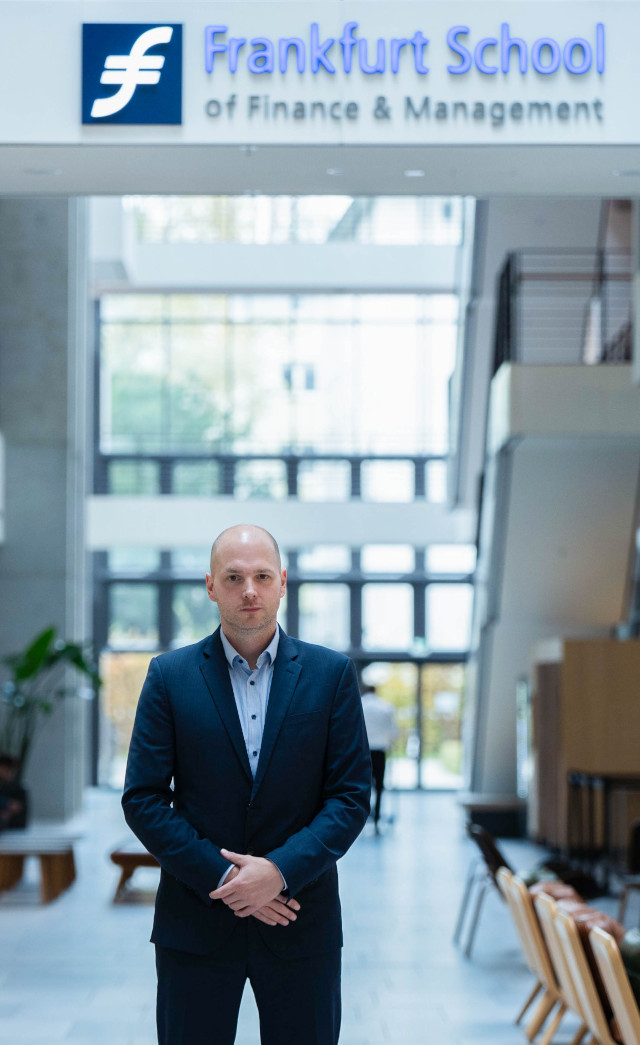
Co-Pierre Georg is a Professor at the Frankfurt School of Finance & Management and Director of the Frankfurt School Blockchain Center. His research spans financial technology, blockchain, systemic risk, and network theory. He previously held the DSI-NRF SARChI Chair in Blockchain Research at the University of Cape Town and worked at the Deutsche Bundesbank's Research Centre. Education: PhD in Economics (Friedrich Schiller University Jena), MSc (Karlsruhe Institute of Technology) Affiliations: Research Associate at Columbia University's Center for Global Legal Transformation and Oxford Martin School Research Interests: Georg specializes in financial networks, systemic risk, and regulatory complexity. He applies network theory to analyze contagion in banking systems, vaccine allocation during pandemics, and software vulnerability propagation. His interdisciplinary work bridges economics, computer science, and complex systems theory. Scientific Awards: No awards explicitly mentioned in the text. Advising: Georg has mentored numerous PhD students and postdocs including Changyeop Lee, Xueying Zhao, and Gideon du Rand. His advisees hold positions at institutions like Oxford, Groningen, and the Bank for International Settlements.
LUO Bin is an Assistant Professor in the Department of Ocean Science and Engineering at Southern University of Science and Technology (SUSTech), where he has been affiliated since 2022. He holds a Ph.D. in Geophysics from Texas A&M University (2018) and a B.S. in Geophysics from the University of Science and Technology of China (2013). Prior to his current position, he served as a Postdoctoral Scholar at Stanford University (2021-2022) and a Postdoctoral Fellow at Colorado School of Mines (2019-2021). Research Focus: Dr. Luo's research centers on earthquake physics and seismology, with specialized expertise in elastic wave propagation modeling, dynamic rupture simulation, and seismic cycle analysis. He pioneers applications of fiber-optic distributed acoustic sensing (DAS) technology for seismic monitoring in diverse environments including urban areas, submarine settings, and hydrocarbon reservoirs. His work integrates computational methods with field data analysis to advance understanding of seismic hazards and subsurface characterization. Publication Trends: His recent articles (2018-2022) demonstrate a strong focus on distributed acoustic sensing applications in microseismic monitoring, guided wave analysis, and seismic inversion techniques. Computational modeling of earthquake dynamics and fault mechanics constitutes another major thematic cluster, featuring advanced finite-element simulations of complex fault systems. Honors and Awards: 2022: Honorable Mention for Best Paper (Geophysics Journal) 2022: Top 25 Presenter at SEG Annual Meeting (IMAGE Conference) 2021: Honorable Mention for Best Paper (The Leading Edge) 2013: Departmental Fellowship (Texas A&M University) Professional Activities: Serves as peer reviewer for leading geophysics journals including Geophysics , Geophysical Research Letters , and Journal of Geophysical Research , contributing to scholarly quality control in seismology and exploration geophysics.
Jelke Dijkstra is an assistant professor at Chalmers University of Technology, working within the Department of Geology and Geotechnology's Geotechnics research group. His academic career focuses on experimental approaches to geomechanics, with particular emphasis on understanding soil behavior through innovative testing methodologies. Dr. Dijkstra's research interests center on experimental geomechanics, especially in capturing and understanding fundamental properties of granular materials using unconventional methods. He has developed new experimental techniques for handling and probing (loose) soils and is an expert in designing and conducting non-standard material testing and physical model experiments, including geotechnical centrifuge tests. His work extensively utilizes 2D imaging techniques for deformation and stress analyses, and he has pioneered the use of geo-electrical techniques to track significant changes in soil samples. His research bridges fundamental soil mechanics with practical engineering applications. Analysis of his recent publications (2024-2025) reveals a strong focus on critical geotechnical challenges, particularly related to sensitive clays, railway infrastructure, and soil-structure interaction. His work spans multiple scales from nanometric clay analysis to full-scale infrastructure modeling. Key themes include quick clay genesis, pile foundation behavior in soft soils, concrete corrosion mechanisms, and advanced monitoring techniques for infrastructure performance. His research demonstrates a consistent interdisciplinary approach combining experimental methods with numerical modeling. Dr. Dijkstra actively participates in numerous collaborative research projects funded by various organizations including Formas, Vetenskapsrådet (VR), Trafikverket, and EU programs. His work addresses critical infrastructure challenges related to climate change adaptation, sustainable transportation systems, and improved geotechnical design methodologies for soft soil conditions.
Kamil S. Jaron serves as a Group Leader at the Wellcome Sanger Institute, where he leads the Jaron Group within the Tree of Life Programme. His research focuses on the genomic underpinnings of unusual reproductive mechanisms across diverse species. Dr. Jaron's research interests center on evolutionary genomics, particularly examining how DNA variation and chromosome structure support unconventional reproductive strategies in nature. His work bridges mathematical biology with genomic analysis to understand the relationship between genome evolution and reproductive modes. He has developed innovative bioinformatics tools like Smudgeplot and Genomescope 2.0 to characterize genomic properties from raw sequencing data. His recent publications highlight trends in k-mer analysis for biodiversity genomics, examination of paternal genome elimination in springtails, and comprehensive analyses of genomic features in parthenogenetic organisms. These works represent a cohesive research program investigating how unusual reproductive mechanisms leave signatures in genome architecture. Active contributor to open-source bioinformatics tools development Organizer of the OH-KNOW workshop for k-mer-based genomics approaches Advocate for open science and collaborative research practices Commitment to making bioinformatics accessible to diverse researchers Dr. Jaron promotes a research culture emphasizing sharing, inclusivity and clear communication. He believes in developing open-source resources with thorough documentation and actively mentors the next generation of genomic researchers through workshops and collaborative projects. His laboratory environment values diversity of skills, experiences and perspectives as essential for producing high-quality scientific work.
Vladimir Alvarado is a Professor and Interim Department Head at the Department of Chemical and Biomedical Engineering , University of Wyoming . His research focuses on Enhanced Oil Recovery (EOR) and transport in porous media , integrating data mining, analytical simulations, and experimental techniques. Education : Ph.D. in Chemical Engineering (University of Minnesota, 1996), Master in Exploration and Production (IFP School, 2002), B.S. in Physics (Universidad Central de Venezuela, 1987) Key research areas include CO2 sequestration , shale geomechanics , and nanoparticle applications in oil recovery . Recent publications highlight advancements in NMR methods for fluid characterization, stimulation fluid impacts on shale , and dynamic interfacial phenomena relevant to EOR and carbon storage. His work combines pore-scale modeling with reservoir simulation to optimize fluid recovery strategies.
Dr. Jonathan Swarbrick is a Lecturer in Economics at the University of St Andrews' Business School, affiliated with the School of Economics & Finance. His research focuses on macroeconomic dynamics, particularly monetary policy transmission mechanisms and financial stability. He currently supervises postgraduate research students and leads the British Academy-funded project 'Unemployment and monetary policy in an uncertain world' (2022-2024). Research Interests: Swarbrick's work centers on macro-financial linkages in DSGE models, unconventional monetary policy tools, credit market frictions, and international financial spillovers. His research examines how banking constraints and asset market participation influence business cycles, with applications to monetary policy design during economic crises. Specific interests include: Zero-lower bound constraints and policy sequencing Macroprudential regulation-business cycle interactions Credit rationing mechanisms during financial stress Cross-border transmission of financial risks Solution methods for nonlinear macroeconomic models Awards & Funding: British Academy Award (£9,970) for 'Unemployment and monetary policy in an uncertain world' (2022-2024)
Gioacchino Cafiero is an Associate Professor at the Department of Mechanical and Aerospace Engineering (DIMEAS), Polytechnic University of Turin. His research focuses on data-driven experimental fluid mechanics, particularly applying machine learning techniques like deep reinforcement learning and genetic algorithms to control turbulent flows and optimize fluidic actuators. As a member of the Fluid Dynamics research group, he leads projects such as GREENER (drag reduction via sinusoidal riblets) and WINDED (drone wind investigation), while also directing commercial research on friction stress measurement methodologies. Specializes in turbulent flow control and machine learning applications Teaches PhD courses on Machine Learning for Flow Control Supervises students in aerospace engineering programs Recent publications analyze jet turbulence with explainable AI, heat transfer fluctuations in channel flows, and riblet-induced drag reduction. His work bridges aerospace engineering and fluid dynamics, contributing to SDG goals 9 (Industry Innovation) and 13 (Climate Action). Scientific awards include the Learning to Teach (L2T) Open Badge from Politecnico di Torino.
Chengfei Wang is an Assistant Professor in the Engineering Division (Great Valley) at Pennsylvania State University . His work bridges theoretical insights and practical applications in deep learning, with a strong focus on understanding and improving neural network reliability and interpretability. Research Interests: Wang's research centers on deep neural networks , particularly in explainability , robustness , and activation analysis . He investigates how neurons behave within complex models, aiming to uncover patterns that can enhance model transparency and performance. His work often involves entropy-based analyses and visualization techniques to dissect activation patterns across layers, contributing to the broader field of explainable AI . Scientific Impact: His publications have garnered significant attention, with one paper accumulating 190 citations in CVPR 2019 , highlighting his influence in addressing vulnerabilities in neural networks when exposed to unconventional data inputs. Advising & Collaboration: While specific student names or funded grants are not detailed, his collaborative efforts are evident through co-authored works with researchers like Wang, L., Li, Y., and Wang, R., indicating active engagement in interdisciplinary projects. Laboratory & Teams: Details about specific labs or teams are not provided, but his affiliation with the Engineering Division suggests access to advanced computational resources and a collaborative environment fostering innovation in AI and machine learning.
Dr. Adhip Agarwala is an Assistant Professor in the Department of Physics at the Indian Institute of Technology Kanpur. His research focuses on condensed matter physics, particularly topological phases of matter and strongly interacting quantum systems. He has established himself as a significant contributor to the theoretical understanding of exotic quantum states in various materials and systems. PhD in Physics, Indian Institute of Science, Bangalore (2018) M.Sc. in Physics, Indian Institute of Technology Delhi (2012) B.Sc. (H) in Physics, Hindu College, Delhi University (2010) Dr. Agarwala's research spans multiple cutting-edge areas including topological insulators in amorphous systems, higher-order topological states, quantum phase transitions in frustrated magnets, and the behavior of Majorana fermions. His work often bridges theoretical concepts with potential experimental realizations, particularly in novel quantum materials where topology, disorder, and interactions play crucial roles. His publication record demonstrates expertise across quantum condensed matter physics, with numerous papers in prestigious journals including Physical Review Letters, Nature Physics, and Nature Nanotechnology. His research shows a consistent focus on the interplay between topology, disorder, and interactions, revealing new quantum phenomena in unconventional materials systems.
Martin Stute serves as the Alena Wels Hirschorn '58 and Martin Hirschorn Professor in Environmental and Applied Sciences and Co-Chair of the Department of Environmental Science at Barnard College. He holds concurrent appointments as Adjunct Senior Research Scientist at the Lamont-Doherty Earth Observatory and faculty member in Columbia University's Department of Earth and Environmental Science. Professor Stute has been teaching at Barnard since 1993, becoming full-time faculty in 1995. His educational background includes a BS from the University of Münster (Germany) and MA/PhD from the University of Heidelberg (Germany). His doctoral research pioneered novel tracer techniques for studying groundwater flow dynamics and using groundwater as paleoclimate archives. Professor Stute's research spans water resources, contaminant transport in groundwater, carbon sequestration, unconventional gas production, paleoclimate reconstruction, and mathematical modeling of environmental phenomena. His work frequently employs environmental tracer methodologies to investigate hydrological systems and climate history. Current projects include the LDEO Environmental Tracer Group, Health Effects of Geochemistry of Arsenic Manganese studies, New Jersey Arsenic Awareness Initiative, Carbfix project in Iceland, and the Big Sky CCUS Partnership. His publication record demonstrates consistent contributions to hydrogeology and environmental science since the early 1990s, with recent work focusing on carbon sequestration techniques and arsenic contamination mechanisms. Professor Stute teaches Environmental Data Analysis, Hydrology, Workshop in Sustainable Development, and leads the joint Columbia/Barnard Senior Research Seminar. As Co-Chair of the Environmental Science Department, Professor Stute oversees curriculum development and faculty coordination while maintaining an active research program. His mentorship approach emphasizes professional communication, meticulous documentation, and integration of field, laboratory, and computational methods. Students working with him gain access to Lamont-Doherty's analytical facilities and participate in international research projects spanning Bangladesh, Hungary, Iceland, and the American West. The LDEO Environmental Tracer Group under his leadership provides students with hands-on experience in noble gas analysis, isotope hydrology, and environmental modeling. Professor Stute encourages thesis students to pursue publication opportunities and conference presentations, with travel support available through Columbia's Earth Institute resources.
David Soloveichik is an Associate Professor holding the Temple Foundation Endowed Faculty Fellowship No.4 in the Chandra Family Department of Electrical & Computer Engineering at The University of Texas at Austin. He leads the Solo-Group and is affiliated with the Center for Advanced Research in Software Engineering (ARISE). He earned undergraduate and Masters degrees in Computer Science from Harvard University and a PhD in Computation and Neural Systems from Caltech, where his dissertation received the Milton and Francis Clauser Doctoral Prize. His research pioneers Molecular Programming —engineering molecular systems from first principles for synthetic biology and nanotechnology—while exploring theoretical connections between distributed computing and molecular information processing. He develops chemical kinetics-based programming languages using DNA hybridization and investigates unconventional computing models including analog, reversible, and quantum systems. Dr. Soloveichik’s major awards include: Feynman Prize in Nanotechnology (Theory) (2012) Tulip Award (2014) NSF CAREER Award (2016) Sloan Research Fellowship (2020) Schmidt Sciences Polymath Award (2023) He actively recruits graduate students and postdocs for interdisciplinary projects spanning RNA bioinformatics, DNA nanotechnology, and quantum computation. His group recently welcomed new members Tony and Hamidreza (Spring 2024) and he co-chairs the 2024 DOE/ASCR Workshop on Analog Computing for Science.
H.J. Broersma is a Professor in the Department of Computer Science at the University of Twente, within the Faculty of Electrical Engineering, Mathematics and Computer Science (EEMCS). He maintains active affiliations with the Formal Methods and Tools (FMT) research group and the Digital Society Institute. Broersma completed his PhD at the University of Twente in 1988, specializing in Graph Theory as a subfield of Discrete Mathematics. His academic trajectory shows continuous progression from lecturer to professor at Twente until 2004, followed by a Chair position in Theoretical Computer Science at Durham University where he co-established the Algorithms and Complexity (ACiD) research group, before returning to Twente in 2011. His research expertise spans Structural Graph Theory, Algorithmic Graph Theory, and Applications of Graph Theory, integrated with Computational Complexity and Unconventional Computing domains. Current emphases include Neuromorphic Computing and Brain Inspired Computing within Programmable Nanosystems, building on core competencies in vertex/edge properties, Hamiltonian cycles, graph order, and subgraph structures. This interdisciplinary work bridges theoretical mathematics with cutting-edge computational paradigms. Professionally, Broersma's career demonstrates sustained institutional commitment across two major European universities. His leadership in building the ACiD group at Durham highlights collaborative research development, while his return to Twente underscores enduring ties to his alma mater. Current work within the Formal Methods and Tools group continues his legacy of advancing theoretical frameworks with practical computing applications.
Tony Yuan, PhD, MS, is an Assistant Professor in the Department of Radiology at the Uniformed Services University of the Health Sciences (USUHS) School of Medicine and serves as Associate Director of Research for the Center for Biotechnology (4DBio3). With over 14 years of Department of Defense (DoD) research experience, he specializes in translating biomedical innovations for military health applications including warfighter-focused diagnostics and tissue engineering solutions. Education B.A. in Biology from University of Texas at Dallas M.S. in Biotechnology from Northwestern University Ph.D. in Biomedical Engineering from University of Texas at San Antonio/UT Health San Antonio Research Interests Dr. Yuan's work spans Molecular Biology, Organ-on-a-Chip systems, Tissue Engineering, and Organoid development with emphasis on environmental sensing and diagnostic biotechnology. His research addresses critical military health challenges including wound healing, infectious disease diagnostics, and psychosocial health of service members, integrating biomaterials science with clinical applications to develop deployable solutions for battlefield medicine. Publication Trends Recent publications (2020-2022) demonstrate interdisciplinary focus on military-relevant health issues: blast-induced neurotrauma modeling using cerebral organoids, SARS-CoV-2 diagnostic systems validation, and pregnancy outcomes in military women. Earlier work (2015-2018) established foundational expertise in electrospun biomaterials for wound healing and bacterial wound pathophysiology, reflecting consistent translation of engineering principles to military medical needs across neuroscience, infectious diseases, and regenerative medicine. Scientific Awards Texas Business Hall of Fame Scholar USUHS School of Medicine Impact Award Advising and Grants Dr. Yuan has built and led multiple DoD-funded research programs including the Center for Advanced Molecular Detection (CAMD) and Joint Integrative Clinical Medicine Directorate. He secures military health research grants spanning infectious disease diagnostics, PTSD, orthopedic innovations, and maternal health, while establishing partnerships with private industry and academic institutions to accelerate technology transition for warfighter needs. Labs and Teams As Associate Director of Research for 4DBio3 at USUHS, Dr. Yuan leads biotechnology development initiatives. Previously, he directed CAMD at the 59th Medical Wing and led the Joint Integrative Clinical Medicine Directorate, managing cross-functional teams focused on unconventional exposures research, diagnostic systems, and requirement-based military medical solutions through collaborations with Naval Medical Research Units and academic partners.
Dr. Mohamed Amish serves as Professor and MSc Oil and Gas Engineering Programme Leader at Robert Gordon University's School of Computing, Engineering & Technology. With 22 years of academic experience complemented by 18 years of industry practice, he bridges petroleum engineering with educational innovation through strategic partnerships with Shell, Sonatrach, PDVSA and BP worth £14m. His leadership extends to establishing the school's digital world principles and postgraduate research frameworks. Dr. Amish's research spans drilling optimization, formation damage, artificial lift systems, and sustainable energy transition, increasingly incorporating machine learning applications. His recent work addresses critical industry challenges including sustained casing pressure prediction, fluid loss management, and water optimization in upstream operations. The Sustainable Energy Research Group serves as his primary research affiliation, focusing on energy transition technologies and environmental impact reduction. His publication trend shows increasing integration of artificial intelligence in petroleum engineering, with 14 of his 20 publications since 2022 exploring machine learning applications. Key research areas include SCP management, artificial lift optimization, and work-based learning models. His scientific contributions focus on practical industry solutions rather than theoretical exploration. Chaired steering groups managing 40+ internal/external contributors Developed £14m strategic partnership programs with major energy companies Pioneered virtual engineering labs using ADDIE instructional model Implemented Merrill's First Principles for work-based learning frameworks Secured significant cost savings through staff development initiatives Dr. Amish actively supervises PhD candidates, with Mahdi M.A.A.'s 2023 thesis on artificial lift selection representing current student work. His Sustainable Energy Research Group focuses on practical applications of digital technologies in energy transition, maintaining strong industry connections that provide students with real-world projects and employment pathways. The group's work particularly addresses upstream operational challenges through machine learning solutions while developing next-generation engineering competencies.
Dr. Gbenga Oluyemi is a Professor in the School of Computing, Engineering & Technology at Robert Gordon University (RGU), Aberdeen, UK. His academic work spans petroleum engineering with a growing emphasis on sustainable energy solutions. His research interests encompass Geomechanics, Oilfield chemistry, Multiphase fluid dynamics, Sand prediction and production, Reservoir characterisation , and Formation evaluation . Recent work has expanded into sustainable energy applications including hydrogen storage and carbon capture technologies. Dr. Oluyemi's publication record shows a clear evolution from traditional petroleum engineering topics toward sustainable energy solutions. His recent work integrates machine learning techniques with conventional petroleum engineering challenges, particularly in well integrity management and artificial lift optimization. The research demonstrates strong industry relevance with numerous projects addressing practical challenges in the energy sector. As a supervisor, Dr. Oluyemi has guided multiple PhD students through completion, with thesis topics ranging from marginal field development optimization to geomechanical impacts of oilfield chemicals. His supervision record reflects both technical depth and relevance to current industry challenges. His current projects demonstrate a strategic shift toward sustainable energy applications while maintaining core petroleum engineering expertise, particularly in areas of waste-to-energy conversion and sustainable well abandonment practices.