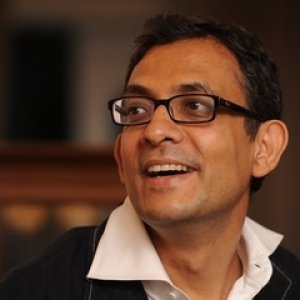
Abhijit Banerjee is the Ford Foundation International Professor of Economics at MIT and Director of the Abdul Latif Jameel Poverty Action Lab (J-PAL). A 2019 Nobel laureate in Economic Sciences, his research focuses on development economics, political economy, and poverty alleviation. He co-authored influential books like Poor Economics and Good Economics for Hard Times , emphasizing evidence-based policies and randomized controlled trials. Banerjee’s work addresses global challenges such as education, health, and social welfare, with notable contributions to microfinance, public health interventions, and anti-poverty programs. He holds leadership roles in global initiatives like the Global Education Evidence Advisory Panel and has advised governments worldwide. His research spans topics from police resource allocation in India to the impact of information during crises like demonetization and the pandemic. Education: Bachelor’s in Statistics, Presidency College, Kolkata M.A. in Economics, Jawaharlal Nehru University PhD in Economics, Harvard University Key Contributions: Co-founder of J-PAL, promoting evidence-based poverty reduction strategies. Pioneer in using randomized controlled trials (RCTs) for policy evaluation. Research on microfinance, education reforms, and health interventions in developing countries. Awards: Nobel Prize in Economics (2019), Infosys Prize in Social Sciences (2009), Member of the National Academy of Sciences (2020). Grants/Advisory Roles: Collaborations with institutions like the World Bank, UN, and governments on poverty, health, and education policies. Labs/Teams: J-PAL global network, Abdul Latif Jameel Poverty Action Lab.
Barbara Caputo is a Full Professor at Politecnico di Torino, leading the VANDAL Laboratory and directing the AI@PoliTo Interdepartmental Lab. She holds a double affiliation with the Italian Institute of Technology (IIT) and has held roles at Idiap-EPFL and Sapienza University. Her research focuses on AI, computer vision, domain adaptation, and federated learning. She contributes to national AI policy, including the Italian Strategy on AI and the National PhD on AI for Industry 4.0. She is an ERC Laureate and ELLIS Fellow, co-founding ELLIS society. Her work spans visual place recognition, action recognition, and cross-domain learning. Education: PhD in Computer Science from KTH Royal Institute of Technology (2005). Major roles include Rector’s Advisor on AI at PoliTo, Board Member of ELLIS, and coordinator of the AI & Industry 4.0 vertical in the National PhD program. Awards include ERC Laureate (2017), ELLIS Fellow (2019), and Inspiring Fifty Italy (2018). Her research emphasizes federated learning, domain adaptation, and AI ethics. Recent articles explore domain generalization, resource-efficient federated models, and AI-environment interactions. She collaborates with institutions like MUR, CNR, and the European Commission on AI policy and tech initiatives.
Francesco Pilati is an Associate Professor at the Department of Industrial Engineering, University of Trento, where he serves as local coordinator for the scientific field ING-IND/17 (Industrial Plants and Logistic Systems). He chairs the research group on Industrial Plants, Production Systems, and Logistics, and teaches courses in Industrial Plants and Design of Digital Production and Assembly Systems. As coordinator of the Master's program in Management and Industrial Systems Engineering and University Coordinator for the EIT double degree in Zero-Defect Manufacture, Pilati bridges academic leadership with advanced manufacturing research. He has also served as Invited Lecturer at universities in Vienna and Göttingen. His research focuses on integrating environmental sustainability with technical-economic criteria through multi-objective optimization and impact assessment. Key areas include: Distribution networks and warehousing systems Manufacturing and assembly line design Hybrid energy production systems Digitization of manual production processes using depth cameras Recent publications highlight applications of Industry 4.0 technologies to pandemic safety, logistics optimization, and smart manufacturing. Pilati has received significant recognition including the Philip Morris Italia Empowering Research Award (2016) and Autostrade per l'Italia academic recognition. His editorial contributions include guest editing special issues on Digital Twins and Smart Factories in Q1 journals.
Rita Cucchiara is a Full Professor at the Department of Engineering 'Enzo Ferrari' of the University of Modena and Reggio Emilia. She leads the AImageLab research laboratory, part of the Artificial Intelligence Research and Innovation Center (AIRI) in Modena. Her research focuses on Computer Vision, Pattern Recognition, Machine Learning, and Multimedia, with applications in video surveillance, medical imaging, human-centered AI, and generative models. She is actively involved in interdisciplinary projects like ELIAS (European Lighthouse for AI Sustainability) and ELSA (European Lighthouse on Secure AI). Her recent roles include being elected Rector of the University of Modena and Reggio Emilia in 2025. She has organized and participated in major AI events, including workshops at NeurIPS, CVPR, and ECCV, and has contributed to advancements in multimodal models, deepfake detection, and trustworthy AI. Education details are not explicitly provided, but her extensive academic and research experience at the University of Modena underscores her expertise. She collaborates with institutions like NVIDIA, CINECA, and industry partners such as Digital Design and NVIDIA's AI Technology Center. AImageLab's projects include developing systems for medical imaging, ethical AI, and generative adversarial networks (GANs) for design surfaces. She co-organizes initiatives like the ELLIS Summer School on Large-Scale AI and contributes to policy discussions on AI ethics and societal impact. Her work spans from foundational research (e.g., vision transformers, continual learning) to applied projects (e.g., DDGan system for surface printing). Key grants and collaborations include the FAIR project and PNRR-M4C2 initiatives. She advises students and researchers in AI, with 7 PhD positions funded under national programs. Her leadership roles in AIRI and AImageLab highlight her commitment to bridging academia and industry, fostering innovation in AI-driven solutions for sustainability and healthcare.
Gian Antonio Susto is an Associate Professor at the Department of Information Engineering , University of Padova . With a Ph.D. in Information Technology and post-doctoral experience at National University of Ireland, Maynooth, he leads research in Machine Learning , Semiconductor Manufacturing , and Industrial IoT . His work bridges Anomaly Detection , Continual Learning , and Algorithmic Fairness with applications in Hydroelectric Power Plants , Particle Accelerators , and Smart Mobility . B.Sc. and M.Sc. in Controls Engineering, University of Padova (cum laude) Ph.D. in Information Technology, University of Padova (2013) Post-Doc at National University of Ireland, Maynooth (2012-2013) Assistant Professor at University of Padova (2013-2021) His research focuses on Explainable AI , Virtual Metrology , and Deep Learning for manufacturing and infrastructure monitoring. Recent projects include the AIMS5.0 (AI for Manufacturing Sustainability) and MICS (Circular Economy in Italy) initiatives. His publications span Engineering Applications of Artificial Intelligence , IEEE Transactions , and Information Processing & Management , with 15+ recent papers on topics like Fault Diagnosis , Continual Learning , and Fair Ranking . Key scientific awards include: IEEE CCTA Best Student Paper Award (2021) IP&M 2020 Ph.D Paper Award Best Industry Paper Award, European Workshop on Advanced Control and Diagnosis (ACD 2019) He has supervised Ph.D. students on projects involving Particle Accelerators , Plant Behavior Modeling , and Explainable AI , with alumni now at institutions like Max Planck Institute , IBM , and Scripps Research . Current teaching includes Reinforcement Learning and Explainable Machine Learning at graduate and Ph.D. levels.
Battista Biggio is a Full Professor at the University of Cagliari, Italy, affiliated with the Department of Electrical and Electronic Engineering under the Faculty of Engineering and Architecture. His research focuses on machine learning security, adversarial attacks, and cybersecurity. He co-founded the cybersecurity firm Pluribus One and has pioneered foundational work in poisoning attacks and adversarial robustness. Education: MSc (2006), PhD (2010). He holds editorial roles as Associate Editor-in-Chief for Elsevier's Pattern Recognition Journal and serves on IEEE TNNLS and IEEE CIM editorial boards. His awards include the 2022 ICML Test of Time Award and the 2021 Pattern Recognition Medal. He chairs IAPR TC1 and organizes conferences like S+SSPR and AISec. Research interests span adversarial machine learning, malware detection, and secure AI systems. He leads initiatives such as the sAIfer Lab and co-develops the SecML-Torch library. Teaching includes courses on Machine Learning Security and Industrial Software Development. Notable contributions include seminal papers like 'Poisoning Attacks against Support Vector Machines' and 'Wild Patterns.' He manages over 10 research projects and advises on AI security for industrial applications. His work bridges academic research with practical cybersecurity solutions.
Dr. Silvia Baiocco serves as Assistant Professor at University of Rome Tor Vergata, teaching entrepreneurship, tourism management, and marketing courses across Bachelor and Master programs including 'Creation of Enterprises and Entrepreneurship' (Master), 'Fundamentals of Service Management' (Bachelor), and 'Tourism and Cultural Management for Sustainability' (Bachelor). Her institutional affiliation centers on Business Economics (sector ECON-07/A) with research rooted in co-evolutionary theory. Her research critically examines sustainable business model innovation through three interconnected lenses: (1) tourism-destination co-evolution in historic villages and Alberghi Diffusi, (2) university-industry knowledge exchange for sustainable spin-offs via PNICube Observatory frameworks, and (3) technology integration in smart tourism through AI-driven destination management. She emphasizes context-specific adaptation in both high-income (Italy) and low/middle-income settings (Ghana), with strong focus on social impact and heritage preservation. Analysis of her 2023-2025 publications reveals accelerating focus on digital tourism transformation (AI applications, smart city integration) and resilience-building in accommodation firms. Her work consistently applies co-evolutionary frameworks to decode organizational adaptation, particularly in sustainable entrepreneurship contexts. The PNICube Observatory reports highlight her policy-relevant contributions to university research valorization. As educator, Dr. Baiocco actively shapes future business leaders through courses spanning startup creation to sustainable destination management. Her research trajectory indicates deepening engagement with technology-mediated sustainability solutions and cross-sectoral innovation ecosystems, particularly through ongoing PNICube Observatory initiatives.
Daniele Ielmini is a Professor at the Department of Electronics, Information and Bioengineering at Politecnico di Milano, Italy, where he leads research in non-volatile memory technologies and neuromorphic computing. He received his Laurea (with merit) and Ph.D. in Nuclear Engineering from Politecnico di Milano in 1995 and 2000, respectively, and has held visiting positions at Intel Corporation (2006), Stanford University (2006), and the University of Illinois at Urbana-Champaign (2010). His research focuses on the modeling and characterization of non-volatile memories, including nanocrystal memory, charge trap memory, phase change memory (PCM), resistive switching memory (RRAM), and spin-transfer torque magnetic memory (STT-MRAM). He has co-edited the book 'Resistive switching – from fundamental redox-processes to device applications' and published over 300 papers with more than 10,000 citations and an H-index of 69 (Scopus, September 2023). Prof. Ielmini's recent publications demonstrate a strong trend toward in-memory computing and neuromorphic applications, with particular emphasis on closed-loop analog computing architectures, reservoir computing with 2D materials, and hardware security implementations using emerging memory technologies. His work bridges fundamental device physics with practical computing applications, especially for energy-efficient AI acceleration. Intel Outstanding Researcher Award (2013) ERC Consolidator Grant (2014) IEEE-EDS Paul Rappaport Award (2015) Fellow of the IEEE Prof. Ielmini leads multiple ERC-funded projects including SHANNON (Secure Hardware with Advanced Nonvolatile memories), NEURO2D (neuromorphic systems based on reservoir computing in MoS2), and ANIMATE (closed-loop in-memory computing). His research group includes post-doctoral researchers, PhD students, and M.Sc. students working on various aspects of emerging memory technologies and their applications. He serves as Associate Editor for IEEE Trans. Nanotechnology and Semiconductor Science and Technology (IOP), and has served in several Technical Subcommittees of international conferences including IEEE-IEDM, IEEE-IRPS, and IEEE-ISCAS. His laboratory at Politecnico di Milano is equipped with advanced semiconductor device testing equipment including probe-stations, semiconductor parameter analyzers, high-speed waveform generators, and other specialized instruments for nano-electronic research. The lab collaborates with major semiconductor companies including Micron Technology Inc. and STMicroelectronics, as well as participating in national and international research projects.
Federico Miretti is an Assistant Professor at the Polytechnic University of Turin, affiliated with the Department of Energy and the interdepartmental center Cars@PoliTo. His research focuses on hybrid and electric vehicles, with emphasis on energy management strategies, battery state estimation, and sustainable transport solutions. PhD in Energetics from Polytechnic University of Turin Research areas include: Optimization-based Energy Management Strategies for hybrid propulsion systems Simulation and digital twinning of hybrid systems Thermal management for electrified vehicles Techno-economic assessment of mobility solutions Recent publications highlight advancements in battery temperature anomaly detection, wireless power transfer feasibility, and control algorithms for energy efficiency. His work aligns with SDGs 7 (Clean Energy) and 9 (Innovation). Teaching roles include: Fluid Machinery (2019-2025) Energy Management in Hybrid/Electric Vehicles (2021-2025) Projects: PRoSIT (2025): Predictive thermal management demonstrator Consulting contract with MIDAC SpA (2025): Battery Digital Twin development EBOAT project (2025-2026): Technical support for Vulkan
Stefano Grivet Talocia is a Full Professor in the Department of Electronics and Telecommunications at Polytechnic University of Turin. He serves as Director of the Doctoral School, is a member of the Interdepartmental Center SmartData@PoliTO - Big Data and Data Science Laboratory, and holds positions on the University Committee for Research and the Commission for the Promotion of Library, Archive and Museum Heritage. He is also President of the Doctoral School Council. His educational background includes a Laurea degree (summa cum laude) in Electronic Engineering (1994) and a Ph.D. in Electronic and Communication Engineering (1998), both from Polytechnic University of Torino. From 1994 to 1996, he worked at NASA/Goddard Space Flight Center in Greenbelt, MD, USA. Professor Grivet Talocia's research focuses on passive macro-modeling of concentrated and distributed interconnect structures for Signal/Power Integrity, order reduction techniques, and modeling and simulation of fields, circuits, and their interactions. His work spans several key areas including fast simulation of transmission lines (TOPLine technique), macromodeling and model order reduction, simulation methods for fields and circuits, passivity enforcement of lumped macromodels, waveform relaxation techniques, and wavelet applications. His research has significant applications in electromagnetic compatibility and signal integrity verification of complex electronic systems. His recent publications demonstrate strong trends in model order reduction techniques applied to power integrity verification, advanced macromodeling for electromagnetic compatibility, nonlinear circuit analysis, uncertainty quantification in PCB design, and power electronics modeling. These works consistently address practical engineering challenges in high-speed electronic design with emphasis on computational efficiency and accuracy. URSI Young Scientist Award (1999) Best symposium paper (2006) Three IBM Shared University Research Awards (2007-2009) IEEE Transactions on Advanced Packaging Best Paper Award (2007) Best EPEP conference paper awards (2007, 2008) Best Associate Editor Award - IEEE Transactions (2020) Best Conference Paper Award (2020) Three Intel SRS Grants (2022-2024) IEEE Fellow (2018) Professor Grivet Talocia actively supervises PhD students working on cutting-edge topics including machine learning applications in signal integrity, model reduction techniques, and electromagnetic compatibility. He has secured significant research funding through competitive grants including PRIN projects and multiple industry-sponsored research contracts with major technology companies such as IBM, Intel, Nokia, Hitachi, and Infineon. His technology transfer activities include co-founding the spin-off IdemWorks (acquired by CST in 2016) and maintaining active collaborations with industry partners. He leads the EMC Group (Electromagnetic Compatibility) within the Department of Electronics and Telecommunications and has developed the autoCircuits web service for automated generation of circuit theory problems. His research has been recognized by inclusion in the top 2% worldwide researcher catalog (Stanford) since 2019.
Francesco Maisano, MD , is Full Professor of Cardiac Surgery at Vita-Salute San Raffaele University (Milan) since 2021, where he also serves as Director of the Cardiac Surgery Clinic and of the Valve Center at IRCCS San Raffaele Hospital. From 2014 to 2020 he held the Chair of Cardiac Surgery and directed the Department at University Hospital Zurich. Education & Training 1990 – MD, Catholic University of Rome 1994 – Clinical Fellowship, University of Alabama at Birmingham 1995 – Specialization in Cardiac Surgery, La Sapienza University of Rome Research Interests Professor Maisano’s work centres on innovative therapies for heart-valve disease, spanning surgical reconstruction, catheter-based interventions (TAVI, MitraClip, transcatheter tricuspid devices), and hybrid approaches. He leads translational programmes in biomedical engineering, multimodality cardiac imaging, and artificial-intelligence-guided interventions, with emphasis on the multidisciplinary “Heart Team” model for complex cardiovascular disease. His recent publications (2024-2025) demonstrate intense activity in transcatheter mitral and tricuspid repair, long-term durability of surgical mitral repair, AI-driven procedural guidance, and renal protection strategies during mechanical circulatory support. A dominant theme is translating imaging innovations and device concepts into first-in-human studies and large-scale registries. Scientific Awards & Recognitions European Society of Cardiology Silver Medal (2018) ICI Lifetime Achievement in Research & Teaching (2018) ICI Best Technology Parade Presentation (2010) C. Walton Lillehei Young Investigator Award (1999) Leadership & Grants He directs multiple postgraduate programmes, including Certificate of Advanced Studies (CAS) tracks at the University of Zurich in multimodality imaging, aortic valve, and mitral–tricuspid interventions. He is principal investigator on investigator-initiated grants, coordinates industry-partnered device trials, and mentors numerous doctoral and post-doctoral researchers. His team has filed >24 patents and spun off several cardiovascular start-ups. Labs & Teams At IRCCS San Raffaele he leads the Valve Science Center , a multidisciplinary hub integrating cardiac surgeons, interventional cardiologists, imaging specialists, biomedical engineers, and data scientists focused on next-generation valve repair/replacement technologies and personalised cardiovascular medicine.
Matteo Nardello is a researcher affiliated with the Department of Industrial Engineering at the University of Trento. His work focuses on embedded systems, IoT, and energy harvesting technologies for sustainable applications. Current academic affiliation: Department of Industrial Engineering, University of Trento Research interests: IoT, embedded systems, energy harvesting, machine learning, cyber-physical systems Contact: matteo.nardello@unitn.it His research integrates hardware-software co-design for batteryless IoT systems, with applications in smart agriculture, industrial monitoring, and autonomous vehicles. Recent work explores deep learning at the edge, energy-efficient sensor networks, and microbial fuel cells for self-powered devices. Key article trends highlight a focus on sustainable power solutions, wireless sensor networks, and machine learning optimization for constrained environments. He contributes to courses on embedded systems, IoT, and AI-powered industrial applications at the University of Trento.
Stefano Grivet-Talocia is a Full Professor at the Department of Electronics and Telecommunications at the Polytechnic University of Turin, where he also serves as Director of the Doctoral School and President of the Doctoral School Council. He is a member of the Interdepartmental Center SmartData@PoliTO - Big Data and Data Science Laboratory, the University Committee for Research, Technology Transfer and Services to the Territory, and the Commission for the Promotion of Library, Archive and Museum Heritage. His academic career spans over two decades at Politecnico di Torino, where he has established himself as a leading researcher in electromagnetic modeling and signal integrity. Grivet-Talocia earned his Laurea degree (summa cum laude) in Electronic Engineering in 1994 and his Ph.D. in Electronic and Communication Engineering in 1998, both from the Polytechnic University of Turin. Between 1994 and 1996, he conducted research at NASA/Goddard Space Flight Center in Greenbelt, Maryland. His educational background laid the foundation for his expertise in electromagnetic modeling, wavelet analysis, and signal processing. His research focuses on behavioral modeling, electromagnetic compatibility, macromodeling, model order reduction, numerical modeling, passivity, power integrity, signal integrity, transmission lines, and wavelets . Grivet-Talocia is particularly renowned for his work on passive macromodeling of interconnect structures, development of the TOPLine technique for transmission line simulation, and pioneering contributions to passivity enforcement algorithms. He has co-authored the first book entirely dedicated to Macromodeling (2016) and developed innovative approaches to waveform relaxation and wavelet-based signal processing. His recent publications (2024-2025) demonstrate continued leadership in model order reduction, with significant contributions to data-driven modeling of linear and nonlinear systems, power integrity analysis, and electromagnetic compatibility. His work spans both theoretical advances in numerical methods and practical applications in circuit design, with strong industry relevance particularly for semiconductor and electronic design automation companies. IEEE Fellow (2018-present) Three Intel SRS Grants (2022-2024) Three IBM SUR Grant Awards (2007-2009) Best Associate Editor Award - IEEE Transactions on Components, Packaging and Manufacturing Technology (2020) Multiple Best Conference Paper Awards (2006-2020) URSI Young Scientist Awards (1999) Ranked among the "top 2% worldwide researchers" (Stanford) since 2019 Grivet-Talocia actively supervises doctoral students including Michele Cusano, Sara Paknezhad Panahi, Antonio Carlucci, and Kun Zhao. He has secured numerous research grants from competitive national calls (PRIN) and commercial contracts with industry partners including Intel, IBM, Nokia, Hitachi, Infineon, and Cadence. His technology transfer activities include co-founding the spin-off IdemWorks (2007-2016), which was acquired by CST in 2016. He also developed the autoCircuits web service for automated circuit problem generation, widely used in electrical engineering education. He leads the EMC Group (Electromagnetic Compatibility) at DET and has been instrumental in establishing the Compact Dynamical Modeling research area. His work has practical applications in high-speed electronics design, with algorithms embedded in commercial tools like IBM PowerSPICE. Grivet-Talocia maintains strong industry connections through his research projects and serves as Associate Editor for IEEE Transactions on Components, Packaging and Manufacturing Technology.
Juan Carlos De Martin is a Full Professor of Computer Engineering at the Polytechnic of Turin, where he is also co-founder and co-director of the Nexa Center for Internet & Society. He holds a Faculty Associate position at the Berkman Klein Center for Internet & Society at Harvard University and is a member of the Scientific Council of the Treccani Institute and the Steering Committee of Biennale Democracy. He previously served as Vice Rector for Culture and Communication at the Polytechnic of Turin (2018–2023) and as president of its libraries (2007–2015). His research centers on the societal implications of digital technologies, with a strong emphasis on algorithmic and data justice, digital power, and the democratic challenges posed by modern technology. He advocates for a more democratic and ethical technological future, particularly critiquing the dominance of smartphones and promoting digital sovereignty. His recent publications reflect a clear trend toward ethical AI, data protection, and the social impact of algorithms. He has published on gender bias in language models, GDPR compliance tools, and non-discrimination audits in software, demonstrating a sustained commitment to fairness, transparency, and accountability in digital systems. Best Student Paper Award IEEE ISCC 2011 Best Student Paper Award IEEE ICME 2005 Fellow at Harvard University (Berkman Klein Center) (2011–2015, 2016–2024) Faculty Associate at Collège d'études mondos, France (2016) De Martin has advised PhD students like Marco Rondina on Responsible AI and has led numerous EU-funded research projects such as COMMUNIA and DECODE. He has also played a key role in public policy, serving on ministerial working groups on AI and online hate. He is the founder of the Biennale Tecnologia and has authored influential books on the future of universities and technology, all published under Creative Commons licenses. He leads the Nexa Center for Internet & Society, a multidisciplinary research group focused on the legal, economic, and social aspects of the Internet. The center fosters collaboration between computer scientists, legal scholars, and social scientists to address pressing digital challenges.
Gaetano Miraglia is a Fixed-term Assistant Professor in the Department of Structural, Building and Geotechnical Engineering (DISEG) at Politecnico di Torino, where he conducts research in structural health monitoring, seismic analysis, and computational modeling. He is a member of the Interdepartmental Center R3C – Responsible Risk Resilience Centre, contributing to interdisciplinary efforts in risk mitigation and infrastructure resilience. His work spans both theoretical and applied domains, with strong emphasis on heritage preservation and sustainable urban development. His research interests include Bayesian calibration of nonlinear models, hybrid simulation, peridynamics, masonry structures, and the integration of satellite interferometric (InSAR) data with in-situ measurements for structural monitoring. He applies advanced computational and machine learning techniques to improve the accuracy and reliability of structural assessments, particularly in historical and monumental buildings. His work supports UN Sustainable Development Goals 9, 11, and 13. His recent publications demonstrate a consistent focus on data fusion, digital twinning, domain adaptation, and real-time damage detection. He frequently collaborates with researchers such as Rosario Ceravolo and Erica Lenticchia, publishing in high-impact journals like Computer-Aided Civil and Infrastructure Engineering , Structures , and Scientific Reports , as well as at major conferences including EWSHM, SAHC, and EVACES. His research is applied in projects such as the monitoring of the Vicoforte Sanctuary and the development of the CAMELOT and HY-LEARN toolboxes. Research Projects: MONITORAGGIO VICOFORTE (2024–2026) – Member of Research Group CAMELOT – PoC Transition (2023–2024) – Member of Research Group HY-LEARN – Model Calibration via Hybrid Simulation and ML (2022–2024) – Scientific Manager (PNRR Mission 4) He teaches in various programs, including as a course collaborator in PhD, Master’s, and Bachelor’s level courses such as Earthquake Engineering , Structural Consolidation , and Seismic Risk of Cultural Heritage . He is also an inventor on national and international patents and software related to the CAMELOT toolbox, highlighting the translational impact of his research. He has no listed scientific awards or formal advisees in the provided text.