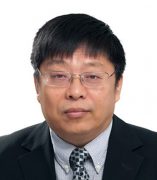
Jian-Ping Wang is a Distinguished McKnight University Professor and holds the Robert F. Hartmann Chair in the Department of Electrical and Computer Engineering at the University of Minnesota's College of Science and Engineering. His research group, the Nanomagnetism and Quantum Spintronics Lab (Nanospin), is actively engaged in cutting-edge research at the intersection of nanomagnetism, spintronics, and biomedical applications. Professor Wang's research interests span a broad spectrum of nanomagnetic and quantum spintronic phenomena. His work focuses on developing novel magnetic materials with extremely high magnetic anisotropy, giant saturation magnetization, high spin polarization ratio, and large spin-orbit torque. His group investigates applications of these materials in next-generation information storage and computing, biomedical technologies including disease early detection and neuron stimulation, and green energy solutions. Specific research programs include studying L1 0 -FePd materials for scalable spintronics, developing synthetic antiferromagnetic magnetic tunnel junctions, and exploring voltage control of magnetic properties for energy-efficient devices. Analysis of Professor Wang's recent publications reveals a strong emphasis on spin-orbit torque phenomena, voltage-controlled magnetism, and biomedical applications of magnetic nanoparticles. His work bridges fundamental physics with practical applications, particularly in developing energy-efficient spintronic memory and logic devices, magnetic particle imaging for biomedical diagnostics, and micromagnetic neurostimulation technologies. The research shows increasing interdisciplinary collaboration, particularly with neuroscience and biomedical engineering fields. Distinguished McKnight University Professor Robert F. Hartmann Chair NSF Graduate Research Fellowship (awarded to student Onri Jay Benally) Professor Wang has successfully advised numerous PhD students including Dr. Renata Saha (thesis on micromagnetic neurostimulation), Dr. Deyuan Lyu (thesis on advanced perpendicular magnetic tunnel junctions), and Dr. Jianxin Zhu (thesis on molecular dynamics simulation of magnetic thin films). His research is supported by substantial funding from multiple sources including the National Science Foundation, Department of Energy, Western Digital Corporation, and SRC, INC. Current projects include Minnealloy (Critical-Material-Free High-power High-Frequency Transformers), NSF-MeitY: Energy-efficient quantum materials based magnetic tunnel junctions, and Ni 4 W for Energy-Efficient, Field-Free and Ultra-Fast Switching SOT MRAM. Professor Wang leads the Nanomagnetism and Quantum Spintronics Lab (Nanospin), which is affiliated with multiple research centers including the C-SPIN Center, SMART Center, Spin Valley, and Minnesota NeuroSpin Initiative. His lab maintains strong collaborations across disciplines, particularly with neuroscience researchers for developing magnetic neurostimulation technologies and with materials scientists for developing novel magnetic materials. The research group actively participates in the broader spintronics community through these centers and initiatives.