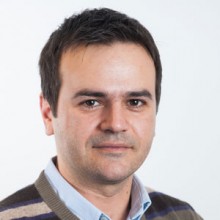
Petros Rakitzis is a Professor in the Department of Physics at the University of Crete and affiliated with the Foundation for Research and Technology - Hellas (FORTH) at the Institute of Electronic Structure and Laser (IESL). He received his B.A. in Physics and Chemistry from Cornell University (1992) and his Ph.D. in Physics from Stanford University (1997), focusing on atomic and molecular angular momentum in chemical reactions. Since 2001, he has progressed from Lecturer to Professor, securing the prestigious ERC Starting Grant in 2008. His research spans quantum angular momentum, spin polarization, photodissociation dynamics, and cavity-enhanced spectroscopy. Education: B.A. in Physics and Chemistry, Cornell University (1992); Ph.D. in Physics, Stanford University (1997) Rakitzis's work explores spin manipulation in particle beams, polarization phenomena in spectroscopy, and chirality sensing using parity-time-symmetric systems. His research has applications in nuclear fusion, laser-plasma acceleration, and quantum metrology. He leads the PREFER collaboration, focusing on polarization research for fusion experiments and reactors, and has developed techniques like signal-reversing cavity ring-down polarimetry for precision measurements. His recent publications highlight trends in spin-polarized hydrogen production, cavity-based chiral sensing, and parity nonconservation studies. These works intersect atomic physics, quantum optics, and nuclear fusion, with methodologies involving laser excitation, relativistic plasmas, and advanced spectroscopic techniques. Scientific Awards: ERC Starting Grant (2008) Rakitzis has contributed to experimental techniques and theoretical frameworks in spin polarization and photodissociation, securing grants and advancing polarized beam applications. His research impacts fusion energy, quantum sensing, and fundamental symmetry studies.