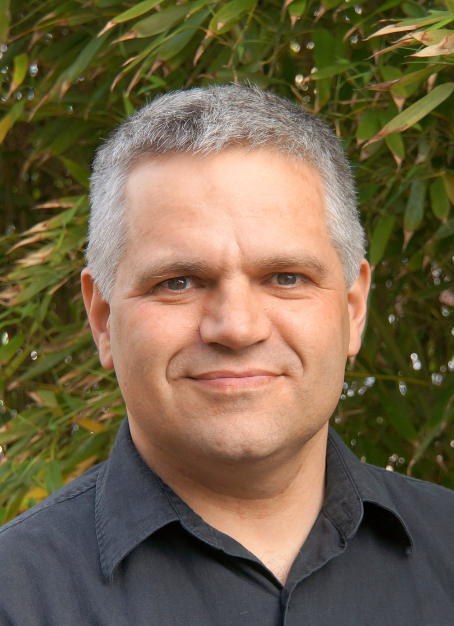
Harold Hwang is a Professor in the Department of Applied Physics at Stanford University's School of Engineering. His research focuses on quantum materials, particularly nickelate superconductors and oxide membranes. He teaches advanced courses including Solid State Physics II (APPPHYS 273), Master's Research (MATSCI 200), and Dissertation Research (APPPHYS 390). Professor Hwang's research interests center on nickelate superconductivity, strain engineering of quantum materials, and advanced characterization techniques. His group investigates metal-insulator transitions, electronic structure of correlated oxides, and ferroelectric phenomena in ultrathin membranes. Key methodologies include electron ptychography, ultrafast spectroscopy, and in situ strain manipulation to probe quantum phase transitions. His recent publications (2025) show concentrated focus on ambient-pressure nickelate superconductivity mechanisms, with emphasis on structural origins, disorder effects, and spin dynamics. The work integrates synthesis, transport measurements, and atomic-resolution imaging to unravel competing orders in infinite-layer systems. Scientific recognition includes: James C. McGroddy Prize for New Materials (2024) Professor Hwang advises graduate students through dissertation research (APPPHYS 390) and master's projects (MATSCI 200), while leading experimental efforts in oxide membrane physics. His group develops specialized instrumentation for strain-controlled quantum material studies, including compact in situ probes for 2D materials under variable tension. Research activities center on freestanding oxide membranes and nickelate heterostructures, utilizing electron microscopy facilities for atomic-scale characterization of superconducting and ferroelectric phases.