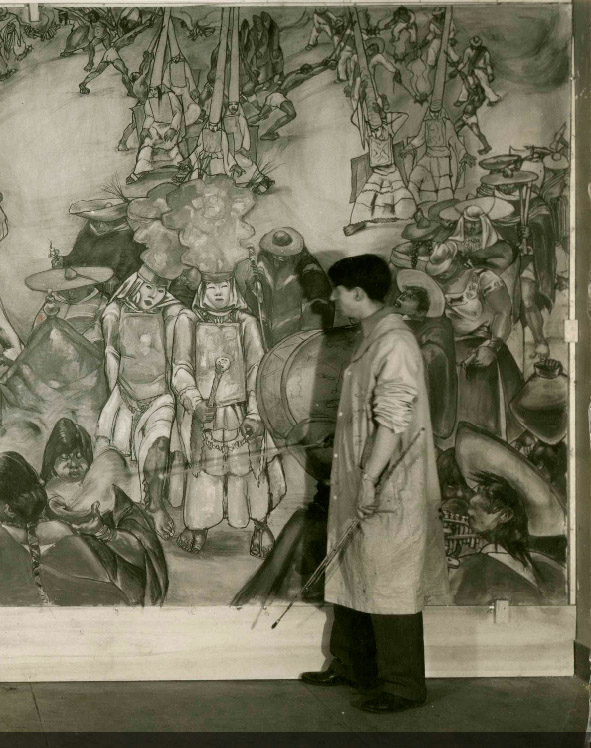
Camilo Egas (1889–1962) was a pivotal Ecuadorian artist and academic who founded the first Art Department at the New School in New York City. He served as Director of the Art Workshops (1935) and later Director of the Art Department until his death in 1962. Egas taught courses in Modern Art, Painting, Oil, and Drawing, and co-taught Advanced Painting with Robert Gwathmey (1946–1951). He integrated European artistic techniques with indigenous Ecuadorian themes, pioneering Pictorial Indigenism and contributing to Latin American modernism. Education: Studied art in Quito, Rome, and Madrid. Key works include the mural Ecuadorian Festival (1932) for the New School and contributions to the 1939 New York World Fair. His art emphasized Andean themes, indigenous struggles, and national identity, blending Social Realism, Surrealism, and Abstract Expressionism over his career. Legacy: Founded Ecuador’s first art periodical Helice , co-founded the Indigenist Movement, and mentored artists like Berenice Abbott and Stuart Davis. His interdisciplinary approach merged anthropology, archaeology, and visual arts to redefine Latin American cultural narratives.
Blair Hoxby is Professor of English at Stanford University's School of Humanities and Sciences, where he has taught since 2007. Previously, he served as Associate Professor of History and Literature at Harvard University (2005-2007) and Associate Professor of English at Yale University (2003-2005), where he began as Assistant Professor in 1998. His academic journey includes a Ph.D. in English from Yale University (1998), an M.Phil. in English Studies from the University of Oxford (1990), and an A.B. in English and American Literature and Language from Harvard University (1988). Hoxby's research focuses on literature and culture from 1500 to 1800, with particular emphasis on tragedy theory, Milton studies, and the intersection of literature and economics. His notable works include What Was Tragedy? Theory and the Early Modern Canon (2015) and Mammon's Music: Literature and Economics in the Age of Milton (2002). He argues that early modern tragedy differed significantly from contemporary understandings of the genre, with passions rather than deeds or character serving as the keys to early modern tragic performance. Hoxby's recent scholarly output reveals a consistent engagement with early modern theatrical practices, particularly tragedy and opera. His work demonstrates sophisticated interdisciplinary approaches, connecting literary analysis with historical context, economic theory, and performance studies. He has made significant contributions to understanding how commercial culture shaped literary production and how theatrical conventions evolved across national boundaries in Europe. Scientific Awards and Honors Internal Fellow, Stanford Humanities Center (2009-2010) Morse Fellowship, Juilliard School (2001-2002) Samuel and Ronnie Heyman Prize, Yale University (2001) John Addison Porter Prize, Yale University (1999) Rhodes Scholarship, University of Oxford (1988-1990) Hoxby has supervised numerous doctoral students and served in various administrative roles at Stanford, including Director of Undergraduate Studies (2011-2014) and Director of Graduate Admissions (2008-2011). His teaching portfolio includes courses on English poetry from the Renaissance to Romanticism, tragedy and tragic theory from Aristotle to the present, theater history, and performance theory. Currently, he teaches courses such as Court Theater from Shakespeare to Mozart and Introduction to English II: From Milton to the Romantics . Hoxby maintains active scholarly engagement through committee memberships, including the Executive Committee of the Milton Society of America (2009-2013) and service as a referee for major academic presses including Oxford University Press and the University of Pennsylvania Press.
Professor Mark Stoyle is a distinguished historian at the University of Southampton's Faculty of Arts and Humanities, Department of History, specializing in early modern British history. His research focuses on the English Civil War, Tudor Rebellions, and Witchcraft studies, with particular emphasis on regional histories of Devon and Cornwall. His research interests include: The English Civil War crisis of the 1640s Tudor Rebellions including the Western Rising of 1549 ('Prayer Book Rebellion') Early modern witchcraft prosecutions, especially in Exeter Urban society in early modern Britain Analysis of his recent publications reveals consistent thematic focus on marginalized historical narratives - particularly maimed soldiers' petitions from the Civil War period, witchcraft prosecutions in Southwest England, and Tudor-era popular uprisings. His work demonstrates interdisciplinary approaches combining archival research with cultural memory studies and public history engagement. His scientific awards include: Helyer an Gof Prize (2023) for best book on Devon history (2022) Helyer an Gof Prize (2023) for best book on Cornwall history (2022) Professor Stoyle actively supervises PhD students including Conor Byrne, Charlotte Kelly Rebecca Samways, and Imogen Bryony Tozer, while leading major AHRC-funded projects. His external engagements include serving on the Royal Historical Society Council, the Victoria County History advisory board, and BBC History Magazine's editorial panel. He has appeared on over 50 radio and television programs including 'The World at One' and 'Who Do You Think You Are?'. His current research includes transcribing maimed soldiers' petitions for the 'Conflict, Welfare and Memory' project, completing a monograph on the Western Rising of 1549, and researching post-Restoration witchcraft prosecutions in Exeter.
Dr. David L. Smith is a Fellow and Director of Studies in History at Selwyn College, Cambridge, and an Affiliated Lecturer in the Faculty of History. He has held roles such as Graduate Tutor at Selwyn College, and previously served as Admissions Tutor (1992-2003) and Praelector (1996-2006). He was appointed to his current position in 1992 after completing his PhD under John Morrill's supervision, having earned his BA, MA, and PGCE in History from the University of Cambridge. His research focuses on early modern British political, constitutional, and legal history, particularly the seventeenth century, emphasizing the history of Parliament, monarchy, Royalism, and Oliver Cromwell’s career. He teaches undergraduate courses on British political history (1485-1714), MPhil modules on absolutism and state formation in Europe, and weekend/summer programs via Cambridge’s Institute of Continuing Education. His publications span edited volumes, book chapters, and reviews, reflecting expertise in revolution dynamics, monarchical governance, and historical analysis through film and manuscripts. Awards include Fellowship of the Royal Historical Society and leadership in the Cambridge History Forum. Smith actively supervises graduate research in early modern British history and is known for engaging adult learners through primary-source discussions and fieldtrips. His pedagogical approach highlights interdisciplinary connections between history and other fields, such as theater and legal studies.
Jason Peacey is Professor of Early Modern British History in the Department of History at University College London, where he joined as a lecturer in 2006, became a senior lecturer in 2009, and holds his current professorship. He is a fellow of the Royal Historical Society and maintains active scholarly engagement through editorial roles and research supervision. His academic credentials include PhD studies completed at the University of Cambridge in 1994, following earlier education at the universities of Lancaster and York. His doctoral research preceded a research fellowship at the History of Parliament Trust before his appointment at UCL. Peacey's research centers on the intersection of print culture and political life in early modern Britain, examining censorship mechanisms, propaganda production, news management in nascent newspapers, and the broader 'information revolution' experienced by diverse social groups. He extends this analysis to transnational dimensions, investigating how political ideas traversed borders and contributed to an emerging European public sphere that required diplomatic manipulation by political elites. His extensive publication record demonstrates consistent thematic focus on petitioning as a political communication tool, the role of ephemeral print in revolutionary politics, and the interplay between local and national political spheres during the English Revolution and Restoration periods. Recent works increasingly analyze George Thomason's book collection and annotations as windows into contemporary reading practices and information dissemination. His scholarly recognition includes: Fellow of the Royal Historical Society Peacey serves on editorial boards for History Compass, Media History, and Parliamentary History (as book reviews editor), and co-edits the monograph series 'Politics, Culture and Society in Early Modern Britain' for Manchester University Press. His teaching encompasses undergraduate courses including 'Tudor and Stuart Britain, 1500-1700', 'The Political City: London in the Seventeenth Century', and 'The British Civil Wars and Interregnum', alongside MA modules on the public sphere. He supervises graduate research on early modern British political history, parliamentary studies, and print culture. While no formal laboratory structures are documented, Peacey's collaborative editorial work and co-edited volumes with scholars like Chris Kyle and Peter Lake indicate active participation in international research networks focused on political communication and print culture in early modern Britain.
Michelle O'Callaghan is a Professor of English Literature at the University of Reading, part of the School of Humanities. Her research focuses on early modern literature and culture, including print and manuscript culture, literary networks, poetic forms, and women’s writing. She has authored influential monographs such as The Shepheards Nation: Jacobean Spenserians and Early Stuart Political Culture (2000) and Crafting Poetry Anthologies in Renaissance England (2020). She co-edits the Palgrave Macmillan series Early Modern Literature in History and leads the Mapping the Early Modern Inns of Court project. Her work integrates digital humanities, exemplified by the Verse Miscellanies Online digital edition. Teaching includes modules like EN3TBS: The Bloody Stage: Revenge and Death in Renaissance Drama and EN2EM: Early Modern Texts and Cultures . She actively supervises postgraduate research in early modern studies. Notable collaborations include co-authoring Early Modern Women and the Poetry of Complaint with Sarah Ross and Rosalind Smith. Research highlights include exploring literary networks through material culture and investigating women’s voices in early modern poetry. She is affiliated with the Early Modern Research Centre and contributes to interdisciplinary projects bridging literature, history, and digital scholarship.
Prof. Dr. Heike Bungert is a leading scholar in North American History at the Westfälische Wilhelms-Universität Münster , focusing on ethnic migration, cultural history, and civil religion. Habilitation (2004) and Doctorate (1995) from German institutions Extensive teaching career since 2000, including visiting roles at UC Berkeley and Columbia University Her research bridges: German-American identity formation through festivals and cultural practices Transnational university history and academic networks Civil religion in US patriotic holidays Native American representation in film and collective memory Key article trends: 19th-20th century German migration patterns Academic institutions in transnational contexts Civil religion analysis in political rituals Historiography of indigenous peoples Scientific Honors : Heisenberg Fellowship (DFG, 2005) DAAD and DFG research fellowships Stuart L. Bernath Prize (1995) As a supervisor , she has guided doctoral research on topics like: Russian-American periodicals Symbolic communication in colonial legislatures Evangelical responses to immigration
Professor Maria Hayward is a leading scholar in early modern history, specializing in textiles, court culture, and material culture. She serves as Head of the History Department at the University of Southampton, having previously held roles such as Director of the AHRC Research Centre for Textile Conservation and Studies (2004-2007). Her research focuses on Tudor and Stuart periods, particularly the interplay between clothing, power, and identity. She has authored award-winning works like Stuart Style: Monarchy, Dress and the Scottish Male Elite (2020) and is currently writing a book on Catherine of Braganza. Education: BA History, PG Dip in Textile Conservation (Textile Conservation Centre), PhD in History (LSE, University of London). Research Groups: Centre for Medieval and Renaissance Culture, Southampton Centre for Nineteenth-Century Research. Awards: Fellow of the Society of Antiquaries (2004), Fellow of the Royal Historical Society (2021). Teaching includes modules on Tudor-Stuart monarchy, Roman imperial history, and supervision of PhD students. Current research explores early modern queenship and textile conservation links.
Revd Dr Brian Mac Cuarta, SJ is a Research Fellow at Campion Hall and an Associate Member of the Faculty of Theology and Religion at the University of Oxford . He previously served as Director and Academic Director at the Jesuit Archives in Rome from 2010 to 2021, focusing on post-1814 Jesuit history and preparing provincial correspondence (1939-1958) for researchers. PhD (Trinity College Dublin, 2004) DLitt (National University of Ireland, 2022) Fellow of the Royal Historical Society His research centers on early modern Irish history, specifically the Catholic community's resilience during the colonial period (pre-1641) and religious conversion in the Caroline era. He explores intersections of Gaelic culture, plantation policies, and cross-community dynamics, drawing on extensive archival work. Recent publications analyze Ulster's plantation structures , Jesuit missionary networks , and colonial violence , reflecting his interdisciplinary approach combining history, theology, and archival science. He has contributed to the Oxford Dictionary of National Biography and Dictionary of Irish Biography . Scientific Awards: Fellow of the Royal Historical Society
Aleksandra Skrzypietz is a Professor at the Institute of History, University of Silesia in Katowice, where she has been a lecturer since 1990. She is also an Associate Professor in the humanities and a member of the Research Team on Royal Courts and Power Elites at the Polish Academy of Sciences. Her research interests include: Polish-French relations in the 17th and 18th centuries, the organization and functioning of royal courts in the modern period, the political significance of the Sobieski family, the impact of education on civic and political attitudes, and the role of women in socio-political changes. Her work bridges political, gender, and cultural history with a strong regional focus on Poland and broader European connections. The themes in her publications show a sustained focus on early modern European monarchy, dynastic politics, and biographical history. Her recent works analyze the Sobieski family, French royal ambitions in Poland, and the legacy of powerful women like Queen Margot, reflecting interdisciplinary engagement with memory, identity, and power structures. Scientific Awards: Rector's Award for Scientific Activity (1996) Rector's Award for Scientific Activity (2010) Rector's Award for Scientific Activity (2013) Rector's Award for Scientific Activity (2017) Golden Badge of the University of Silesia (2018) She has participated in multiple research grants and is a multiple scholarship holder of the Lanckoroński Foundation. While no formal advisees are listed, her editorial roles indicate mentorship and academic collaboration. She is currently working on a biography of Maria Clementina Sobieska, wife of James Stuart. She is affiliated with the Research Team on Royal Courts and Power Elites at the Polish Academy of Sciences, contributing to a larger scholarly network focused on elite political structures in early modern Europe.
Dr. Fred Schurink is a Senior Lecturer in Early Modern Literature and English and American Studies at The University of Manchester. He holds a D.Phil. from Oxford University, following MAs from the University of Amsterdam and the Warburg Institute, London. His research focuses on transnational literary exchange, classical reception, and digital humanities, particularly examining the circulation of books in early modern Europe and their impact on English literary history. Key projects include the AHRC-funded 'Continental European Books in Early Modern England' and collaborations with institutions like Chetham's Library on regional readership studies. Education : MA, University of Amsterdam MA, Warburg Institute, University of London D.Phil., University of Oxford Research Interests : Early Modern Literature, Classical Reception, Digital Humanities, Translation Studies, Book History, Global Literary Connections, and Shakespeare Studies. His work challenges national literary narratives by emphasizing transnational textual movements and their socio-political implications. Key Projects : Monograph Antiquity Made Present in Reformation England (Cambridge UP, 2026) Two-volume edition Plutarch in English, 1528–1603 (MHRA, 2020) Bibliographic Data Science initiative analyzing foreign books in Renaissance England Awards & Fellowships : Leverhulme Early Career Fellow AHRC and British Academy grants Fellowships at Folger Shakespeare Library, Newberry Library, and others Advising & Grants : Collaborates on AHRC-funded doctoral projects and serves as editor for the Bulletin of the John Rylands Library and MHRA's Tudor & Stuart Translations series. Labs/Teams : Affiliated with the Digital Futures initiative and John Rylands Research Institute, contributing to interdisciplinary digital humanities research.
Professor Stuart Littlefair is a Professor of Astrophysics at the University of Sheffield's School of Mathematical and Physical Sciences. His research focuses on Interacting binary stars , Brown dwarfs and low-mass stars , Star formation , and High time resolution astrophysics . He contributes to projects like the Gravitational-wave Optical Transient Observer (GOTO), which detects transient astrophysical events. His work bridges observational astronomy and theoretical modeling, emphasizing multi-messenger astronomy and gravitational wave source identification. Research interests include studying accretion processes in compact binaries, AGN variability, and transient phenomena like gamma-ray bursts. Recent publications highlight his involvement in analyzing high-cadence optical/X-ray data (e.g., NGC 4395 AGN variability studies) and discovering peculiar systems such as inflated brown dwarfs in eclipsing binaries. He collaborates internationally, serving on committees like the ESO Observing Programmes Committee and the LSST:UK Board. Teaching activities include PHY241 Observational Astronomy . Professional roles include leading the Astrophysics Research Cluster and contributing to departmental administration (e.g., Head of Second Year Astrophysics). His work supports the University of Sheffield's astronomy infrastructure, including the GOTO telescope array.
John West is an Associate Professor in the Department of English and Comparative Literary Studies at the University of Warwick. He earned his BA and PhD from Warwick and an MSt from Oxford. He previously held a post-doctoral fellowship at Exeter, a visiting fellowship at the Folger Shakespeare Library, and was Assistant Professor at the University of Nottingham before joining Warwick in 2017. His research focuses on seventeenth-century literature, especially during the Civil Wars and Restoration, with strong interests in literature’s relationship to politics and religion. He was a Research Fellow on the Stuart Successions Project, which produced a database, anthology, and essay volume on succession literature. He contributed to Stuarts Online , an educational website developed with the Bodleian Library, Ashmolean Museum, and Shakespeare Birthplace Trust. His current book project explores literature surrounding the 1660 Restoration, focusing on writers like Dryden, Katherine Philips, and George Wither. Future research includes a study of the mythological figure Comus across cultures and media, and a theological examination of the Holy Spirit in early modern British literature, reconnecting with his earlier work on Lucy Hutchinson. His publications reflect a deep engagement with political and religious themes in early modern literature. Recent and forthcoming articles analyze royal deaths, poetic laureateship, democratic discourse, and myth-making during succession crises. His work spans major academic presses including Oxford University Press, Cambridge University Press, and Liverpool University Press. Dryden and Enthusiasm: Literature, Religion, and Politics in Restoration England (Oxford, 2018) Literature of the Stuart Successions: An Anthology (Manchester, 2017, co-edited with Andrew McRae) "Epiques chang'd to Doleful Elegies": The Poems on the Death of Henry Stuart, Duke of Gloucester (The Seventeenth Century, 2024) "Good and Acceptable Services": John Dryden and the Laureateship (Liverpool UP, forthcoming) The People and the English Civil Wars (Cambridge UP, forthcoming) Poetry, the Passions, and Anti-Democracy in Later Stuart England (Leiden, 2019) ‘A great Romance feigned to raise wonder’: Literature and the Making of the 1689 Succession (Oxford, 2019) John West actively supervises graduate and undergraduate students, having co-supervised a PhD on religion in Restoration drama (completed 2023) and advised numerous dissertations on Shakespeare, Restoration poetry, Eikon Basilike, and witchcraft plays. He convenes key modules including EN101: Epic Into Novel, EN2K5/3K5: Literature and Revolution, 1640–1660, and EN9ZF: Shakespeare in History. He is involved in academic grants and public engagement through projects like Stuarts Online, reflecting a commitment to both scholarly excellence and outreach. He is a core member of the Faculty of Arts at Warwick and contributes to research networks in early modern studies, literature and history, and public humanities. His office is located in Room 5.43 of the Faculty of Arts Building, where he holds regular office hours for student consultation.
Professor Vera Keller, Norman H. Brown, Jr. Faculty Fellow at the University of Oregon, specializes in the intersections of the history of science with the history of knowledge, ignorance, and political/economic thought. She is affiliated with the College of Arts and Sciences (Humanities school) and serves as Membership Chair and a Board Director of the Renaissance Society of America. Books: Knowledge and the Public Interest, 1575–1725 (2015), The Interlopers: Early Stuart Projects and the Undisciplining of Knowledge (2023), Curating the Enlightenment: Johann Daniel Major and the Experimental Century (2024) Current Project: Superability (Disability History of the Renaissance) Her research spans colonial epistemic dynamics, the co-production of experimental reason with statecraft, and the institutionalization of academic disciplines. Articles focus on topics like Drebbel’s self-regulating oven, Baconian desiderata, and chymical intelligencers. Scientific Awards: Gordan Prize (Renaissance Society of America) Gershoy Award (American Historical Association) Snow Prize Shortlist (North American Conference of British Studies) She co-edits the De Gruyter series Cultures and Practices of Knowledge in History and contributes to journals like Isis . Funding includes fellowships from the Mellon Foundation, ACLS, and Guggenheim.
Professor Kathy Lavezzo is a faculty member in the Department of English at the University of Iowa’s College of Liberal Arts and Sciences. She holds a PhD from the University of California, Santa Barbara (1999) and an MA from the University of Virginia (1988). Her research bridges medieval and modern studies, focusing on medieval literature, postcolonial theory, and cultural studies. Notable works include Angels on the Edge of the World: Geography, Literature and English Community, 1000-1534 (2006) and The Accommodated Jew (2018), recognized by Book Riot as essential medieval texts. Her upcoming book, Bad Medievalism and the Modernity Problem (2025), explores connections between Stuart Hall and J.R.R. Tolkien to challenge medieval-modern divides. Research interests include medieval romance, Chaucer, and contemporary authors like Paule Marshall and Kazuo Ishiguro. She teaches courses on narrative’s role in identity and has pioneered interdisciplinary approaches linking medieval texts to modern social issues. Awards include inclusion in Book Riot’s top medieval reads (2018). Her recent work critiques whiteness and medievalism in immigration discourse, reflecting her commitment to intersectional analysis. Publications span medieval gender studies, antisemitism, and cultural theory. She actively contributes to pedagogical innovation, such as global medieval studies frameworks. Her writing bridges scholarly rigor with accessible cultural critique, exemplified by her analysis of sanctuary narratives in medieval literature (2024) and Tolkien fandom’s critical potential (2023).