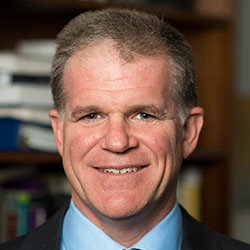
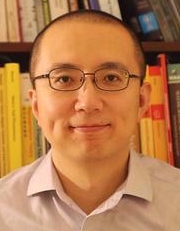
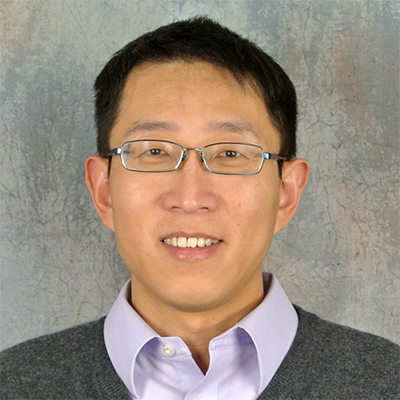
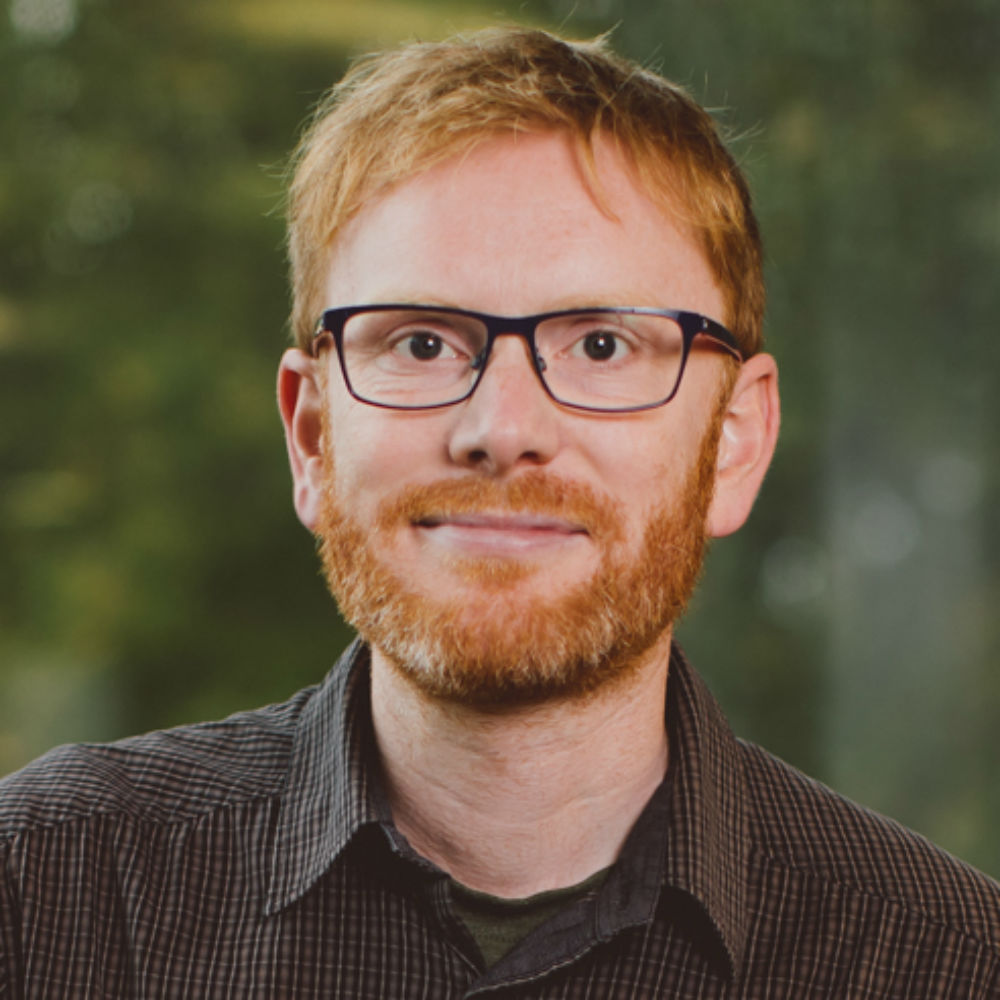
David Chopp is a Professor of Engineering Sciences and Applied Mathematics at Northwestern University's McCormick School of Engineering. His research focuses on numerical methods, scientific computing, and interface motion, with applications in bacterial biofilms, neurophysiology, and materials science. He holds the Charles Deering McCormick Professor of Teaching Excellence award. Chopp earned his Ph.D. in Mathematics from UC Berkeley and a B.S. in Mathematics and Applied Mathematics from the University of Washington. Research interests include level set methods, computational neuroscience, fracture mechanics, and biofilm modeling. Notable contributions span phase field modeling, microbial fuel cell simulations, and adaptive algorithms for neural systems. His work bridges computational tools with real-world applications in engineering and biology. Key Projects: Phase field modeling with large driving forces (2023), biofilm potassium signaling (2021), non-planar crack tracking (2016). Awards: Charles Deering McCormick Professor of Teaching Excellence. Chopp advises students in biofilm dynamics, computational materials, and fracture mechanics. His lab develops algorithms for interface tracking and neural simulations, collaborating on biofilm bioclogging and material failure analysis. Active in teaching and publishing, he authored textbooks on high-performance computing and contributed to over 60 peer-reviewed articles.
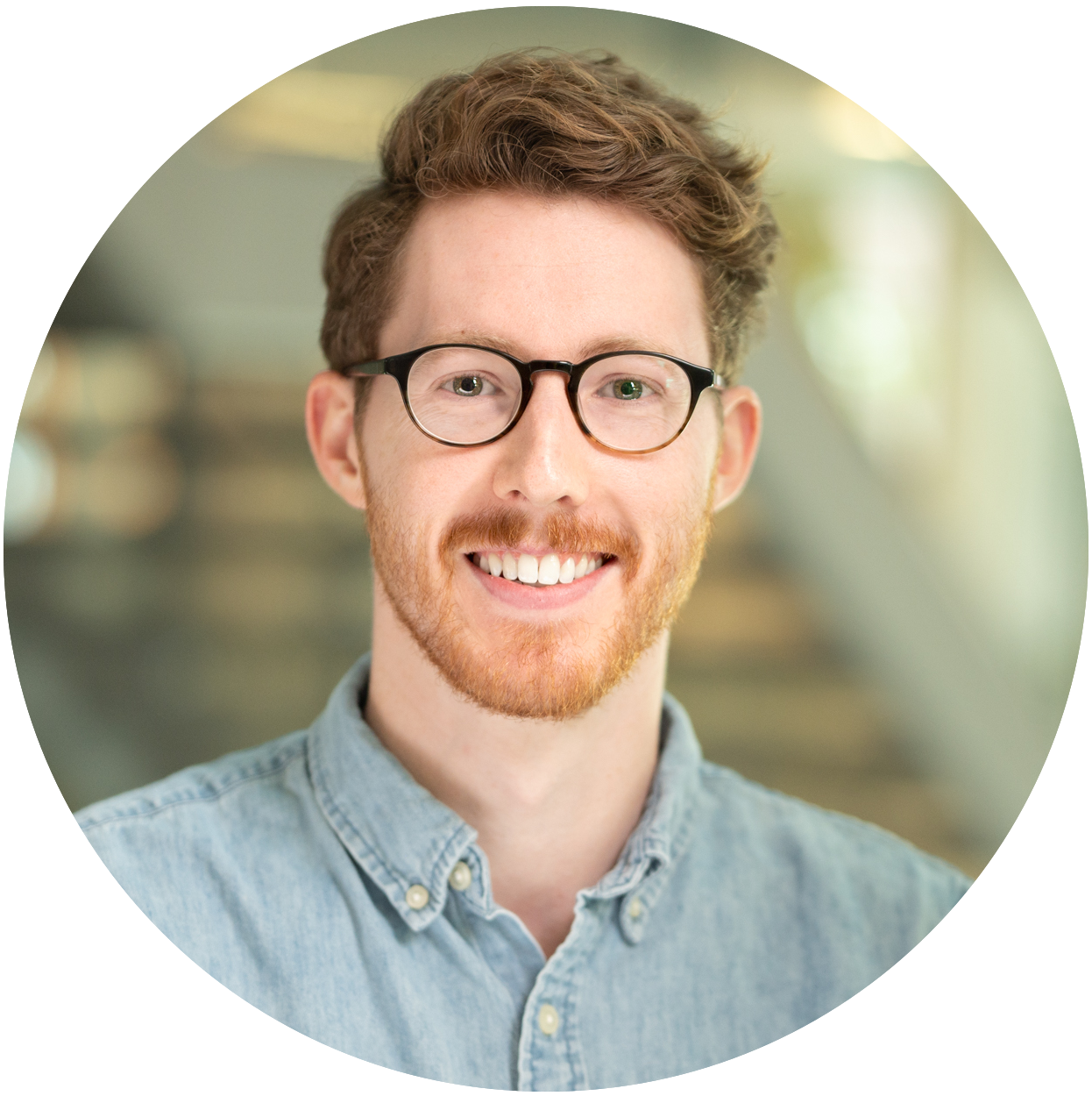
Glen McGee is an Assistant Professor in the Department of Statistics and Actuarial Science at the University of Waterloo. He holds a PhD in Biostatistics from Harvard University and a BScH in Mathematics from Queen's University. His research focuses on developing statistical tools for epidemiology, environmental health, and health policy, with a particular emphasis on environmental mixture analysis, cluster-correlated data modeling, and outcome-dependent sampling methodologies. Education : PhD in Biostatistics, Harvard University BScH in Mathematics, Queen's University Research Interests : McGee advances methodologies for analyzing complex environmental mixtures and their health impacts, including incorporation of biological knowledge into statistical frameworks. His work addresses challenges in multigenerational studies, informative cluster sizes, and measurement error correction in case-crossover designs. Key application areas include hospital profiling, exposure misclassification, and longitudinal health data analysis. Research Trends : His publications emphasize Bayesian methods for mixture modeling, innovative sampling strategies for clustered data, and causal inference techniques. Notable contributions include frameworks for integrating biological pathways into environmental health analyses and developing efficient sampling approaches for healthcare performance evaluation. Grants & Labs : McGee collaborates on projects involving CMS data applications and maintains GitHub repositories like hospODS for hospital profiling methodology implementation. His work bridges statistical theory with practical public health applications, particularly in environmental epidemiology and healthcare analytics.
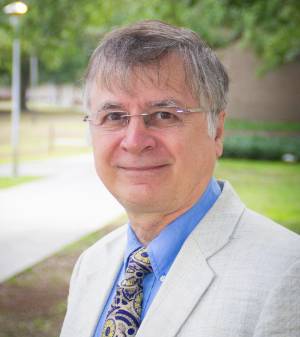
Toan T. Nguyen is a Professor in the Department of Mathematics at Pennsylvania State University, affiliated with the Eberly College of Science. He holds a Ph.D. from Indiana University (2009). His research focuses on Partial Differential Equations, Mathematical Physics, Fluid Dynamics, and Kinetic Theory, with contributions to boundary layer stability, inviscid limits, and plasma physics. Education: Ph.D. in Mathematics, Indiana University, 2009. Affiliations: Editorial Board member of Kinetic & Related Models and SIAM Journal on Mathematical Analysis. Grants & Support: Recipient of Simons Fellowship (2019), Centennial Fellowship (2018). His work bridges theoretical analysis and applications, including nonlinear wave dynamics, fluid-structure interactions, and quantum kinetic models. He has organized international conferences, such as the VIASM Summer School in Mathematical Physics (2023–2024), and advised Ph.D. students like Chanjin You and Trinh T. Nguyen. Awards: T. Brooke Benjamin Prize (2022), highlighting his contributions to nonlinear waves and Landau damping. His research also explores instabilities in boundary layers and the mathematical foundations of plasma physics. Nguyen collaborates internationally, contributing to journals like the Journal of the American Mathematical Society and Communications in Mathematical Physics. His teaching includes advanced graduate courses on PDEs and kinetic theory.
Robert D. Gray is a Professor of Mathematics at the School of Mathematics, University of East Anglia. His research focuses on combinatorial and geometric group and semigroup theory, algorithmic problems in algebra, decidability, homological finiteness properties, and group actions on graphs and topological spaces. EPSRC Research Fellow Editorial Board: International Journal of Algebra and Computation Available for PhD supervision in semigroup and inverse monoid theory His recent work explores: Topological finiteness properties of monoids Undecidability in one-relator inverse monoids Algorithmic properties of inverse monoids Maximal subgroups in special inverse monoids Key article trends include: Geometric and algorithmic aspects of inverse monoids Homological properties of semigroups Connections between group theory and semigroup theory Applications to graph theory and automata Scientific Awards: EPSRC Fellowship EP/V032003/1 EPSRC grant EP/N033353/1 EPSRC Postdoctoral Fellowship EP/E043194/1 Contact: Room S1.29, School of Mathematics, University of East Anglia, Norwich NR4 7TJ. Email: Robert.D.Gray@uea.ac.uk . Phone: +44 1603 591443.
Dr. Aydin K. Sunol is a Professor of Chemical, Biological and Materials Engineering at the University of South Florida's College of Engineering. With a distinguished career spanning several decades, he leads the Environmentally Friendly Engineered Systems (EFES) Lab and serves as principal investigator for numerous research projects funded by NASA, DOD, NSF, and industry partners. Education: PhD in Chemical Engineering, VPI & SU, Blacksburg, Virginia MEng in Industrial Engineering and Operational Research, VPI & SU, Blacksburg, Virginia Diploma in Chemical Engineering, University of Aston, Birmingham, England BS in Chemical Engineering, Bogazici University, Istanbul, Turkey Dr. Sunol's research focuses on green engineering and chemistry, sustainability in the chemical industry, systems engineering, and cleaner energy conversion processes. His work integrates global computational methods, machine learning, product prototyping, and experimentation across multiple temporal and spatial scales. Recent projects include developing nano-structured photo-catalysts, therapeutic particles, and energetic materials using environmentally friendly pathways, as well as creating efficient fuel conversion processes utilizing supercritical fluids. His research demonstrates a consistent trend toward sustainable solutions that address fundamental challenges in materials science, energy conversion, and environmental protection through innovative application of supercritical fluid technology and computational methods. Scientific Awards: USF Chemical and Biomedical Engineering Department Outstanding Teaching Award, 2018 University of South Florida Outstanding Undergraduate Teaching Award, 2002-2003 Engineering Professor of the Year, 1984 Outstanding Professor of Chemical Engineering, VPI & SU, 1981 Outstanding Technology Innovation Award, Aerospace Space System Conference, 2010 As an educator, Dr. Sunol has advised 18 PhD and 29 Master's students, developing innovative teaching methods and curricula including NSF-funded Web-based Teaching Modules and Design Course Series. His research has been supported by diverse funding sources including DOE, NSF, NATO, UNESCO, NAVY, NASA, and numerous industry partners. Dr. Sunol also serves as principal partner and CTO of Temptroll LLC and Accent Creations LLC, which develop self-heating and cooling products, demonstrating the practical application of his research. The EFES Lab, which Dr. Sunol directs, brings together interdisciplinary researchers including chemical engineers, mechanical engineers, and computer scientists to tackle complex challenges in sustainable engineering. Current team members include PhD candidates working on nano-structured materials, wastewater management systems, and temperature modulation products, continuing the lab's tradition of innovation in environmentally friendly engineered systems.
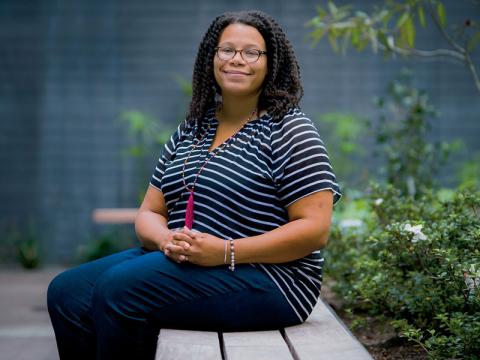
Lisa Molix is an Associate Professor at Tulane University's School of Science & Engineering. Her research focuses on intergroup relations, health disparities among marginalized populations, and the psychological impacts of social stigma. She teaches courses in Social Psychology, Intergroup Relations, and Structural Equation Modeling. Her publications investigate how social factors like stigma and discrimination affect physiological and psychological health outcomes, particularly in minority populations. Research methodologies include biomarker analysis and meta-analytic approaches to understand broad patterns in social perception and health outcomes.
Sergey Dyachenko is an Assistant Professor in the Department of Mathematics at the University at Buffalo, New York. He holds a PhD in Applied Mathematics from the University of New Mexico (2014) and a BS in Applied Physics and Mathematics from Moscow Institute of Physics and Technology (2007). PhD: University of New Mexico BS: Moscow Institute of Physics and Technology His research focuses on nonlinear wave phenomena and fluid dynamics, particularly singularity formation in free-surface flows like water wave breaking and whitecapping. He employs computational mathematics and applied analysis to study: Free surface wave dynamics Stokes wave singularities Wave turbulence theory Integrable systems (NLS, KdV) Recent publications analyze: Stokes wave instabilities Capillary wave propagation Conformal mapping techniques Operator splitting methods Contact: Office: 312 Mathematics Building, UB North Campus Email: sergeydy@buffalo.edu
Jessie Kemmick Pintor, PhD, MPH, is an Assistant Professor in the Department of Health Management and Policy at Drexel University’s Dornsife School of Public Health. She holds a PhD in Health Services Research, Policy & Administration and an MPH in Maternal & Child Health from the University of Minnesota, followed by an AHRQ-funded postdoctoral fellowship at UC Davis. Her research focuses on immigration and healthcare policy, health disparities, and mixed-methods approaches to evaluate population health interventions. She has extensive experience working with Latino immigrant communities and studying the impacts of policy on healthcare access for children and families. Key research areas include immigrant health, maternal and child health equity, and state-level policies affecting healthcare coverage. Her work emphasizes community-based participatory research and policy analysis. Dr. Kemmick Pintor has contributed to studies on Medicaid expansion impacts, disparities in insurance coverage, and the mental health consequences of immigration enforcement on US-citizen children of undocumented parents. Publications span topics like maternal-clinician ethnic concordance, ACA implementation effects, and discrimination in healthcare. Her research has been published in high-impact journals such as JAMA Network Open and PLoS One. While no formal academic awards are listed, her work reflects strong engagement with vulnerable populations and policy advocacy. She advises no explicitly listed students, though her postdoctoral training and collaborations suggest active mentorship roles. Grants include AHRQ funding for her postdoctoral work.
Yizao Wang is a Professor in the Department of Mathematical Sciences at the University of Cincinnati. He holds a Ph.D. from the University of Michigan (2012) and specializes in Probability Theory, Stochastic Processes, and their applications, with a focus on extreme value theory, long-range dependence, and random fields. His research includes studies on asymmetric exclusion processes, fractional Brownian motion, and self-similar processes. Education : Ph.D. in Mathematics, University of Michigan, 2012. Research Interests : Probability theory, stochastic processes, extreme value theory, long-range dependence, random fields, limit theorems, and applications in finance and statistics. His work frequently explores the interplay between combinatorial structures and stochastic models, such as random partitions and operator-scaling processes. Grants : He has led and co-led multiple grants, including: DoD Army Research Laboratory: Advances in Extreme Value Theory with Long-Range Dependence ($84,229, 2020–2023) National Security Agency: From Random Partitions to Self-Similar Processes ($40,000, 2016–2018) National Science Foundation: Cincinnati Symposium on Probability Theory and Applications ($20,000, 2018–2019) Students and Advising : Mentored numerous graduate and undergraduate students in capstone projects and independent studies, focusing on topics like random walks, branching processes, and stochastic differential equations. Notable advisees include Connor McClellan, Yiyang Yu, and Weiqing Yu (recipient of the Charles Phelps Taft Senior Thesis Fellowship). Labs/Teams : Active in collaborative research groups within the department, contributing to interdisciplinary projects in stochastic modeling and mathematical finance. Teaches advanced courses in probability, stochastic processes, and financial mathematics.
Dr. Jun Yan is a Professor in the Department of Statistics at the University of Connecticut. His research spans network analytics, spatial extremes, survival analysis, and statistical computing with applications in public health, finance, and environmental science. His core research interests include: network modeling and analysis, spatial statistics for climate extremes, survival analysis methodologies, statistical computing frameworks, and applications in interdisciplinary domains including sports analytics. Dr. Yan has developed significant statistical methodologies for network analysis, climate change detection, financial modeling, and health analytics. His recent publications demonstrate innovation in modeling complex network structures, analyzing climate extremes, developing computational approaches for massive datasets, and creating specialized statistical methods for health and finance applications. He maintains active collaborations across disciplines and contributes to open-source statistical software. Honors include: Guggenheim Fellowship, multiple Fromm Foundation commissions, and Barlow Endowment recognition.
James M. Lattimer is a Distinguished Professor of Astronomy at Stony Brook University, affiliated with the Department of Physics & Astronomy. He specializes in neutron star structure, dense matter equation of state, core-collapse supernovae, and nuclear astrophysics. His research integrates observational data from missions like NICER with theoretical models rooted in nuclear physics. B.S. in Physics (University of Notre Dame, 19XX) Ph.D. in Astronomy (University of Texas at Austin, 19XX) His work focuses on constraining neutron star properties via X-ray observations and gravitational wave events. Key projects include NASA's Binary Neutron Star Mergers Grand Challenge and analyses of pulsar data (e.g., PSR J0740+6620, PSR J0030+0451). He teaches advanced courses like PHY 521 (Stars) and CEN 511 (Recent Discoveries in Astronomy), emphasizing stellar structure, compact objects, and cosmic phenomena. Recent research highlights include studies of symmetry energy constraints, universal neutron star relations, and implications of NICER/XMM-Newton measurements for dense matter physics. His work bridges nuclear theory, astrophysical observations, and computational modeling to address fundamental questions about matter under extreme conditions.
Kami Mohammadi is an Assistant Professor in the Civil & Environmental Engineering department at the University of Utah , with an adjunct appointment in Geology & Geophysics . Holding a PhD from Georgia Institute of Technology and postdoctoral experience at Caltech, Mohammadi specializes in seismic wave propagation, basin effects, and computational geotechnical modeling. Education PhD (2015), Civil and Environmental Engineering - Geotechnical Engineering, Georgia Institute of Technology MS (2012), Geotechnical Engineering with minor in Applied Mathematics, Georgia Institute of Technology MS (2006), Civil Engineering, University of Tehran BS (2003), Civil Engineering, Chamran University of Ahvaz Their research focuses on: 3D seismic wave propagation in heterogeneous media Basin effects on earthquake amplification Hybrid physics-informed machine learning models Finite element/discrete element modeling of geotechnical systems Ground motion prediction and hazard analysis Hydraulic fracturing in fractured rock Recent work integrates full-waveform inversion with neural networks for subsurface imaging. Mohammadi teaches graduate courses in geotechnical engineering, soil dynamics, and earthquake engineering, with a focus on computational methods and laboratory practices. Current grants include: EXTERNAL GRANT OR CONTRACT (2024-2030): Integration of computational and experimental analyses for earthquake amplification EXTERNAL GRANT OR CONTRACT (2024-2029): 3D site effect modeling at LANL EXTERNAL GRANT OR CONTRACT (2021-2024): Various seismic projects Professional activities include community outreach through engineering education presentations.
Dr. Eoin O'Gorman is a Senior Lecturer in the School of Life Sciences at the University of Essex. His research investigates the impacts of global change across multiple levels of ecological organisation, from individual metabolism to ecosystem processes, with a particular focus on food web dynamics and body size as a functional trait. BSc, University College Cork (2004) PhD, University College Cork (2009) Current research projects include: Warming effects on trophic interactions Anthropogenic stressors in marine and freshwater systems Body size scaling in ecological networks Food web stability under climate change Recent work demonstrates how warming alters plankton body-size distributions (2025), simplifies freshwater food webs through multiple stressors (2025), and reduces trophic diversity in high-latitude ecosystems (2024). His studies span marine, freshwater, and terrestrial habitats, seeking universal responses to environmental change. Current grants include: 2024 WebDNA: Food web reconstruction through environmental DNA analysis (Leverhulme Trust) 2023 Predicting Impacts of Global Environmental Change on Ecological Networks (NERC) 2022 ORBIT: Offshore Renewables and Benthic Communities (NERC) Supervises PhD candidates studying: Zelin Chen: Offshore structures' impacts on North Sea biodiversity Patrick Eskuche Keith: Southern Ocean food web dynamics Anamika Poyil: Environmental biology of marine communities
Mohammad Zunoubi is an Associate Professor in the Department of Engineering Programs at SUNY New Paltz, part of the School of Science & Engineering. He holds an undergraduate degree from the University of Mississippi and a postgraduate degree from the University of Illinois at Urbana-Champaign. His research focuses on High-Performance Computing solutions for electromagnetic problems, Nonlinear Optics, and Microwave/Antenna Design. He has conducted extensive work in Computational Electromagnetics, utilizing methods like FDTD and FEM. His teaching interests span Electromagnetics, Numerical Methods, and EMC/EMI. He has been recognized with multiple awards, including the SUNY Provost’s Research Award (2005) and several United States Air Force Summer Faculty Fellowships (2009–2017). His research often involves collaboration with the Air Force, focusing on advanced electromagnetic modeling and high-power microwave effects. Dr. Zunoubi’s publications highlight contributions to antenna design, electromagnetic compatibility, and high-performance computing techniques. His work bridges theoretical electromagnetics with practical applications in aerospace, medical physics, and material science.
Dr. Nicholas Kevlahan is a Professor in the Department of Mathematics and Statistics at McMaster University. He holds a BSc in Physics from the University of British Columbia (1985–1989), a PhD in Applied Mathematics from the University of Cambridge (1990–1994), and completed a Marie Curie postdoctoral fellowship at École Normale Supérieure in Paris (1998). He has held visiting positions at institutions including Université Grenoble-Alpes, INRIA, and the University of Cambridge. His research focuses on advanced computational and mathematical methods for fluid dynamics, including the development of the WAVETRISK code for adaptive climate modelling, data assimilation techniques, fluid-structure interaction, and compressive sampling. His work integrates interdisciplinary approaches across applied mathematics, geophysics, and engineering. Key research areas include geophysical fluid dynamics, numerical analysis, partial differential equations, and wavelet-based methods. He has published extensively on topics such as ocean circulation models, turbulence simulation, and adaptive numerical methods. Dr. Kevlahan teaches courses in numerical methods, differential equations, asymptotic analysis, and mathematical physics. He mentors a diverse group of PhD, MSc, and BSc students in his active research laboratory.