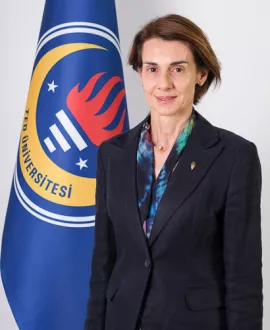
Professor Gulser Köksal is a distinguished academic in the Department of Industrial Engineering at TED University. She previously served as Professor at Middle East Technical University (METU) from 1993 to present, holding significant administrative roles including Vice Rector (2017-2019) and Advisor to the Rector (2016-2017). Her academic journey includes positions as Associate Professor (1999-2006) and Assistant Professor (1993-1999) at METU, and Assistant at North Carolina State University (1988-1993). Her educational background includes a PhD in Industrial and Systems Engineering from North Carolina State University (1987-1992), an MS in Industrial Engineering from Middle East Technical University (1985-1987), and a BS in Industrial Engineering from the same institution (1980-1985). She is proficient in English at an advanced level (C1). Professor Köksal's research focuses on quality engineering, statistical process control, robust design methodologies, and data mining applications for quality improvement. Her work bridges theoretical statistical methods with practical industrial applications, particularly in multi-response optimization, desirability functions, and quality function deployment. She has made significant contributions to understanding inspection errors, rework processes, and their economic impacts on quality characteristics. Her publication portfolio demonstrates a consistent trajectory from foundational work in statistical process control to more recent applications of machine learning and neural networks in quality engineering. The research shows strong emphasis on practical industrial applications while maintaining theoretical rigor, particularly in handling categorical responses, uncertainty modeling, and multi-criteria decision making in product design. Professor Köksal has successfully supervised 64 theses across doctoral and master's levels, demonstrating her commitment to academic mentorship. Her research has been supported by numerous projects from TÜBİTAK, Erasmus, and Teknopark, totaling 21 projects. These projects span quality engineering, data mining applications, product design optimization, and strategic university governance. She has contributed to the academic community through extensive service, including participation in international conferences, workshops on quality engineering and higher education leadership, and collaborative research projects with institutions across Europe and China. Her work on university governance, particularly through the LEAD project, demonstrates her commitment to advancing academic leadership practices.