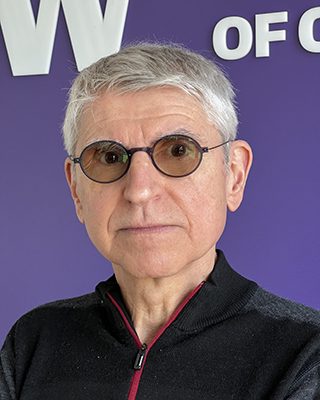
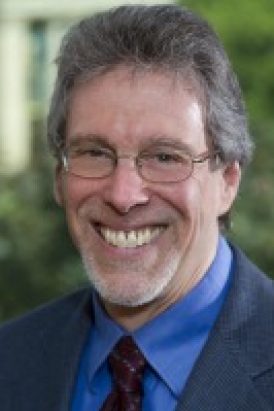
Dan Suciu is a Microsoft Endowed Professor in the Paul G. Allen School of Computer Science & Engineering at the University of Washington. His research focuses on data management, query optimization, probabilistic databases, parallel data processing, and information theory applications to databases. Awards : ACM Fellow (2011), American Academy of Arts and Sciences (2024), ACM SIGMOD Codd Innovation Award (2022), NSF Career Award (2001), Alfred P. Sloan Fellow (2001-2002). Research Trends : Recent work emphasizes cardinality estimation using Lp-norms, submodular width for query evaluation, dynamic query processing, and tensor program optimization. His publications highlight intersections between database systems and formal methods, driven by mathematical rigor. Key Collaborators : Mahmoud Abo Khamis, Dan Olteanu, Amir Shaikhha, Maximilian Schleich, Kyle Deeds, Moe Kayali. Advising : PhD students Gerome Miklau (2006), Christopher Re (2010), Paris Koutris (2016), Nilesh Dalvi (2008 runner-up), Yisu Remy Wang (2024 runner-up) have excelled in dissertation awards.
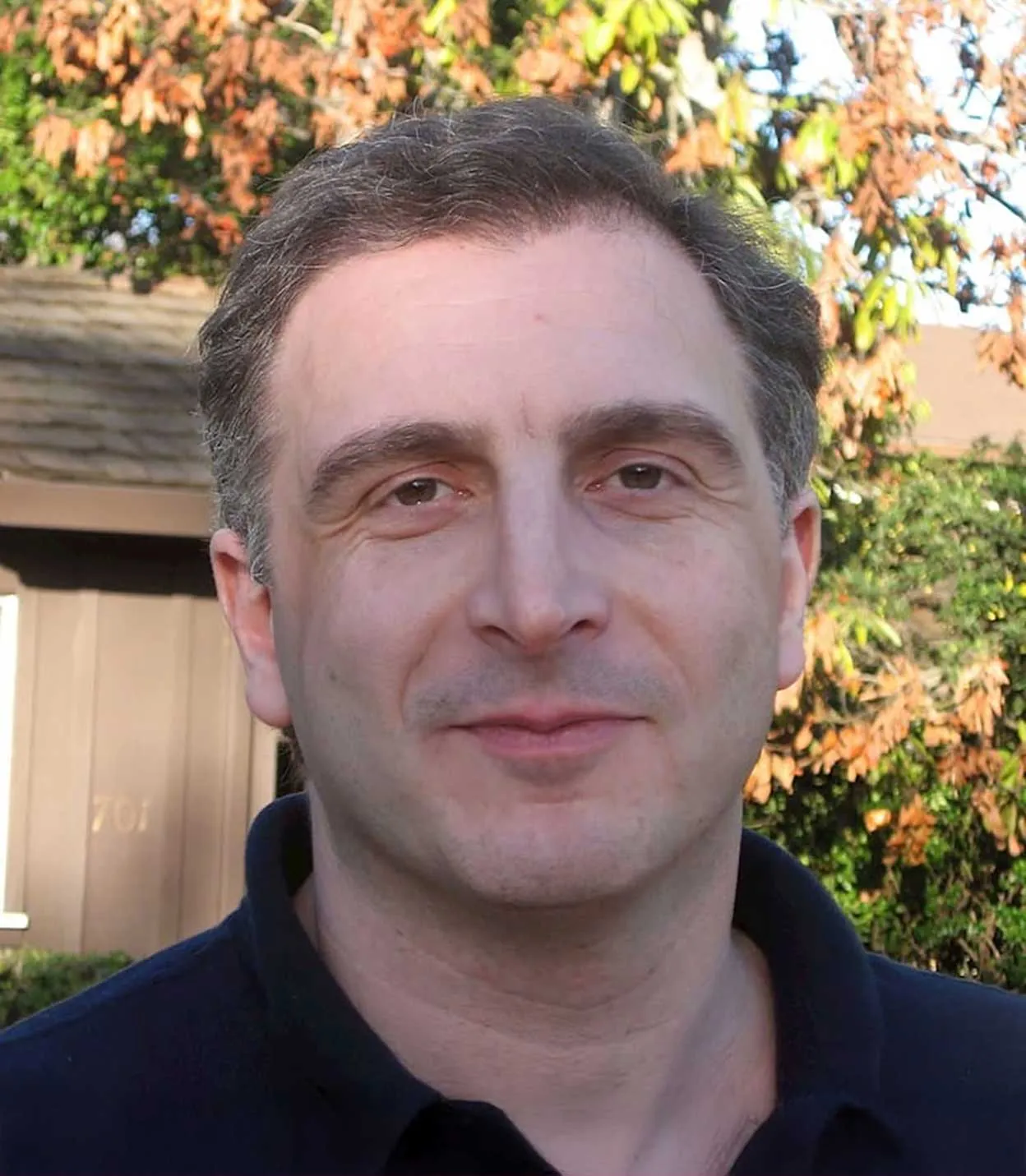
Abhijit Sarkar is a Professor in the Department of Civil and Environmental Engineering at Carleton University, Ottawa. His work centers on computational dynamics and probabilistic modeling, with office MC 3076 in the Minto Centre for Advanced Studies in Engineering and contact details including phone (613) 520-2600 x6320 and email abhijit_sarkar@carleton.ca . Education: D.Phil. from University of Oxford M.Sc. from Indian Institute of Science (IISc) B.E. from Calcutta University Professional Engineer (P.Eng.) designation His research drives innovation in uncertainty quantification for complex engineering systems. Core interests include dynamics of nonlinear structures, probabilistic mechanics for stochastic finite element methods, and Bayesian inference frameworks for parameter estimation. He pioneers scalable high-performance computing solvers for large-scale systems and sparse learning algorithms to address overfitting in statistical modeling. Recent publications (2022-2024) reveal three dominant trends: (1) Bayesian model calibration for stochastic compartmental systems applied to epidemiology and aerospace, (2) domain decomposition techniques for scalable uncertainty quantification in stochastic PDEs, and (3) sparse learning methods for nonlinear aerodynamic encoding. Key applications span wind turbine vibration analysis, flutter margin prediction, MEMS resonator optimization, and geospatial pandemic modeling. Scientific awards: No awards, fellowships, or medals listed in the source material Graduate supervision includes 6 current students (Ajay Kumar, John Clarabut, Nastaran Dabiran, Sakhi Mittal, Michael Pantano, Brandon Robinson) and 18 graduated students across 17 years (2006-2023). His research leverages high-performance computing for projects in structural dynamics, aeroelasticity, and computational epidemiology, frequently co-supervised with Dominique Poirel and Chris Pettit. Notable grants focus on wind tunnel validation for nonlinear systems and pandemic spread modeling. Based in the Minto Centre for Advanced Studies in Engineering, his computational mechanics group develops algorithms for stochastic dynamics using Carleton University's high-performance computing infrastructure. Collaborations span aerospace engineering (flutter analysis), civil infrastructure (seismic wave propagation), and public health (Covid-19 modeling).
Philipp Afeche is a Professor of Operations Management and Statistics at the Rotman School of Management, University of Toronto. His research bridges operations and marketing/economics, focusing on revenue management, pricing strategies, and service design in congestion-prone systems like healthcare and transportation. He holds a BA from the University of St. Gallen and MS/PhD degrees from Stanford University. Afeche has been recognized with the 2014 Best Paper Award (MSOM) and the 2018 Roger Martin Teaching Award. Education: BA, University of St. Gallen, Switzerland MS, Stanford University, USA PhD, Stanford University, USA Research Interests: Afeche explores optimization challenges in dynamic service systems, including pricing under uncertainty, strategic customer behavior in queues, and platform design for shared mobility systems. His work integrates queueing theory, game theory, and empirical analysis to address real-world operational inefficiencies in healthcare delivery and transportation networks. Recent studies focus on ride-hailing market mechanisms and bipartite matching systems. Awards: 2014 Best Paper Award, Manufacturing & Service Operations Management 2018 Roger Martin Award for Excellence in Teaching Grants & Editorial Roles: Editor for Management Science and Operations Research, with funding reviews for agencies in Canada, Hong Kong, Israel, and the US. Past chair of the Service Management SIG for MSOM Society. Labs/Teams: Active in Rotman's Operations Management group and collaborates with industry partners on supply chain optimization and revenue management projects.
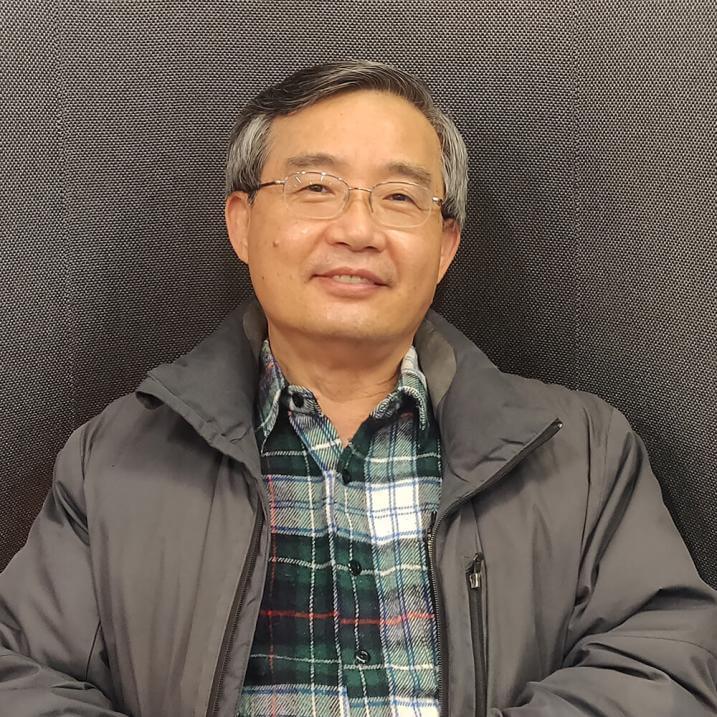
Professor Byung S. Lee is a distinguished faculty member in the Department of Computer Science at the University of Vermont's College of Engineering and Mathematical Sciences. He joined UVM in 1999 and continues to be actively engaged in teaching, research, and service. His office is located in Innovation Hall at the Burlington campus, where he maintains regular office hours and oversees his research lab. Professor Lee holds a Ph.D. from Stanford University, an MS from Korea Advanced Institute of Science and Technology, and a BS from Seoul National University. His educational background provided the foundation for his extensive career in computer science research and education. Professor Lee's research spans multiple domains within computer science, with a particular focus on database systems, data mining, and data science. His work increasingly integrates machine learning techniques with traditional database approaches, especially in the analysis of time series data. He has made significant contributions to graph theory applications, anomaly detection methods, and environmental data analysis. His research often bridges computer science with practical applications in healthcare, environmental science, transportation, and astrophysics through interdisciplinary collaborations. An analysis of his recent publications reveals a strong trend toward time series analysis and anomaly detection, particularly applied to environmental monitoring and healthcare data. His work demonstrates a consistent evolution from foundational database research to more applied machine learning approaches, with increasing emphasis on real-world problem solving across multiple scientific domains. Professor Lee has served as primary advisor for numerous graduate students across multiple cohorts, including PhD candidates, Master's students, and postdoctoral researchers. His advising portfolio reflects the breadth of his research interests, with students working on topics ranging from graph neural networks to medical informatics applications. He has also been actively involved in professional service, serving on program committees for major conferences including SAC, PAKDD, DASFAA, and CIKM. Professor Lee leads a vibrant research laboratory that focuses on cutting-edge data science methodologies and their applications. His team collaborates extensively with researchers in environmental science, hydrology, and healthcare, demonstrating the interdisciplinary nature of modern data science research. The lab maintains active projects in time series analysis, graph analytics, and environmental monitoring systems, often working with large-scale datasets from real-world applications.
Dr. Hengrui Cai is an Assistant Professor of Statistics at the University of California Irvine (UCI), affiliated with the Donald Bren School of Information and Computer Sciences. She holds a Ph.D. in Statistics from North Carolina State University (NCSU) and a B.S. in Statistics from Zhejiang University. Her research focuses on causal inference, reinforcement learning, and graphical models, with applications in precision medicine, healthcare analytics, and epidemiology. She develops interpretable solutions for individualized decision-making, particularly in healthcare settings such as ICU patient treatment optimization and pandemic analysis. Notable achievements include the NSF CDS&E-MSS Award (2024), ICS Research Awards (2023–2024), and recognition for contributions to causal discovery and policy evaluation. Dr. Cai advises graduate and undergraduate students on projects involving causal AI, machine learning, and healthcare data analysis. She teaches courses like 'Causal Machine Learning' and 'Introduction to Probability and Statistics,' emphasizing interdisciplinary approaches to real-world problems. Her work integrates statistical theory with practical applications, exemplified by software tools like ANOCE-CVAE for causal mediation analysis and the Sepsis EHR Benchmark Environment for reinforcement learning. Dr. Cai collaborates widely, contributing to projects such as quantifying the impact of the 2020 Hubei lockdowns on virus spread in China through causal graph analysis.
Na Young Kim is an Associate Professor in the Department of Electrical and Computer Engineering at the University of Waterloo with affiliations at the Institute for Quantum Computing (IQC) and Waterloo Institute for Nanotechnology. She holds cross-appointments in the Departments of Physics and Astronomy and Chemistry. Her research focuses on developing large-scale quantum processors using novel materials and advanced technologies, including semiconductor quantum processors and multi-functional nanoscale devices. Dr. Kim leads the Quantum Innovation (QuIN) laboratory, pioneering projects in planar architecture design for quantum devices integrating electrical, optical, thermal, and mechanical functionalities. Prior to academia, she worked at Apple Inc. on small display technologies. She earned a BS in Physics from Seoul National University and a PhD in Applied Physics from Stanford University, where she specialized in mesoscopic transport in nanostructures. Her postdoctoral work expanded into quantum optics and nanophotonics through collaborations with international researchers. Current teaching includes courses on quantum mechanics, quantum computing algorithms, quantum information processing devices, and photonic systems. She actively supervises graduate students in quantum technology development and is accepting new applications. Research activities span quantum artificial intelligence, quantum security protocols, and nanotechnology applications. Her work bridges theoretical frameworks with experimental implementations in solid-state quantum systems.
Jian Peng is an Assistant Professor in the Department of Computer Science at the University of Illinois at Urbana-Champaign. His research focuses on computational biology, machine learning, and their applications to protein structure prediction, drug design, and molecular modeling. He has contributed to advancements in antibody engineering, protein-ligand docking, and generative models for biological systems. Key research areas include: Machine Learning for Molecular Modeling Protein Structure Prediction Antibody and Peptide Design Genomics and Single-Cell Analysis Structure-Based Drug Discovery His work emphasizes integrating deep learning techniques with biological datasets to address challenges in precision medicine, drug development, and systems biology. Notable achievements include developing the FastFold system to accelerate AlphaFold training and pioneering flow-based methods for antibody design. Awards include the Overton Prize (2020), recognizing contributions to computational biology. His research has been published in top journals and conferences, spanning topics from protein mutation prediction to geodesic-based immune complex modeling.
Matilde Marcolli is the Robert F. Christy Professor of Mathematics and Computing and Mathematical Sciences at the California Institute of Technology (Caltech). She holds joint appointments in the Division of Physics, Mathematics, and Astronomy (PMA) and the Division of Engineering and Applied Sciences (EAS). Her research spans noncommutative geometry, mathematical physics, number theory, and mathematical linguistics. She has been recognized with prestigious awards such as the Sofja Kovalevskaya Award (2001) and the Heinz Maier Leibnitz Prize (2001). Marcolli has advised numerous PhD students and contributed to over 300 publications. Her work bridges abstract mathematics with applications in cosmology, quantum field theory, and computational linguistics. Education : PhD in Mathematics, University of Chicago, 1997 M.Sc., University of Chicago, 1994 Laurea in Mathematics, University of Pavia, 1993 Research Interests : Marcolli’s research explores the intersection of geometry, number theory, and physics. Key areas include noncommutative geometry models of particle physics and cosmology, motives in quantum field theory, and algebraic models of generative linguistics. She applies advanced techniques such as Feynman integrals, spectral action principles, and Hopf algebras to interdisciplinary problems. Grants & Awards : NSF grants DMS-2104330, DMS-1707882, and others NSERC Discovery Grant RGPIN-2018-04937 FQXi grant FQXi-RFP-1804 Collaborations & Labs : Marcolli collaborates with institutions like the Perimeter Institute and Florida State University. She leads research groups on topics such as quantum statistical mechanics, holography, and neural information networks. Her work on syntax-semantics interfaces and quantum gravity models has been pivotal in interdisciplinary studies.
Mark S. Mizruchi serves as the Robert Cooley Angell Collegiate Professor of Sociology, Barger Family Professor of Organizational Studies, and Professor of Management and Organizations at the University of Michigan's College of Literature, Science, and the Arts. His distinguished career spans over three decades since joining Michigan as a full Professor in 1991 after rising to Associate Professor at Columbia University. Robert Cooley Angell Collegiate Professor of Sociology Barger Family Professor of Organizational Studies Professor of Management and Organizations Former Director of Organizational Studies Program (2012-2021) His research centers on the economic and political behavior of large American corporations through social network analysis, with current projects examining the changing nature of the American corporate elite, globalization of American banking, and corporate lobbying determinants. Mizruchi's work bridges sociology, organizational studies, and political economy, revealing how corporate networks shape American political life and economic structures. His publications include four influential books, with The Fracturing of the American Corporate Elite (2013) winning both the George R. Terry Award and the Distinguished Contribution to Scholarship Award. His research demonstrates significant trends toward corporate elite fragmentation and its political consequences, particularly the decline of corporate moderation in American politics. George R. Terry Award from Academy of Management Distinguished Contribution Award from ASA Political Sociology Section Guggenheim Fellowship (2011) National Science Foundation Presidential Young Investigator Award Center for Advanced Study in Behavioral Sciences Fellowship Two University of Michigan teaching excellence awards Mizruchi has advised numerous students through the Organizational Studies Program, securing Barger Leadership Institute funding for student research on corporate elites. His extensive service includes Associate Editorship at Administrative Science Quarterly , Consulting Editorship at the American Journal of Sociology , and reviewing for over 50 scholarly journals and granting agencies. He maintains active research laboratories examining corporate networks and their societal implications, with ongoing projects investigating contemporary corporate political behavior in polarized America.
Linda Mulcahy is Professor of Socio-Legal Studies and Director of the Centre for Socio-Legal Studies at the University of Oxford. She specializes in dispute resolution and the experiences of lay users in legal systems, with research spanning healthcare complaints, court design, and digital justice. Her interdisciplinary work bridges law, sociology, and architecture. Mulcahy's research examines the socio-legal dynamics of disputes in contexts ranging from medical negligence to neighborhood conflicts. She explores how institutional designs and digital transformations affect access to justice and procedural fairness. Her current projects include oral histories of law centers and rape crisis movements, plus studies on explaining legal rights to the public. Mulcahy's extensive publications focus on legal architecture's impact on due process, visual representations of justice, and digital court reforms. Her work demonstrates consistent attention to how marginalized groups experience legal institutions. Awards and Recognition: Fellow of the Academy of Social Sciences She directs doctoral training programs and leads the Frontiers of Socio-Legal Studies blog/podcast for early career scholars. Mulcahy consults for governmental bodies including the Access to Justice Foundation and Law Centres Network.
Richard A. Davis is the Howard Levene Professor of Statistics at Columbia University's Faculty of Arts and Sciences. He is affiliated with the Data Science Institute (DSI) and the Financial and Business Analytics Center. His research focuses on applied probability, time series analysis, stochastic processes, and extreme value theory, with applications to financial data and spatial modeling. He co-founded the Space-Time Aquatic Resources Modeling and Analysis Program (STARMAP), supported by an EPA-STAR grant. Education details are not explicitly provided in the text, but his academic roles indicate advanced qualification in statistics. His work combines theoretical advancements with practical applications, such as analyzing financial time series models (e.g., GARCH) and spatial environmental data. Recent research emphasizes high-dimensional extremes, sparsity, and privacy-preserving methods. His articles explore cutting-edge topics like kernel PCA for multivariate extremes, quantile treatment effects, and goodness-of-fit testing for time series. He has also contributed to applications in healthcare imaging and disaster economics. His collaborative projects aim to bridge statistical theory with environmental and societal challenges. Key contributions include the STARMAP initiative and grants focused on extreme value analysis. His work often integrates advanced statistical techniques with real-world data challenges, reflecting a commitment to both methodological innovation and interdisciplinary impact.
Khaled Giasin is a Senior Lecturer in Mechanical Engineering at the University of Portsmouth, part of the School of Electrical and Mechanical Engineering and affiliated with the Portsmouth Centre for Advanced Materials and Manufacturing. He joined the university in 2019, bringing expertise in machining aerospace materials through experimental and numerical techniques. Prior to this, he worked at Cardiff University on the ASTUTE2020 project, focusing on applied research for advanced manufacturing challenges in Wales. His research interests span machining of metals, composites, and fiber metal laminates, finite element modeling of machining processes, and additive manufacturing of metallic alloys. He collaborates internationally with institutions in France, Turkey, China, and Australia, emphasizing industry-academia partnerships. Dr. Giasin currently supervises PhD projects on topics such as GLARE fiber metal laminate machining and ultrasonic-assisted drilling, reflecting his focus on advanced materials and manufacturing solutions. He teaches modules including Engineering Materials and Design, Advanced Materials, and Metrology. Over 137 research outputs highlight his contributions to machining methodologies, material characterization, and sustainable manufacturing techniques. His work bridges theoretical modeling and industrial applications, addressing challenges in aerospace and advanced manufacturing sectors.
Stanislav Smirnov is a Professor at the University of Geneva and holds a part-time position at the Chebyshev Laboratory of St. Petersburg State University. A leading figure in mathematical physics, he works on probability, complex analysis, and dynamical systems, with significant contributions to conformal invariance in statistical mechanics models.
Gunnar Blohm is an Assistant Professor in the Department of Biomedical and Molecular Sciences at Queen's University, affiliated with the School of Medicine and Faculty of Health Sciences. His research focuses on sensorimotor neuroscience, particularly 3D sensorimotor control, eye-hand coordination, and computational modeling of neural processes. He holds a Ph.D. from Université Catholique de Louvain and has held postdoctoral positions at York University and his alma mater. Cross-appointed to the School of Computing, Department of Psychology, and Department of Mathematics and Statistics, he is also Vice-Director of the Connected Minds initiative. His research integrates behavioral experiments, brain imaging (MEG/EEG), and patient studies to understand how sensory information is transformed into goal-directed actions. Key areas include visuomotor transformations, multisensory integration, and Bayesian processes in neural computations. Blohm leads the Computational Sensorimotor Neuroscience Lab, emphasizing collaborative projects like Neuromatch Academy and contributions to open science initiatives. Affiliated with Queen's Centre for Neuroscience Studies and Ingenuity Labs, his work bridges computational approaches with clinical applications, aiming to develop frameworks for understanding brain dysfunction and clinical tools. His recent articles explore topics like saccade dynamics, pupil responses, and generative adversarial collaborations in scientific discourse.
Florence d'Alché-Buc is a Professor at Télécom Paris (Institut Polytechnique de Paris), holding an Isaac Newton Institute Simons Chair (2025) and leading the Data Science and Artificial Intelligence for Digitalized Industry & Services (DSAI) Chair. She heads the Image, Data, and Signal Department and is part of the Signal, Statistics, and Learning (S2A) team at the LTCI laboratory. Her research focuses on machine learning, bioinformatics, and industrial applications, emphasizing kernel methods, structured prediction, and reliable AI. Education: Previously a professor at Université d’Evry and deputy director of the IBISC lab. Co-director of the Paris-Saclay Data Science Master and creator of specialized AI programs (e.g., Certificate of Specialized Studies in AI). Research highlights include contributions to operator-valued kernel methods, graph prediction, and frugal AI. She actively collaborates with institutions like Inria, École Polytechnique, and industry partners (Airbus, Engie, etc.). Notable roles: Scientific director of Digicosme Labex, Ellis Fellow, and board member of IVADO (Montreal). Her recent work addresses AI explainability, robustness, and sustainability, including projects on interpretable networks and energy-efficient models.