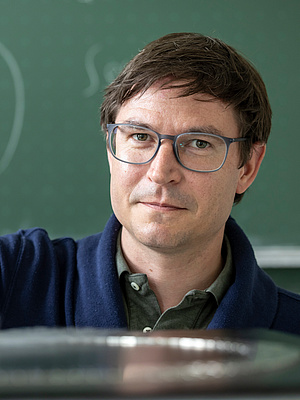
Christoph Heilمشاهده پروفایل
دانشیار
Christoph Heil is an Associate Professor in the Department of Theoretical and Computational Physics at Graz University of Technology (TU Graz), a position he has held since 2024. Previously, he served as an Assistant Professor at TU Graz from 2022 to 2024. His academic journey includes being a Project Leader and Senior Postdoc Researcher at TU Graz (2019-2022), a Schrödinger Fellow at both the University of Oxford (2016-2018) and TU Graz (2018-2019), and a Postdoc Researcher at TU Graz (2015-2016). He completed his PhD studies in Technical Physics at TU Graz from 2011 to 2015. Dr. Heil leads the Heil Group - Computational Material Design at TU Graz, which is part of the Institute of Theoretical and Computational Physics. His research group focuses on computational approaches to understand and design novel materials with specific properties, particularly in the field of superconductivity. Christoph Heil's primary research interests lie in computational materials science, with a strong focus on superconductivity and lattice dynamics. His work employs state-of-the-art computational methods to describe physical phenomena in materials completely from first principles. He investigates superconductivity, charge-density waves, and their competition in reduced dimensions, particularly in transition metal chalcogenides. His research also explores new superconducting carbon-based materials in the nano-regime, such as nanoribbons and nanosheets, and aims to understand the superconducting phase in high-pressure hydrides while predicting new highest-Tc materials. His approach combines theoretical physics with practical materials design, bridging fundamental understanding with potential applications. His recent publications demonstrate a strong focus on superconducting materials, particularly hydrides and transition metal compounds. There's a clear progression toward more sophisticated computational methods, including the development of the IsoME framework for high-precision Eliashberg calculations. His work spans from fundamental theoretical investigations to practical materials synthesis and characterization, showing a comprehensive approach to computational materials design. The research shows increasing attention to quantum anharmonic effects, which are crucial for understanding high-temperature superconductivity in hydrides. Dr. Heil has received notable recognition for his work, including: FWF Schrödinger Fellowship (2016-2019) supporting research at both the University of Oxford and TU Graz USPTO Patent 16/789143 for High Temperature Superconducting Structures He leads multiple significant research projects including DARPA SynQuaNon (2023-2028), an external research project on Computational Modelling of Superconducting Structures and Material Systems funded by Intellectual Ventures (2020-2026), and an FWF stand-alone project on Transition Metal Chalcogenides under Extreme Pressures (2019-2024). His group has successfully defended master's theses, indicating active student mentoring, and collaborates with researchers worldwide, as evidenced by numerous international co-authorships. The Heil Group operates as a dynamic research team focused on computational materials design, with current projects spanning superconducting nanophononic crystals (IVPH-NanoPhon2), computational modeling of superconducting materials, and transition metal chalcogenides under extreme pressures. The group has developed specialized computational tools like IsoME, a Julia-based framework for streamlining superconductivity calculations, demonstrating their commitment to advancing computational methodologies in materials science.