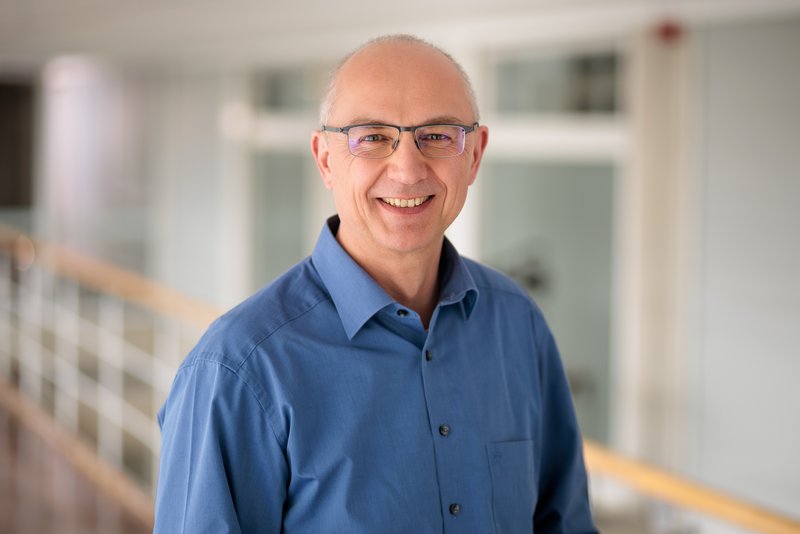
Prof. Peter Hertkorn is a full professor of Computer Science at Reutlingen University's Faculty of Computer Science, specializing in programming languages and databases. He holds leadership roles including Chair of the Examination Board for Media and Communication Informatics B.Sc. and BAföG Officer for the same program. His research focuses on model-driven software development, domain-specific languages, DevOps automation, interactive learning technologies, and distributed ledger technologies. He co-leads the Software Engineering and User Experience (swuxLAB) and Distributed Ledger Technologies (DLT-LAB) research groups. Education background includes a Diplom-Informatiker (master's equivalent) and Dr.-Ing. (PhD) from University of Stuttgart. Professional experience includes 5 years at T-Systems International GmbH and prior academic roles at University of Stuttgart. His teaching focuses on Software Engineering and Database Systems courses. Publications span interactive learning environments, collaborative innovation systems, and AR-based knowledge spaces. Active in academic service roles and interdisciplinary research collaborations since 2009.
Selina Heppell is a Professor and Department Head in the Department of Fisheries, Wildlife, and Conservation Sciences at Oregon State University, College of Agricultural Sciences. She holds an adjunct appointment and is based in Nash Hall, Corvallis, OR. Her research focuses on marine ecology, conservation biology, and fisheries science, particularly on long-lived marine species such as sea turtles, sharks, sturgeon, and rockfish. She leads the Heppell Lab, which conducts interdisciplinary research across global ecosystems. Education: BSc in Zoology, University of Washington (1991) MSc in Zoology, North Carolina State University (1993) PhD in Zoology, Duke University (1998) Her research interests center on population ecology, climate change impacts, habitat assessment, and human perturbations on marine species. She uses computer models and simulations to guide conservation and management policy, with a focus on recovery strategies for threatened species. Her lab integrates biological organization levels—from cells to ecosystems—in rigorous conservation science. The 15 most recent publications reflect a strong emphasis on sea turtle ecology, fisheries modeling, marine protected areas, and interdisciplinary conservation. Key themes include climate effects on sex ratios, growth modeling, telemetry studies, and policy-relevant science for fisheries and marine species management. Scientific Awards and Honors: President, Faculty Senate, OSU (2021) Aldo Leopold Leadership Program Scholar (2006) Roy G. Arnold Leadership Award (2017) Fishery Worker of the Year, Oregon AFS (2016) Multiple awards for student advising and teaching excellence Editorial roles at Ecological Applications and ESA She has mentored 8 PhD and 14 MSc students. She teaches courses including FW 320 (Intro Pop Dyn), FW 520 (Ecology and Mgmt of Marine Fishes), and FW 524 (Stock Assess Fish Mgrs). She has received grants and led projects with NOAA, USFWS, and the Lenfest Ocean Program. She collaborates internationally and with Indigenous communities, emphasizing inclusive science. The Heppell Lab fosters collaborative, enthusiastic science, with members working from Oregon to the Caribbean and beyond. The lab addresses local to global conservation challenges, emphasizing applied research and policy engagement.
James O. Fiet is a Professor of Management and the Brown-Forman Chair in Entrepreneurship at the University of Louisville College of Business . His work bridges strategy and entrepreneurship , with over 175 publications and leadership roles in academia. Education : PhD in Entrepreneurship & Strategic Management (Texas A&M), MBA in Entrepreneurship (USC), BA in English (Brigham Young University) His research spans entrepreneurship theory , strategic management , and social enterprises , focusing on institutional logics, poverty alleviation, and time-space dynamics. Recent publications include Time, Space and Entrepreneurship (2021) and Poverty Alleviation and the Science of What's Possible (forthcoming 2022). Scientific recognition includes being ranked 5th most productive U.S. entrepreneurship researcher (2009) and 8th globally . He served as editor of Entrepreneurship Theory and Practice , the #2 cited business journal globally. Awards: Top 1% entrepreneurship researcher (2021), Top 2% scientist worldwide (2021), Emerald Certificate of Excellence (2017).
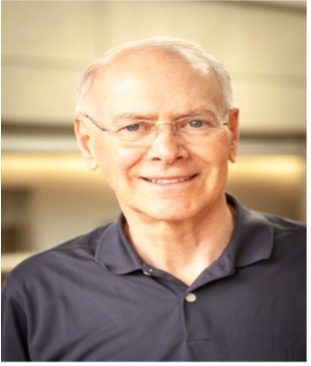
Michael A. Lieberman is a Professor in the Graduate School at the Department of Electrical Engineering and Computer Sciences, University of California, Berkeley. He joined UC Berkeley in 1966 and has received numerous accolades, including the Distinguished Teaching Award (1971) and Guggenheim Fellowship (1972-1973). His research focuses on low-temperature plasma physics and chemistry, particularly plasma-assisted materials processing, capacitive/inductive discharges, and nonlinear plasma dynamics. Education: Ph.D., Electrical Engineering, Massachusetts Institute of Technology (1966) B.S./M.S., Electrical Engineering, Massachusetts Institute of Technology (1962) Research Interests: Prof. Lieberman's work bridges fundamental plasma theory and industrial applications. Key areas include: Modeling of electromagnetic effects in capacitive discharges Hybrid analytical/numerical simulations of plasma processes Nonlinear wave phenomena in RF plasmas Plasma-material interactions for semiconductor fabrication Development of global models for atmospheric-pressure discharges Current projects (2018-2019) involve 2D fluid-analytical simulations, high-pressure discharge modeling, and particle-in-cell methods. Publications Focus: Recent articles emphasize computational plasma physics, including PIC simulations of transport phenomena, sheath dynamics in electronegative plasmas, and resonance effects in RF heating. His work consistently advances predictive modeling for industrial plasma applications. Awards & Honors: AVS Plasma Science Prize (2022) NPSS Marie Curie Award (2020) Will Allis Prize (2006) Von Engel Prize (2005) IEEE Plasma Science Award (1995) Fellowships: APS, AAAS, IEEE, AVS, IPCS, IOP Collaborations & Support: Collaborates extensively with Prof. A.J. Lichtenberg (nonlinear dynamics/plasma textbooks). Research funded by DOE Office of Fusion Energy Sciences and Applied Materials/Display (AKT). Maintains active international partnerships in plasma diagnostics and simulation.
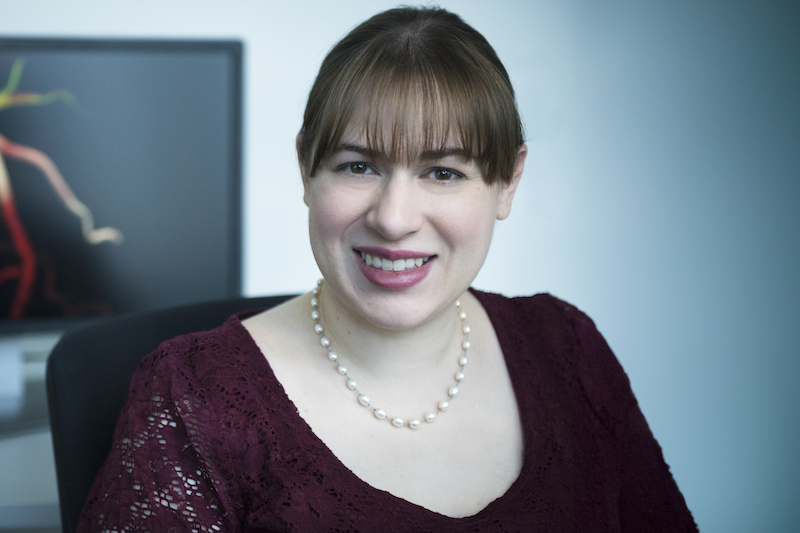
Michelle Borkin is an Assistant Professor in the Khoury College of Computer Sciences at Northeastern University’s Boston campus, where she co-leads the Visualization @ Khoury Lab and co-directs the Northeastern Visualization Consortium (NUVis). She additionally serves as Affiliated Faculty with the NULab for Text, Maps, and Networks and with the Information Design & Data Visualization Program in the College of Arts, Media, and Design. Education PhD, Applied Physics, Harvard University School of Engineering and Applied Sciences (2014) MS, Applied Physics, Harvard University BS, Astronomy & Astrophysics and Physics, Harvard University Research Interests Borkin’s research integrates data visualization and human-computer interaction to create novel techniques that enable discovery across disciplines. Her work spans: Multidimensional brushing-and-linking methodologies 3D data visualization and selection techniques Tree and network visualization Visualization evaluation methodologies and perception/cognition theory Accessibility and visualization for social good Medical and astrophysical visualization applications Publication Trends Across more than 50 peer-reviewed papers, Borkin’s research exhibits three dominant threads: (1) foundational studies on visualization perception and memorability, (2) design and evaluation of novel interactive tools for complex data (medical, astronomical, political, and social media), and (3) methodological contributions such as the Design Study “Lite” Methodology that accelerate visualization pedagogy and community-engaged research. Awards & Honors CHI 2020 Best Paper Award IEEE VIS 2020 Best Poster Honorable Mention IEEE VIS 2018 Best Poster Award NSF Graduate Research Fellowship NDSEG Graduate Fellowship TED Fellow Advising & Grants Borkin currently advises five PhD students—Jane Adams, Mackenzie Creamer, Franc O, Aditeya Pandey, and Laura South—and has previously mentored Michail Schwab and Uzma Haque Syeda. Her research has been supported by NSF, NDSEG, and TED fellowships, as well as internal Northeastern awards. Labs & Teams Co-Lead, Visualization @ Khoury Lab Co-Director & Co-Founder, Northeastern Visualization Consortium (NUVis) Affiliated Faculty, NULab for Text, Maps, and Networks Affiliated Faculty, Information Design & Data Visualization Program, CAMD
Adam Thomas Clark is an Associate Professor in the Department of Biology at the University of Graz, Austria, where he leads research on ecological community stability, self-assembly, and persistence across spatial and temporal scales. He is affiliated with the Institute of Biology and the Department of Plant Sciences, focusing on predictive models of community ecology. His academic journey includes a PhD from the University of Minnesota under David Tilman, postdoctoral work at the Helmholtz Centre for Environmental Research (UFZ) and iDiv with Stan Harpole and Helmut Hillebrand, and undergraduate research at Harvard University's Museum of Comparative Zoology. His research interests span Community Ecology , Grassland and Plant Ecology , Ant Community Assembly , Biodiversity , and Theoretical Modeling . He investigates how ecological systems maintain stability despite disturbances, integrating field experiments, taxonomy, and data synthesis. His work has particular emphasis on tallgrass prairies in the US Midwest, Central European grasslands, and ant communities in the Caribbean and northeastern US. The recent publications and social media activity highlight a strong focus on ecological acclimation , coexistence mechanisms , landscape and historical ecology , climate change impacts , and food web dynamics . His work often bridges empirical data with theoretical frameworks to improve predictive ecology. He is actively involved in mentoring, having advertised funded PhD and postdoctoral positions, and collaborates with institutions across Europe. ORCID: 0000-0002-8843-3278 Homepage: adamclarktheecologist.com Social: Bluesky , Twitter , GitHub , Google Scholar Clark is engaged in broader academic discourse, commenting on faculty hiring practices, research evaluation, and scientific trust. He promotes interdisciplinary climate research and has contributed to studies on public perception of science and ecological resilience in marine and terrestrial systems.
Jonathan Hersh is an Associate Professor at Chapman University's George L. Argyros College of Business and Economics, specializing in Economics and Management Science. His research bridges artificial intelligence, machine learning, and economics to address business, labor, and societal challenges through diverse data sources like satellite imagery and economic records. Education: University of Chicago (BA), University of Pennsylvania (MS), Boston University (PhD) Research focuses on AI's societal impact, including digital platform strategy, online piracy, and development economics. He has pioneered methods for poverty mapping using satellite data and war destruction analysis with AI. Recent publications explore AI skills gaps in financial institutions, API-driven economic growth, and satellite-based poverty estimation. His work has appeared in Management Science , MIS Quarterly , PNAS , and NeurIPS . Awards: BBVA Foundation Frontiers of Knowledge Award (2023) Previously worked as a data scientist for startups and the World Bank. Teaches AI, machine learning, and development economics to undergraduate and MBA students.
Ludwig Schmidt is an Assistant Professor in the Computer Science Department at Stanford University and a member of Stanford Data Science. He also serves as a member of the technical staff at Anthropic and LAION, contributing to both academic and industrial research in machine learning. Dr. Schmidt completed his PhD at MIT, where he received the prestigious George M. Sprowls Award for best PhD theses in computer science, followed by a postdoctoral position at UC Berkeley. His educational background provides a strong foundation for his research at the intersection of theoretical and applied machine learning. Dr. Schmidt's research focuses on the empirical foundations of machine learning, with particular emphasis on datasets, reliable generalization, multimodality, and language models. His work addresses critical challenges in ensuring machine learning models perform consistently across different domains and data distributions. His research group has made significant contributions to open source machine learning through projects like OpenCLIP, DCLM, and the LAION-5B dataset, which have become important resources for the machine learning community. An analysis of Dr. Schmidt's recent publications reveals a strong focus on dataset quality, multimodal learning, and language model training. His work spans from fundamental research on generalization and robustness to practical applications in vision-language systems and tabular data. A recurring theme is the importance of high-quality, diverse datasets for training robust machine learning models, with several papers addressing dataset curation, evaluation methodologies, and the impact of data quality on model performance. New Horizons Award at EAAMO Best paper awards at ICML & NeurIPS Best paper finalist at CVPR Sprowls dissertation award from MIT (George M. Sprowls Award) Dr. Schmidt actively mentors doctoral students and postdoctoral researchers. His current advisees include doctoral candidates Liangyu Chen, Shiye Su, Elaine Sui, Audrey Xie, John Yang, Yuhui Zhang, and Wanjia Zhao. He serves as Doctoral Dissertation Reader for Kyle Hsu and Aishwarya Mandyam, and as Postdoctoral Faculty Sponsor for Benjamin Feuer and Mike Merrill. His research has attracted significant funding that supports these students and enables his group to contribute to open source projects like OpenCLIP and LAION-5B. Dr. Schmidt leads a research group focused on empirical machine learning foundations. The group actively contributes to open source machine learning through code repositories and datasets, including OpenCLIP, OpenFlamingo, LAION-5B, and the DataComp datasets. Their work bridges theoretical insights with practical applications, developing tools and resources that advance the entire machine learning community.
Provvidenza Rita D'Urso is a Fixed-term Assistant Professor at the University of Catania's Department of Agriculture Food and Environment (Di3A), specializing in Rural Buildings and Agro-forest Land Planning within the School of Agriculture. Her current position runs from March 1, 2023 to February 28, 2026, as part of the SAMOTHRACE project funded by the European Union through NextGenerationUE. She maintains an office in the Engineering Area at Via Santa Sofia, 100, and conducts research focused on environmental monitoring in agricultural settings. Dr. D'Urso earned her PhD in Agricultural, Food and Environmental Science from the University of Catania in 2022 with a thesis on measuring ammonia and GHG concentrations in dairy housing systems. She holds dual qualifications as both a Civil and Environmental Engineer (2017) and an Agronomist and Forestry Doctor (2020), demonstrating her interdisciplinary expertise. Her educational background includes two Master's degrees earned cum laude : one in Agricultural Sciences and Technologies (2018) and another in Building Engineering and Architecture (2016). Her research interests center on environmental monitoring in agricultural contexts, particularly focusing on ammonia and greenhouse gas emissions from livestock housing systems. She investigates innovative measurement techniques using infrared photo-acoustic multi-gas analyzers and low-cost devices, while also exploring mitigation strategies including green wall systems and bio-acidification treatments. Her work bridges agricultural engineering with environmental protection, addressing critical challenges in sustainable farming practices. Analysis of her recent publications reveals a strong focus on precision environmental monitoring in agricultural settings, with particular emphasis on spatial and temporal distribution of gaseous emissions in dairy barns. Her research demonstrates methodological rigor in measurement techniques while maintaining practical applications for emission reduction in livestock farming. She frequently employs geospatial analysis and contributes to systematic literature reviews that advance understanding of environmental impacts across agricultural sectors. National Scientific Qualification as Associate Professor (2023) PhD awarded with honors (unanimous decision by Committee, 2022) Multiple Master's degrees earned 110/110 cum laude Active member of the Italian Society of Agricultural Engineering (AIIA) Dr. D'Urso serves as an academic advisor and collaborator on multiple research projects, frequently working with Professor Claudia Arcidiacono as primary supervisor. Her research group focuses on developing practical solutions for environmental challenges in Mediterranean agricultural systems, with particular attention to measurement methodologies and mitigation strategies that can be implemented in real-world farming operations. She maintains active collaborations with European research institutions through COST Training School programs.
Tanvir Arafin serves as an Assistant Professor in the Department of Cyber Security Engineering at George Mason University, where his research focuses on hardware security and trust mechanisms for emerging computing platforms. With publications in premier venues including IEEE Transactions on Very Large Scale Integration Systems, IEEE Transactions on Computers, and ACM International Conference on Computer-Aided Design, he addresses critical security challenges in next-generation systems through rigorous hardware-software co-design approaches. His research portfolio spans Hardware Security, Trusted Computing, and IoT Security, with specialized expertise in Side-Channel Attacks and Secure Hardware Design. Dr. Arafin investigates electromagnetic side-channel vulnerabilities in O-RAN networks, develops countermeasures for autonomous vehicle cybersecurity, and pioneers RRAM-based security solutions for memory-constrained devices. His work bridges theoretical security models with practical implementations, emphasizing real-world applicability in edge computing environments and autonomous navigation systems. Current projects explore machine learning integration for anomaly detection in connected vehicles and secure acceleration of cryptographic operations. Analysis of Dr. Arafin's 2022-2025 publications reveals strategic focus areas: electromagnetic fingerprinting for radio units in O-RAN (2025), spatial acceleration of Kolmogorov-Arnold Networks (2025), and NTT-based cryptography accelerators (2024). His research demonstrates consistent innovation in securing autonomous navigation systems and edge devices, with emerging work on in-memory computing architectures using resistive memory technologies. Key trends include hardware-centric defense against model inversion attacks, voltage overscaling for lightweight authentication, and robust multi-robot coordination in dynamic environments. Scientific Awards: No scientific awards, fellowships, or medals were documented in the source materials. Dr. Arafin leads significant collaborative research, including the NSF CISE-MSI grant (DP: CNS) for edge-based robust multi-robot systems. His educational initiatives feature Capture-the-Flag competitions targeting underrepresented students in cybersecurity. Current grant activities emphasize practical security solutions for autonomous navigation, multi-robot coordination, and IoT edge devices, with demonstrated focus on translating research into deployable countermeasures for real-world threats in dynamic operational environments.
Dr. Eve M. Schooler is a Visiting Professor of Sustainable Computing at the University of Oxford , sponsored by the Royal Academy of Engineering. She is an IEEE Fellow and co-recipient of the IEEE Internet Award (2020), with expertise in Networking , Distributed Systems , and Carbon-aware Networking . Her work bridges industry-academia partnerships, focusing on edge-cloud infrastructure and AI for cybersecurity . BS, MS, PhD in Computer Science (Yale, UCLA, Caltech) Board of Directors, Computing Research Association (US) Advisory Council, University of Delaware College of Engineering Her research spans IoT security , smart grids , reverse CDNs , and data-centric networking . She co-founded the IETF's SUSTAIN research group on sustainability and chairs standards initiatives in fog computing and open footprints. Recent trends in her publications include carbon-aware networking , edge-cloud convergence , and AI-driven cybersecurity , with over 100 papers and 35 patents. IEEE Fellow (2021) IEEE Internet Award (2020) N2Women Stars in Networking (2023) Dr. Schooler champions STEM outreach , serving organizations like Grace Hopper Conference and Sally Ride Science. She leads industry-academia collaborations through projects like EU H2020 SPATIAL and NSF-Intel ICN-WEN.
Dr. Tim Schwartz is an Associated Member at the German Research Center for Artificial Intelligence (DFKI) located at the Saarland Informatics Campus in Saarbrücken, Germany. He is affiliated with the Ubiquitous Media Technology Lab (UMTL) where he conducts research at the intersection of human-robot interaction, multimodal interfaces, and industrial applications. His work spans over two decades with significant contributions to the fields of robotics, augmented reality, and Industry 4.0 implementations. Dr. Schwartz's research interests focus primarily on Human-Robot Interaction , Multi-modal Interaction , and Industry 4.0 applications. His work explores how humans and robots can effectively collaborate in industrial settings, with particular attention to communication modalities, task division, and intuitive interfaces. Recent projects include human-robot collaboration in assembly cells, social cognitive robots for warehouse environments, and augmented reality applications for aircraft manufacturing. Analysis of his publication history reveals a clear trajectory from foundational work in multimodal interfaces and context-aware computing (2005-2015) toward increasingly applied research in industrial robotics and human-robot collaboration (2016-2024). His most recent publications demonstrate a strong emphasis on practical implementations in manufacturing and warehouse environments, with a particular focus on optimizing work dynamics between humans and robots. Dr. Schwartz actively engages in academic supervision, offering thesis opportunities such as the user-study on optimal work dynamics in human-robot collaboration at the Power4Production Hall in Saarbrücken. His collaborations extend to institutions including ZeMA (Zentrum für Mechatronik und Automatisierungstechnik gGmbH), indicating strong industry-academia partnerships. At DFKI, he works within a vibrant research community that includes numerous colleagues in the Ubiquitous Media Technology Lab, contributing to a collaborative environment focused on cutting-edge research in human-robot interaction, multimodal systems, and industrial applications of artificial intelligence.
Brian Weeks is an Associate Professor in the School for Environment and Sustainability at the University of Michigan, where he joined as an Assistant Professor in 2019. His research focuses on understanding how species and communities respond to human-induced environmental changes, with particular emphasis on avian systems. Weeks leads an active research group that integrates museum specimen-based work, genomics, and field studies to investigate biodiversity responses to global change. Weeks' research interests span evolutionary ecology, climate change biology, and biodiversity conservation. His work primarily examines how bird species and communities have responded to environmental change through morphological adaptations. He combines museum-, field-, and lab-based approaches to study evolutionary processes across multiple scales, from macroevolutionary patterns in the Solomon Islands to contemporary changes in North American migratory birds. His lab has developed innovative methods like Skelevision for high-throughput measurement of functional traits from museum skeletal specimens. His publication record shows a strong focus on climate-driven morphological changes in birds, with recent work demonstrating how warming temperatures drive size reductions while simultaneously increasing wing length. His research has revealed that smaller-bodied species change at faster rates, and that migration timing shifts are decoupled from morphological changes. Weeks' lab also investigates biodiversity-ecosystem functioning relationships and extinction risk prediction. Packard Fellowship in Science and Engineering (2022) Ecological Society of America's George Mercer Award (2022) Katma Award, American Ornithological Society ISI Highly Cited paper (2021) Weeks advises multiple PhD and Master's students, and his lab collaborates extensively with researchers across institutions. His work has received significant media attention, with coverage in Science, The Wall Street Journal, The Washington Post, BBC News, and numerous international outlets. His research on birds shrinking due to climate change achieved an Altmetric score higher than 99.98% of papers tracked, reflecting its substantial scientific and public impact.
Sjoerd Dirksen is a Professor of Mathematics for Data Sciences at Utrecht University since May 2025, having previously served as an Associate Professor for Applied Mathematics (2019-2025) and Junior Professor at RWTH Aachen University (2014-2019). He is affiliated with the Mathematical Institute within the Faculty of Science at Utrecht University, where his office is located in the Hans Freudenthal Building. His research interests focus on high-dimensional probability theory and its applications in data science, machine learning, and signal processing. Specifically, he investigates randomized data dimension reduction methods using structured random matrices, theory for deep learning including random neural networks, high-dimensional covariance estimation for wireless communication systems, and statistical postprocessing of weather forecasts in collaboration with the Royal Netherlands Meteorological Institute (KNMI). Previously, he worked on compressed sensing, sharp estimates for stochastic processes in Banach spaces, and noncommutative analysis. Analysis of his recent publications (2018-2024) reveals a strong focus on quantization effects in high-dimensional data processing, particularly one-bit compressed sensing and covariance estimation under coarse quantization. His work bridges theoretical mathematics with practical applications in signal processing, wireless communications, and meteorological forecasting, demonstrating a consistent trajectory from foundational mathematical research to applied data science problems. Dirksen's academic career shows progression from postdoctoral work at the Hausdorff Center for Mathematics in Bonn to independent research positions. His publication record demonstrates significant contributions to the mathematics of data science, with papers appearing in top journals across mathematics, statistics, and signal processing. His research combines deep theoretical insights with practical applications, particularly in the areas of dimensionality reduction and high-dimensional statistics.
Dr Leonie Newhouse is an Associate Professor in the Department of Geography at Durham University. As an economic and political geographer, her work intersects feminist, decolonial, and critical political economy approaches to examine conflict, displacement, and urbanization across Africa and the developing world. Affiliation: Durham University, Department of Geography Research Focus: Humanitarian economies, migration, land rights, and climate change impacts Her research explores how social assemblages form during crises, analyzing the interplay between humanitarian interventions and local livelihood strategies. She emphasizes ethnographic co-production and participatory methods, particularly in South Sudan, the Horn, and the Sahel. Her publications span topics like refugee camp governance, post-conflict land control, and urban hedging strategies. Leonie supervises PhD students working on climate-related displacement, including Belen Desmaison Estrada (flood resilience in Peru) and Tilly Hall (wildfire risk in California). She collaborates with the Likikiri Collective and South Sudanese researchers on arts-based participatory projects.