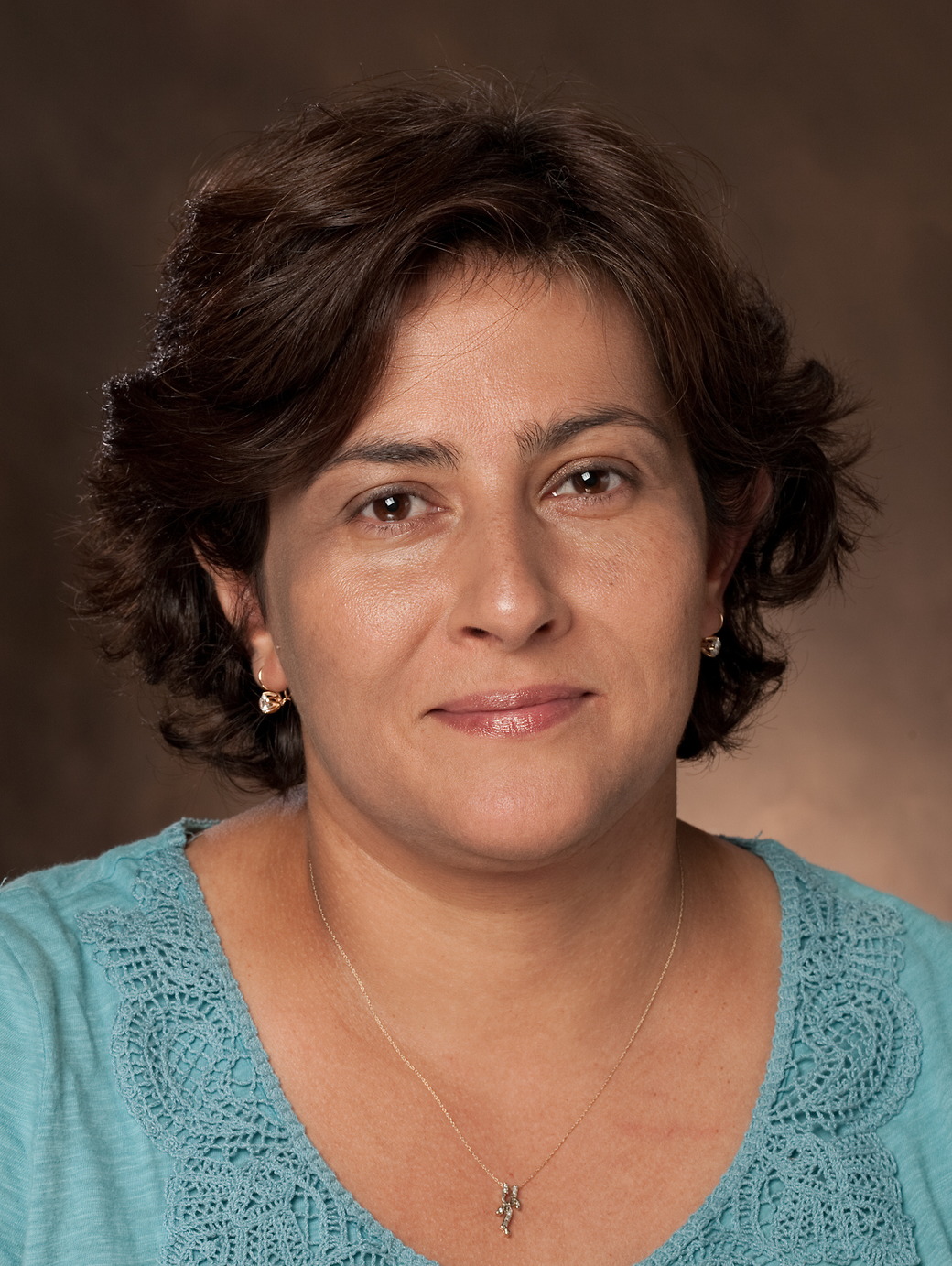
Anna Ghazaryan is a Professor and Department Chair in the Department of Mathematics at Miami University. She holds a Ph.D. in Mathematics from The Ohio State University, with postdoctoral research at the University of North Carolina and the University of Kansas. Her research focuses on applied dynamical systems, nonlinear waves, and reaction-diffusion systems, with applications in ecological models, combustion theory, and fluid dynamics. She has organized international conferences on Dynamical Systems and Applications in 2016, 2019, and 2023, supported by the NSF and Miami University. Her collaborative work includes co-authoring the textbook Introduction to Traveling Waves (2022) and securing grants such as the NSF DMS-1311313 and Simons Foundation Collaboration Grant (2012–2017). Prof. Ghazaryan mentors undergraduate and graduate students in research projects, including studies on disease spread modeling, mussel population dynamics, and malaria transmission. Her research has led to publications in journals like Studies in Applied Mathematics , SIAM Journal on Applied Mathematics , and Physica D . She actively engages in academic leadership, including roles at Miami University’s Undergraduate Research Awards and professional societies such as the Association for Women in Mathematics (AWM). Her work bridges theoretical analysis and applied problems, emphasizing interdisciplinary collaboration.
Alex Kiselev is the William T. Laprade Professor of Mathematics at Duke University, part of the Trinity College of Arts & Sciences. He holds a B.S. in Physics from St. Petersburg State University (1992) and a Ph.D. in Mathematics from Caltech (1996). His research focuses on partial differential equations, fluid mechanics, mathematical biology, combustion, and Schrödinger operators. He has held positions at the University of Chicago, University of Wisconsin-Madison, Rice University, and Duke University since 2018. Kiselev's work explores fluid dynamics, singularity formation in PDEs, and mathematical biology, with notable contributions to chemotaxis and turbulence. He has been honored with the Alfred P. Sloan Research Fellowship and the Guggenheim Fellowship. Education: B.S., Physics, St. Petersburg State University, 1992 Ph.D., Mathematics, California Institute of Technology, 1996 Awards: Alfred P. Sloan Research Fellowship Guggenheim Fellowship Editorial Roles: Managing Editor, Duke Mathematical Journal Associate Editor, Communications in Mathematical Sciences
Xiaoqiang Wang is a Professor in the Department of Scientific Computing at Florida State University (FSU). His research focuses on numerical analysis, applied partial differential equations, mathematical biology, image processing, and scientific computing. He holds a Ph.D. from Pennsylvania State University (2005). His work emphasizes phase-field modeling for elastic bending energy, biological microstructures, and computational methods for complex systems. Notable contributions include advancements in centroidal Voronoi tessellation algorithms for image segmentation and high-performance computing techniques for scientific visualization. Recent publications highlight innovations in topology-preserving phase-field models, neural network-based energy minimization, and stochastic resource competition models. His research bridges theoretical mathematics with practical applications in biophysics, materials science, and biomedical engineering. Wang collaborates actively with interdisciplinary teams, contributing to FSU's computational science initiatives. His lab focuses on developing novel numerical methods and simulations for biological and physical systems, reflecting a commitment to both foundational and applied research.
Panagiotis Gianniotis is an Assistant Professor at the Department of Mathematics of the National and Kapodistrian University of Athens. His research focuses on Geometric Analysis, particularly the application of Partial Differential Equations to problems in Geometry, with an emphasis on geometric flows such as the Ricci flow and mean curvature flow. His work explores singularity formation, curvature control, and the evolution of geometric structures under these flows. He has organized the Workshop in Geometric Analysis in Athens (12-13 September 2025), reflecting his active role in advancing research collaborations in this field. While no academic awards are explicitly mentioned, his prolific publication record in top-tier geometric analysis topics underscores his scholarly contribution. His research interests span across geometric flows (Ricci flow, mean curvature flow), curvature estimates, singular set analysis, and boundary value problems in geometric evolution equations. Recent work includes studies on Hilbert functionals, splitting maps in Ricci flows, and gradient flows of isometric structures.
Professor Juhi Jang is a mathematician specializing in analysis and partial differential equations (PDEs) with applications to fluid dynamics, gas dynamics, kinetic theory, and astrophysics. She holds the rank of Professor in the Department of Mathematics at the University of Southern California (USC), where she has been since 2020. Prior to this, she served as an Associate Professor at USC (2015–2020) and UC Riverside (2014–2015), and as an Assistant Professor at UC Riverside (2010–2014). Her research focuses on the mathematical analysis of fluid and gas dynamics, singularities in PDEs, and gravitational collapse. Notable contributions include work on the Einstein-Euler system, hydrodynamic limits from kinetic equations, and nonlinear stability of expanding stars. Educationally, Jang earned a B.Sc. (summa cum laude) in Mathematics from Seoul National University (2000), followed by a M.Sc. (2004) and Ph.D. (2007) in Mathematics from Brown University. Her honors include the Frontiers of Science Award (2023), Simons Fellowship (2019–2020), and NSF CAREER grant (2014–2020). She has also organized international summer schools on mathematical fluids and served on editorial boards for journals like SIAM Journal on Mathematical Analysis and Kinetic and Related Models. Her research interests span: fluid dynamics, gas dynamics, kinetic theory, plasma physics, and mathematical physics. Key areas include moving boundary problems in compressible fluids, stability of gravitational systems, and singularity formation in fluid models. She has authored over 50 peer-reviewed articles, with recent work appearing in Annals of PDE , Archive for Rational Mechanics and Analysis , and Inventiones Mathematicae . Jang’s teaching spans graduate courses in PDEs, real analysis, and topology, alongside undergraduate calculus and topology. She has advised numerous graduate students and postdocs, contributing to the training of the next generation of mathematical analysts.
Professor Georg Gottwald is a distinguished academic in the School of Mathematics and Statistics at the University of Sydney, where he has been a faculty member since 2002, progressing from Lecturer to his current position as Professor since 2013. He also holds a Visiting Professor position at the University of Surrey in the UK since 2013. His extensive research career spans dynamical systems theory, geophysical fluid dynamics, and the intersection of machine learning with complex systems. Professor Gottwald's research focuses on dynamical systems theory as an abstract formalism for studying systems evolving in time and space. His work has significant applications across diverse fields including climate modeling, biological systems, and complex networks. He is particularly known for developing methods for model reduction of complex dynamical systems, stochastic modeling approaches, and the application of machine learning techniques to dynamical systems. His research aligns with the Faculty of Science Research Strengths in Understanding the Universe, Fundamental Laws of Nature, Complex Systems, Climate and Environmental Change, Data and Decisions, and National Security. His most recent publications demonstrate a strong trajectory toward integrating machine learning with dynamical systems theory, particularly in developing stable generative models, learning dynamical systems with random feature maps, and combining data assimilation with machine learning for forecasting. His work spans pure mathematical theory to practical applications in climate science, finance, and biological systems, showing remarkable breadth while maintaining deep mathematical rigor. Future Fellowship, 'Stochastic methods in mathematical geophysical fluid dynamics', Australian Research Council, 2010-2014 Australian Research Fellowship, 'Stochastic methods in mathematical geophysical fluid dynamics', Australian Research Council, 2010-2015 (declined) Australian Research Fellowship, 'Geometric methods in geophysical fluid dynamics', Australian Research Council, 2004-2009 Professor Gottwald has successfully supervised numerous PhD and Master's students who have gone on to academic and industry positions worldwide. His current research group includes postdocs and PhD students working on machine learning for dynamical systems, stochastic model reduction, physics-informed machine intelligence, and tensor methods for scientific machine learning. He has secured multiple ARC Discovery Project grants and has been involved in significant international collaborative research projects. He is actively involved with the Sydney Dynamics Group, which he co-founded in 2007, fostering collaboration between the University of Sydney and UNSW. Professor Gottwald maintains strong editorial commitments as Associate Editor for Geophysical and Astrophysical Fluid Dynamics, SIAM Journal of Applied Dynamical Systems, and Journal of Computational Dynamics, and serves on the Editorial Advisory Board for Chaos and the Editorial Board for Physical Review E. His professional activities demonstrate leadership in the dynamical systems community through organizing workshops, seminars, and special journal issues.
Dr. Grey Ballard is an Associate Professor in the Department of Computer Science at Wake Forest University . He earned a B.S. in Math and Computer Science (2006), M.A. in Math (2008) from Wake Forest, and PhD in Computer Science (2013) from the University of California, Berkeley. He was a Truman Fellow at Sandia National Laboratories before joining Wake Forest. Research Focus: Ballard develops communication-optimal algorithms for high-performance computing , particularly in tensor decompositions , symmetric matrix computations , and nonnegative matrix factorization . His work combines numerical linear algebra with parallel algorithm design to reduce data movement costs in distributed systems. Publications demonstrate expertise in communication lower bounds , randomized tensor rounding , and visualization tools for parallel algorithms. He has contributed software packages such as TuckerMPI , GentenMPI , and PLANC for large-scale data compression and clustering. Scientific Awards: Wake Forest Excellence in Research Award NSF CAREER Award SIAM Linear Algebra Prize Three Conference Best Paper Awards (SPAA, IPDPS, ICDM) C.V. Ramamoorthy Distinguished Research Award (UC Berkeley) ACM Doctoral Dissertation Award – Honorable Mention Teaching: Courses include Introduction to Computer Science , Numerical Linear Algebra , and Parallel Algorithms . He has developed educational tools using the Thread-Safe Graphics Library to visualize parallel dynamic programming and collective communication.
Shing-Tung Yau is a distinguished mathematician and professor associated with the Shing-Tung Yau Center at Southeast University's School of Physics, reflecting his profound influence in mathematical physics. His career spans premier institutions including Harvard University (emeritus) and Tsinghua University, where he holds active positions. Yau's research centers on differential geometry , mathematical physics , and geometric analysis , with transformative work on Calabi-Yau manifolds underpinning string theory. His investigations into Einstein's equations, black hole thermodynamics, and geometric flows bridge pure mathematics and theoretical physics, driving advancements in quantum gravity and mirror symmetry. His publications reveal consistent focus on geometric structures in theoretical physics, particularly Calabi-Yau applications in string compactification and geometric flows for singularity analysis. Recent works emphasize Kähler-Einstein metrics and stability in algebraic geometry. Scientific accolades include: Fields Medal (1982) for contributions to partial differential equations and Calabi conjecture Wolf Prize (2010) for geometric analysis breakthroughs MacArthur Fellowship (1985) and Crafoord Prize (1994) National Medal of Science (1997) for unifying geometry and physics Yau has mentored over 50 doctoral students, including Gang Tian and Huai-Dong Cao, shaping modern geometric analysis. He leads collaborative initiatives like the Harvard-Yau Center and Tsinghua's Mathematical Sciences Center, fostering cross-disciplinary research in geometric methods for quantum gravity. Current efforts focus on geometric foundations of quantum information and gravitational wave mathematics.
Christian Kühn is a Professor of Multiscale and Stochastic Dynamics at the Technical University of Munich (TUM), affiliated with the TUM School of Computation, Information and Technology. He has been an External Faculty member at the Complexity Science Hub Vienna since 2017, reflecting his interdisciplinary engagement in complex systems research. His academic background includes a BSc in Mathematics from Jacobs University Bremen (2005), an M.A.St. from the University of Cambridge (2006), and a PhD in Applied Mathematics from Cornell University (2010). He held postdoctoral positions at the Max Planck Institute for the Physics of Complex Systems in Dresden and the Vienna University of Technology, where he also served as an APART-Fellow and Leibniz Fellow. Christian Kühn's research lies at the intersection of differential equations, dynamical systems, and mathematical modeling. He focuses on multiscale problems, the impact of noise and uncertainty in deterministic and stochastic systems, and adaptive networks. Central phenomena of interest include bifurcations, pattern formation, and scaling laws. His work bridges theoretical developments with applications in epidemiology, neuroscience, and complex network dynamics. His recent publications (2021–2024) reflect a strong trend in analyzing nonlinear and stochastic dynamics on networks, with applications ranging from epidemic modeling to synchronization and critical transitions. Key themes include explosive phenomena, adaptive network behavior, moment closure methods, and non-Markovian systems, demonstrating a consistent focus on foundational aspects of dynamical systems with practical relevance. Notable scientific awards include: Richard-von-Mises Prize, GAMM (2017) Lichtenberg Professorship, VolkswagenStiftung (2016) Best Paper Award, TU Vienna (2014) Leibniz Fellow, Oberwolfach (2013) APART-Fellow, Austrian Academy of Sciences (2012) While specific details about advised students are not provided, his role as a full professor and active researcher suggests involvement in mentoring graduate students and postdoctoral researchers. His work has been supported by prestigious grants such as the Lichtenberg Professorship. He leads research in multiscale and stochastic dynamics, contributing to both theoretical advances and interdisciplinary applications. Kühn is part of vibrant research environments at TUM and the Complexity Science Hub Vienna, collaborating with leading scientists in network science, applied mathematics, and complex systems. His work continues to advance the understanding of critical transitions and nonlinear behavior in high-dimensional and stochastic systems.
Takeharu Nagai is a Professor at Hokkaido University's Research Institute for Electronic Science, leading the Nagai Laboratory in the Department of Biomolecular Science and Engineering. His research integrates bioimaging technologies with molecular biology to explore fundamental questions about life and develop practical applications. Ph.D. from The University of Tokyo (1998) Professor, Hokkaido University (2022-present) Visiting Professor, Nara Institute of Science and Technology (2022) Vice Director, Osaka University SANKEN (2020-2022) Research Interests: Focus on Singularity Biology to study outlier cells' impact on biological systems, trans-scale imaging technologies (e.g., AMATERAS 3.0), and autoluminescent plants for sustainable lighting. Key methodologies include fluorescent/bioluminescent protein development and super-resolution imaging. Publication Trends: Recent works span cellular thermodynamics , water quality monitoring , synaptic plasticity , and trans-scale analytical systems . Collaborative projects address kidney injury mechanisms, plant biotechnology, and medical diagnostics. Scientific Recognition: 44th Shimadzu Prize (2024) 15th Nakatani Award Grand Prize (2023) Japanese Society of Microscopy Award (2020) 38th Japanese Society for Bioimaging Research Paper Award (2023) Grants & Collaborations: Recipient of JST ERATO grants and a Takeda Science Foundation grant (2021) for trans-scale life imaging. Collaborates with RIKEN, JST PRESTO, Health Sciences University of Hokkaido, and Kyushu Institute of Technology. Lab Overview: The Nagai Lab maintains active international partnerships (Indonesia University, Emory University) and hosts students through Osaka University's Frontier Bio program. Technical staff and research associates support projects in bioluminescent reporter systems and cellular logic.
Yannan Shen is an Associate Professor in the Department of Mathematics at the University of Kansas. Her research focuses on applied mathematics, particularly models from physics and engineering involving optical systems, metamaterials, plasmas, and Bose-Einstein condensates. She employs methods such as asymptotics, variational approximations, rigorous analysis, numerical analysis, and scientific computing to study existence, stability, and dynamics of solitary wave solutions. Her work has been supported by an NSF grant (DMS-206218, 2022-2025). Recent research emphasizes nonlinear wave equations, including the Camassa-Holm system, Novikov equation, and short-pulse equations. She teaches advanced courses like Applied Partial Differential Equations and Numerical PDE, reflecting her expertise in applied mathematics and computational methods. Key research areas: Dynamical systems, mathematical physics, numerical analysis, and nonlinear PDEs Expertise in models involving metamaterials, plasmas, and optical systems Recipient of NSF funding supporting studies on wave systems and liquid crystals
Sergey Dyachenko is an Assistant Professor in the Department of Mathematics at the University at Buffalo, New York. He holds a PhD in Applied Mathematics from the University of New Mexico (2014) and a BS in Applied Physics and Mathematics from Moscow Institute of Physics and Technology (2007). PhD: University of New Mexico BS: Moscow Institute of Physics and Technology His research focuses on nonlinear wave phenomena and fluid dynamics, particularly singularity formation in free-surface flows like water wave breaking and whitecapping. He employs computational mathematics and applied analysis to study: Free surface wave dynamics Stokes wave singularities Wave turbulence theory Integrable systems (NLS, KdV) Recent publications analyze: Stokes wave instabilities Capillary wave propagation Conformal mapping techniques Operator splitting methods Contact: Office: 312 Mathematics Building, UB North Campus Email: sergeydy@buffalo.edu
Ching-Yao Lai is an Assistant Professor of Geophysics at Stanford University, leading the Lai Research Group. His work integrates mathematical and machine-learned models with observational data to study ice dynamics, geophysics, and fluid mechanics across vast spatial scales. Key focuses include understanding ice-sheet behavior under climate change, fluid-elastic interactions, and interdisciplinary collaborations. He holds a Ph.D. (2018, Princeton University) in Mechanical and Aerospace Engineering and a B.S. (2013, National Taiwan University) in Physics. Research interests span ice dynamics, climate science, and fluid mechanics, with emphasis on machine learning applications to uncover missing physics in ice-sheet models. Notable contributions include discovering self-similar blow-up solutions for Euler equations and developing physics-informed neural networks. His work bridges theory and observation, addressing global challenges like ice-sheet vulnerability. Scientific awards include the 2024 Sloan Research Fellowship and 2023 Google Research Scholar Award. He leads NSF-funded projects on singularities in incompressible flows and Greenland meltwater pathways. Advising highlights include mentoring students like Yongji Wang (Science publication, 2025) and Yuno Iwasaki (2024 Soros Fellow). Labs/Teams: Lai Research Group at Stanford, collaborating across geophysics, engineering, and computer science. Active in open science, with a YouTube channel and Google Scholar profile.
Peter Constantin is a Professor in the Department of Mathematics at Princeton University, specializing in mathematical physics and applied mathematics. His research focuses on fluid dynamics, partial differential equations, and nonlinear systems, with particular emphasis on Navier-Stokes equations, surface quasi-geostrophic (SQG) equations, and magnetohydrodynamics (MHD). He explores critical aspects of fluid behavior, including singularity formation, turbulence, and inviscid limits. Key areas of study include global regularity analysis for hydrodynamic models, stability of plasma equilibria, and coupled systems such as Nernst-Planck-Navier-Stokes. His work bridges theoretical analysis and applications in geophysical fluid dynamics and plasma physics. Recent research highlights include studies on the inviscid limit of vorticity distributions, magnetic relaxation in MHD systems, and the mathematical foundations of complex fluid models. He has contributed to understanding electrokinetic phenomena, electrodiffusion, and the interplay between fluid dynamics and particle interactions. His publications reflect a deep engagement with both foundational PDE theory and applied problems, addressing topics like singularity conditions in Euler equations, blow-up criteria, and the role of symmetry in fluid and plasma systems.
Robert V. Kohn is the Silver Professor of Mathematics at New York University, affiliated with the Courant Institute of Mathematical Sciences (CIMS). He holds academic positions within the Department of Mathematics at the College of Arts & Science and the Graduate School of Arts & Science. His research focuses on nonlinear partial differential equations (PDEs), calculus of variations, and their applications to materials science, thin elastic sheets, and machine learning. Education: Ph.D. in Mathematics from Princeton University (1979), M.Sc. from the University of Warwick (1975), and A.B. from Harvard University (1974). Research interests span elastic energy-driven pattern formation (e.g., wrinkling, folding), PDEs in machine learning (e.g., prediction with expert advice), and continuum mechanics. Recent work includes variational analysis of thin film mechanics and PDE-based approaches for binary sequence prediction. His articles explore topics ranging from metamaterials to stochastic growth models. Notable themes in his publications include energy minimization in materials, optimal control analogies in learning algorithms, and mathematical modeling of physical phenomena. While no formal awards are listed, his contributions to PDE theory and applied mathematics are widely recognized. Advising and grants details are not explicitly documented here.