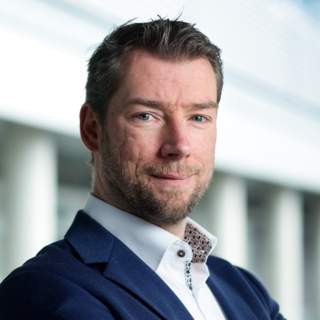
Dr. Dennis Hetterscheid is an Associate Professor at the Leiden Institute of Chemistry (LIC), Leiden University, specializing in electrochemistry and catalysis. His research focuses on mimicking bioinorganic multi-electron processes for energy infrastructure, particularly in renewable energy applications like solar fuels and small molecule activation. He leads research in the MCBIM and CASC groups at LIC. Research Interests: Electrocatalytic processes for energy conversion Homogeneous catalysis and redox mechanisms Oxygen reduction/selectivity control in catalytic systems Key Contributions: Development of molecular catalysts for water oxidation and solar fuels Investigations into ligand-centered reactivity and bioinorganic systems Exploration of metal-organic frameworks for catalytic selectivity Grants & Collaborations: Received funding from the Dutch Research Council and Proof of Concept grants, contributing to projects addressing energy challenges. Labs/Teams: Head of the Hetterscheid Group, collaborating with interdisciplinary teams in energy and sustainability.
Maurice van Keulen is an Associate Professor affiliated with the University of Twente's research institutes including Datamanagement & Biometrics, Digital Society Institute, and TechMed Centre. His multidisciplinary work bridges computer science, healthcare, and social systems. Research Focus: Van Keulen specializes in artificial intelligence applications with emphasis on: Data management (quality, integration, probabilistic databases) Explainable AI and interpretable machine learning models Healthcare informatics (cancer prediction, medical imaging, outcome analysis) Natural language processing and social media analytics His recent work explores dynamic sparse training, meta-learning for data imputation, and ethical AI frameworks. Publication Trends: Recent articles (2023-2025) show strong focus on: Interpretable AI methods in healthcare diagnostics Robust machine learning under data corruption Meta-learning approaches for data preprocessing 3D medical imaging and reconstruction techniques Awards: Beste paper award (2018) for work on probabilistic data conditioning Supervision & Activities: Has supervised 14 research projects and serves on executive boards including EDBT (Extending DataBase Technology) and IFIP WG 2.6. Leads research on ethical dimensions of AI systems.
Martijn Mes is a full professor of Transportation and Logistics Management and chair of the Industrial Engineering & Business Information Systems section at the University of Twente, Netherlands. He leads research and education initiatives that integrate AI, simulation and optimisation into logistics and supply-chain innovation. Education: Ph.D. in Operations Research, University of Twente – 2008 M.Sc. in Applied Mathematics, University of Twente – 2002 Post-doctoral researcher, Princeton University, Dept. of Operations Research & Financial Engineering Research focus: Mes develops quantitative models and AI techniques for strategic, tactical and operational logistics challenges. His work spans three application pillars: Emergency & humanitarian logistics – rapid relief distribution with trucks and UAVs Urban logistics – city distribution, self-organising systems and last-mile innovations Sustainable logistics – synchromodal transport, green ports and electric/autonomous fleets Methodologically he combines approximate dynamic programming, reinforcement learning, multi-agent simulation, discrete-event simulation and stochastic optimisation to create decision-support tools for industry and government. Publications trend: Recent articles (2025-2022) exhibit a strong emphasis on integrating reinforcement learning and stochastic optimisation into dynamic vehicle routing, drone-assisted delivery and post-disaster inventory allocation, signalling a shift towards data-driven, real-time logistic systems. Grants & projects: Mes has coordinated and participated in numerous national and European projects on sustainable logistics, urban distribution, port optimisation and healthcare logistics, frequently collaborating with industry partners and public bodies. Teaching & supervision: He coordinates and lectures in the BSc and MSc programmes Industrial Engineering & Management, offering courses on simulation, queueing theory, dynamic programming, Markov chains, transportation management and technology management. He has authored a widely used Plant Simulation tutorial and supervises PhD candidates working on AI-driven logistics, autonomous vehicles and digital twins.
Prof. Remko Boom is a Full Professor of Food Process Engineering at Wageningen University & Research. His research focuses on sustainable food systems, plant-based alternatives, and advanced food processing technologies such as 3D food printing, membrane filtration, and protein functionalization. Key areas include edible robotics, animal-free cheese alternatives via artificial casein micelles, and functional ingredient extraction from plant and insect-based sources. He collaborates globally on biorefinery processes and contributes to edible robotic systems through material science innovations. Education Background: PhD in Food Technology (exact details not specified) Master's/Undergraduate degrees in relevant engineering disciplines (not explicitly stated) Research Interests: Prof. Boom's work spans food process engineering with emphasis on: - Development of plant-based protein ingredients using mild fractionation techniques - 3D-printed food materials with tailored mechanical properties - Electrophoretic and membrane-based separation technologies for food components - Engineering edible casein micelles for cheese analogues - Biodegradable robotics using food-grade materials Recent Research Trends: Publications from 2024-2025 highlight advancements in: - 3D-printed starch cryogels and protein-based composites - Oleosome extraction and encapsulation of bioactive compounds - Functional characterization of artificial casein micelles - Edible robots powered by Marangoni propulsion Awards & Recognition: No specific awards listed in available data, though his work has received significant media attention including features on edible robotics and sustainable food innovations. Advising & Collaboration: Supervising 87+ PhD projects including work on: - Electrohydrodynamic drying - Brewer's spent grain valorization - Recombinant protein purification Active in industry partnerships for scaling-up electrophoretic separation and 3D food printing technologies Labs & Teams: Leads research groups focused on: - Advanced Food Processing Technologies - Sustainable Ingredient Development - Biorefinery Applications in Food Systems
Leon Lefferts is a Full Professor in Catalytic Processes and Materials at the University of Twente, affiliated with the Faculty of Science and Technology and the MESA+ Institute for Nanotechnology. He has held visiting professorships at Tokyo Institute of Technology (2005–2007) and Aalto University in Helsinki (2011 onward), where he was appointed Finnish Distinguished Professor (2011–2015). His research focuses on three interconnected themes: (1) heterogeneous catalysis in liquid phase , particularly for drinking water purification via hydrogenation of nitrate, nitrite, and bromate, with innovations such as micro-structured 'hairy foams' and membrane contactor reactors; (2) activation of stable molecules like alkanes using breakthrough techniques including plasma-catalysis, soft oxidants, and electrical fields, in collaboration with DIFFER and the University of Antwerp; and (3) catalytic upgrading of biomass , especially flash-pyrolysis oil, inspired by early work at Twente and leading to industrial application by KiOR. His group has pioneered in-situ IR spectroscopy for aqueous-phase catalytic studies under elevated conditions. Recent publications highlight a shift toward electrified and sustainable chemical processes, including membrane-assisted dehydrogenation of ethane and propane using green electricity, plasma-catalytic nitrogen fixation, and in-situ adsorption strategies to improve energy efficiency. These works reflect a strong trend toward integrating catalysis with renewable energy and plasma technologies for decarbonized chemical production. Finnish Distinguished Professor (2011–2015) Leon Lefferts has supervised 38 students and early-career researchers, contributing significantly to education and training in catalysis. His research has been supported by collaborations with major institutions including DIFFER, Aalto University, and the University of Antwerp. He has delivered numerous invited talks and participates actively in interdisciplinary workshops, especially in the emerging field of plasma-catalysis. He leads a research group at the forefront of catalytic innovation, with strong ties to industrial applications and sustainability goals. The team operates within the MESA+ Institute, leveraging advanced nanofabrication and characterization facilities for developing next-generation catalytic materials and reactor systems.
Baptist Liefooghe is an Associate Professor in the Social, Health and Organisational Psychology department at Utrecht University's Faculty of Social and Behavioural Sciences. His research bridges cognitive psychology with human-centered artificial intelligence, focusing on how humans interact with and trust AI systems while examining fundamental cognitive processes like task switching and instruction-based learning. His primary research interests include Cognitive Psychology , Experimental Psychology , Applied Data Science , and Human-centered Artificial Intelligence . Dr. Liefooghe investigates how humans process instructions, switch between tasks, and develop trust in artificial intelligence systems. His work demonstrates how cognitive processes influence human-AI interactions, particularly examining how people judge AI morality and competence, how social presence affects trust in algorithms, and how cognitive control mechanisms operate during task switching. Analysis of his recent publications reveals a strong trend toward interdisciplinary research combining cognitive psychology with AI applications. His work spans from fundamental cognitive processes (task switching, instruction implementation) to applied human-AI interaction research (trust in AI, facial perception of artificial agents, health behavior change through AI). This integration of basic cognitive research with practical AI applications represents a distinctive feature of his scholarly contributions. Dr. Liefooghe has published extensively in top-tier journals including Journal of Cognition, Cognitive Research, Cortex, and Frontiers in Artificial Intelligence. His research has garnered significant attention in the field, with multiple highly cited publications examining the cognitive mechanisms underlying human interaction with technology. His methodological expertise includes experimental design, statistical analysis using R programming language, and cognitive modeling. This technical proficiency enables him to conduct rigorous investigations into complex cognitive phenomena while applying these insights to real-world human-AI interaction scenarios.
Dr. Zhiming Zhao is an Associate Professor and Chair of the Multiscale Networked Systems (MNS) research group at the Informatics Institute (IvI), University of Amsterdam (UvA). He serves as the technical manager of the Virtual Lab and Innovation Center (VLIC) of LifeWatch ERIC, a European research infrastructure for ecology and biodiversity science. Zhao holds an IEEE Senior Member designation and is the Managing Editor of the Journal of Cloud Computing . He earned his Ph.D. in Computer Science from UvA in 2004. His research focuses on quality-critical distributed computing, data-intensive workflows, virtual research environments, and digital twins. He leads projects such as LTER-LIFE (Dutch research infrastructure for digital twins) and coordinates UvA contributions to EU initiatives like ENVRI-HUB Next , EVERSE , and BlueCloud-2026 . Zhao’s work spans technical development in EU projects (e.g., ENVRI-FAIR , ARTICONF , CLARIFY ) and leadership roles in international workshops and conferences. His team develops frameworks like NaaVRE (Jupyter-based collaborative environments) and CloudsStorm (dynamic infrastructure planning). Current research emphasizes trustworthy AI in cloud systems, federated learning, and edge-cloud resource optimization. Key achievements include over 150 peer-reviewed publications, supervision of numerous PhD students, and contributions to open science initiatives. His lab actively explores interdisciplinary applications in environmental science, medical imaging, and blockchain-based decentralized systems.
Dr. Kerstin Schneeberger-Verjaal is an Assistant Professor at the Department of Clinical Sciences, Internal Medicine of Companion Animals, Faculty of Veterinary Medicine, Utrecht University. She also serves as a Scientific Advisor at Orgonex B.V. Her research focuses on stem cell biology and tissue engineering, particularly developing mini-livers from patient-derived stem cells to address organ shortages for transplantation. VenI grant recipient (2018) for liver research Co-developer of synthetic growth gel for large-scale liver cell culture Principal investigator in €1.4 million Horizon 2020 bioprinting project Her recent publications highlight advancements in bioprinting technology , hydrogel development , and organoid scalability . Key research collaborations include Dr. Bart Spee and European experts in the ORGANTRANS consortium. Scientific awards: 2018 NWO Veni grant 2018 WFIRM Young Investigator Award 2017 Aegean award (Tissue Engineering Conference) 2017 Best selected presentation at HEPRO symposium 2014 EMBO workshop attendance grant 2013 Best oral presentation (Dutch Stem Cell Meeting) In her ancillary role at Orgonex B.V., she contributes to commercial applications of organoid technology. Her work has generated multiple patents and translational grants for clinical implementation of synthetic growth gels.
Alain Hecq is a Full Professor in the department of QE Econometrics at the School of Business and Economics, Maastricht University. His research focuses on econometric methodologies, particularly in time series analysis, noncausal models, and financial econometrics. He has contributed significantly to the understanding of volatility dynamics, cryptocurrency markets, and inflation targeting regimes. His work often addresses policy-relevant questions in macroeconomics and financial markets. Key research interests include mixed causal-noncausal autoregressive models, volatility modeling with MARMA-GARCH frameworks, and the application of these techniques to real-world phenomena such as oil price bubbles and cryptocurrency volatility. He has also explored the credibility of central banking policies during crises, such as the Brazilian inflation-targeting regime during the pandemic. His recent work emphasizes methodological advancements in high-dimensional time series analysis, including spectral estimation, hierarchical regularizers for mixed-frequency data, and reduced-rank matrix autoregressive models. These contributions reflect a blend of theoretical rigor and practical applicability in addressing complex economic and financial problems. While no formal awards are listed, his extensive publication record and focus on cutting-edge econometric techniques underscore his scholarly impact. Advising and grant activities are not detailed in the provided information, but his research demonstrates sustained engagement with both academic and policy-oriented audiences.
Prof. Isabel Arends is the Dean of the Faculty of Science at Utrecht University and holds the title of Professor of Sustainable Organic Chemistry. She previously served as Full Professor of Biocatalysis and Organic Chemistry at TU Delft, leading the Biotechnology Department until 2018. Her research focuses on sustainable chemical processes, biocatalysis, and green chemistry, with over 160 publications and 40+ supervised PhD students. She chairs Utrecht University’s strategic themes in Life Sciences and Pathways to Sustainability, and leads national initiatives to enhance STEM education. Awards include membership in the Royal Netherlands Academy of Arts and Sciences (KNAW) and an honorary doctorate from UCLouvain. Key roles include supervisory board memberships at Utrecht Holdings, the Ruisdael Observatory, and the National Chamber of Payers for academic STEM teachers. Education: PhD in Physical Organic Chemistry (cum laude, Leiden University, 1993) Postdoctoral Research at the National Research Council, Ottawa (1994) MSc in Physical Organic Chemistry (Leiden University, 1988) Research Interests: Biocatalytic oxyfunctionalization and enzyme-driven sustainable processes Development of green oxidation and reduction systems Enzymatic regeneration of cofactors like NAD+ and H2O2 Applications in pharmaceuticals, biofuels, and circular economy Articles Overview: Recent work emphasizes light-driven biocatalytic systems, enzyme-catalyzed oxidation/reduction cascades, and sustainable synthesis of steroidal compounds. Key topics include photocatalytic regeneration of cofactors, peroxynitrite-catalyzed epoxidation, and chemoenzymatic routes to specialty chemicals. Awards & Recognition: Officer in the Order of Orange-Nassau (2018) Founding Chair of TU Delft Bioengineering Institute (2016) Member of NWO Applied & Engineering Sciences Board (2014–present) Grants & Leadership: Chair of the TU Delft 175th Anniversary Committee (2017), founder of the Bioengineering Institute, and advocate for diversity and Open Science in academia. Active in national STEM teacher recruitment strategies and educational outreach. Labs & Teams: Previously directed the TU Delft Biotechnology Department and led the Bioengineering Institute. Engaged in collaborative projects with the Westerdijk Fungal Biodiversity Institute and the NIOO-KNAW ecological research institute.
Elmine Meyer is an Assistant Professor in the Electrical Engineering department at Eindhoven University of Technology. Her research focuses on antenna design, millimeter wave technology, and RF engineering. She leads the EM Antenna Systems Lab and EM for Radio Science Lab, contributing to advancements in 5G/6G communication systems and space-based radio astronomy. She holds a PhD in Electrical Engineering from the University of Stellenbosch (2018) and a Bachelor of Engineering from Fairleigh Dickinson University (2013). Meyer's projects include leadership roles in the ANTERRA (6G Non-Terrestrial Networks), INNOSTAR (EM), and MyWave initiatives. She has organized events like the 28th European Microwave Week 2025 and contributed to high-impact research on antenna arrays, 3D-printed RF devices, and pedestal resonators. Her work bridges academic research with industrial applications, emphasizing practical implementations in wireless communication systems. Her research interests span antenna array design, millimeter wave systems, and electromagnetic compatibility. Over 38 citations highlight her contributions to fields like substrate integrated waveguide (SIW) technology and adaptive beamforming. Collaboration networks include institutions globally, particularly in antenna measurement systems and space-based communication technologies.
Prof. dr. Martin van Hecke is a group leader at the FOM Institute AMOLF in Amsterdam and a professor of physics at Leiden University. He obtained his PhD in theoretical physics from Leiden University in 1996 and has since led interdisciplinary research at the intersection of experiments, simulations, and theory in soft matter and mechanical metamaterials. Professor of Physics, Leiden University Part-time Group Leader, AMOLF PI of the 'Designer Matter' and 'Modern Mechanics' initiatives His research focuses on harnessing disorder and frustration in materials to design systems where complex behavior emerges, particularly in mechanical metamaterials capable of storing and processing information. Key areas include pattern formation, origami-inspired design, jamming, and the inverse problem in material science. Notable scientific awards include the Vici grant (2011) and the ERC-Advanced grant (2021). His group at AMOLF actively trains PhD students such as Bernat Dura Faulí, Colin Meulblok, and Margot Teunisse, while pioneering collaborations in programmable materials and soft robotics. Selected publications highlight his work on emergent memory , geometric control , non-Abelian mechanics , and information processing in materials . His research infrastructure leverages the AMOLF NanoLab and Transmission Electron Microscope (TEM) facilities.
Eric A.M. Klumperink is an IEEE Fellow and Associate Professor at the University of Twente's IC-Design Laboratory. He holds a PhD in Transconductance Based CMOS Circuits from the same institution and completed a sabbatical at Ruhr Universität Bochum. His research focuses on RF CMOS circuits for Software Defined Radio, Cognitive Radio, and Beamforming applications. Research areas include: High-frequency analog circuit design RF front-end architectures Signal mixing and filtering techniques Frequency conversion systems Publication trends show consistent focus on RF circuit innovations, with recent work exploring time converters, N-path filters, and receiver architectures. His 200+ publications demonstrate expertise in balancing linearity, noise, and frequency performance. Awards include: IEEE Fellow (2020) Two Van Vessem Outstanding Paper Awards Distinguished Lecturer for IEEE SSC Teaching includes courses in Analog & RF IC Electronics while mentoring PhD and MSc projects. Professional service includes editorial roles for IEEE TCAS-I/II and JSSC, plus committee positions at ISSCC and RFIC Symposium.
Artem Kaznatcheev is an Assistant Professor at Utrecht University in the Department of Mathematics and Department of Information and Computing Sciences within the Science faculty. His research bridges theoretical computer science and evolutionary biology to analyze biological and social systems through an algorithmic lens. Current role since January 2023 Recruiting PhD students and postdocs Previously: James S. McDonnell postdoctoral fellow at University of Pennsylvania His work focuses on: Computational complexity of evolution Evolutionary game theory Algorithmic biology Mathematical modeling of cancer dynamics Cultural evolution of science Selected article trends show: Interdisciplinary integration of computer science and cancer biology Key themes: fitness landscapes, evolutionary games, treatment optimization 2021-2020 publications dominate Mathematical formalisms applied to biological and social phenomena Scientific contributions include: James S. McDonnell Foundation Independent Postdoctoral Fellowship 2019 Genetics paper on computational complexity as evolutionary constraint 2017 Nature Ecology & Evolution study on fibroblast-drug interactions in cancer Collaborative environments: Worked with Theory, Evolution and Games Group Previous affiliations: Oxford University, University of Pennsylvania, Moffitt Cancer Center, McGill University Developed teaching roles at Oriel College (Oxford)
Dr. Christian Steglich is an Associate Professor in the Department of Sociology at the University of Groningen's Faculty of Behavioural and Social Sciences. His research focuses on stochastic network modeling, social networks, and adolescent behavior, with particular emphasis on peer influence, friendship dynamics, and network co-evolution. He is part of the SIENA software development team for dynamic network analysis. Research Interests: Mathematical sociology and network dynamics Adolescent social networks and behavior Stochastic modeling and statistical inference Interorganizational networks and gender dynamics Missing data methodologies and network imputation Recent Articles: Focus on Chinese adolescents' friendship dynamics, networked solidarity economies, and longitudinal network behavior interactions. His work bridges theoretical modeling with empirical applications in education, health, and organizational contexts. Scientific Awards: William D. Richards Jr. Software Award (2017) 2013 Awards for prosocial relationships and child social development research Grants/Advising: Extensive ERC panel involvement and collaborations on youth behavior and network interventions. Supervised 7 research projects focusing on peer networks and academic outcomes. Labs/Teams: Active in interdisciplinary research teams at the University of Groningen, focusing on social network analysis methodologies and their applications in diverse fields.