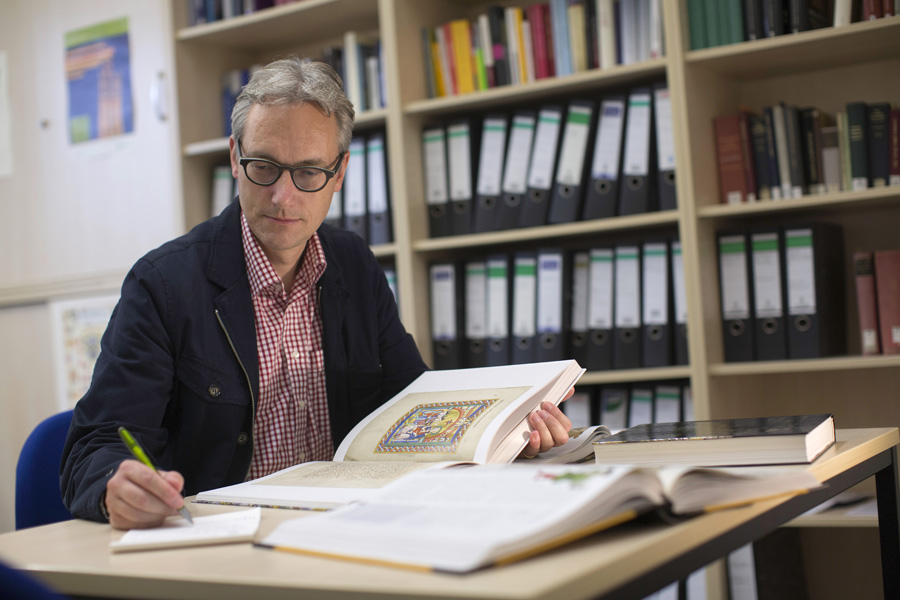
Wolfram Drews is a Professor of Medieval History at the University of Münster (Westfälische Wilhelms-Universität), Germany, since 2011. He holds a Dr. phil. (summa cum laude) from Freie Universität Berlin and completed his Habilitation in Medieval History at the University of Cologne. His research focuses on comparative and transcultural approaches to medieval history, examining themes like monarchical strategies, religious violence, and cultural entanglements between Christianity, Judaism, and Islam. Education: 1986–1991: Humboldt-Universität, Berlin (Languages: English, Spanish, French) 1992–1998: Freie Universität Berlin (History, Jewish Studies, Theology) 2001: Ph.D., Freie Universität Berlin (supervisor: Kaspar Elm) 2008: Habilitation, University of Cologne (supervisor: Georg Jenal) His research interests include medieval kingship, transcultural history, and the interplay between religion and power. He has led major projects like the Special Research Field 'Cultures of Decision Making' and the Cluster of Excellence 'Religion and Politics' in Münster. His work often bridges European and Islamicate contexts, as seen in studies comparing Carolingian and Abbasid dynasties. Dr. Drews has held visiting professorships at Cologne University, Ruhr-Universität Bochum, and Humboldt-Universität Berlin. He is a Fellow of Dumbarton Oaks (Harvard) and has served as President of the Mediävistenverband (Interdisciplinary Association of Medievalists). His honors include the Friedrich-Meinecke-Preis (2001) and leadership roles in global historical networks. He has organized conferences across Europe and North America and contributed to interdisciplinary research on premodern decision-making cultures and religious-political dynamics. His edited volumes and articles address topics ranging from medieval Spanish imperialism to the cultural emergence of Abbasid Iraq.